Diglipur (North Andaman):
A Serious Explorer Extension
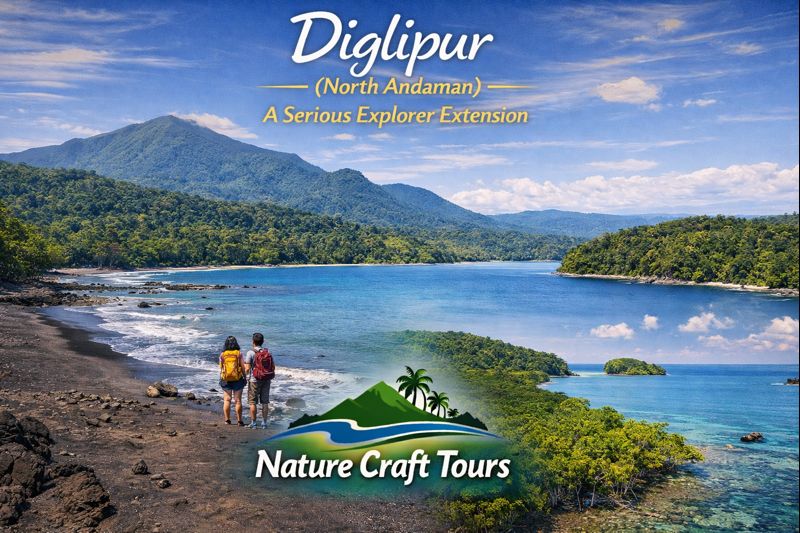
Diglipur, North Andaman: Where Exploration Moves Beyond Comfort into Discovery
Far beyond the familiar circuits of South Andaman and the gentle lagoons of Shaheed Dweep lies Diglipur—an uncompromising frontier of the Andaman Islands that rewards only those prepared to travel deeper, slower, and with intent. Diglipur is not an extension for casual sightseeing; it is a destination for serious explorers who seek geographic scale, ecological variation, and the intellectual satisfaction of reaching the archipelago’s far northern edge. Here, distances grow longer, forests become denser, and the Andamans reveal a raw, continental character rarely associated with island travel.
Located in North Andaman, Diglipur represents a shift in the Andaman narrative. Beaches exist, but they are framed by forests and mountains rather than resorts. Rivers carve through lowlands, volcanic sand replaces coral-white shores, and trekking routes replace beach walks. This comprehensive exploration presents Diglipur as a destination of endurance, learning, and layered landscapes—an essential extension for travelers who wish to understand the Andamans in their entirety.
Geographical Context: Diglipur at the Edge of the Andamans
Diglipur is the northernmost significant settlement in the Andaman Islands, situated approximately 290 kilometers from Port Blair. Unlike the fragmented island geography of South Andaman, this region feels expansive and continuous. Low mountain ranges, river valleys, wetlands, and dense tropical forests dominate the terrain, creating an environment that feels closer to mainland wilderness than island leisure.
The region is also geologically significant, hosting Saddle Peak—the highest point in the Andaman and Nicobar Islands. This alone distinguishes Diglipur as a destination where elevation, climate variation, and forest stratification play a crucial role in shaping the landscape.
Why Diglipur Is a True Explorer’s Territory
Diglipur demands time, patience, and logistical planning. Travel durations are long, infrastructure is functional rather than polished, and experiences are defined by natural processes rather than curated attractions. This makes Diglipur fundamentally different from mainstream Andaman destinations.
Reaching Diglipur: The Journey Defines the Experience
Traveling to Diglipur is a commitment. The journey itself acts as a gradual transition from urban Port Blair to remote North Andaman.
By Road: The Andaman Trunk Road Expedition
The most immersive route is by road via the Andaman Trunk Road. This journey typically begins before dawn and can take 10–14 hours depending on convoy schedules, ferry crossings, and road conditions. The route passes through protected forest corridors and designated tribal reserve zones, emphasizing conservation and controlled access.
Travelers familiar with long, ecosystem-driven journeys—such as river-bound expeditions during a Sundarban Tour—will recognize the value of movement as part of the exploration, rather than merely a means to an end.
By Sea: Limited and Weather-Dependent
Occasional ship services connect Port Blair with Diglipur, but schedules are irregular and heavily weather-dependent. While scenic, sea travel requires flexibility and contingency planning.
Best Time to Visit Diglipur
Due to its geographic position and terrain, Diglipur’s accessibility and comfort vary significantly across seasons.
October to March: Optimal Exploration Window
This period offers the most stable conditions. Cooler temperatures, manageable humidity, and clearer skies make trekking, beach exploration, and long-distance travel feasible.
April to May: Intense but Rewarding
Pre-monsoon months are warmer and more physically demanding. However, landscapes remain accessible, and wildlife activity can be high in forested areas.
June to September: Restricted Access
Monsoon rains affect road conditions, ferry crossings, and trekking routes. This season is recommended only for experienced travelers with flexible schedules.
Natural Landscapes of Diglipur
Saddle Peak: The Andamans’ Highest Ascent
Saddle Peak rises to approximately 732 meters above sea level, offering a rare opportunity to experience altitude-driven ecological transitions within the islands. The trek passes through multiple forest layers—lowland evergreen forests, mid-elevation canopies, and cloud-influenced upper zones.
The ascent is physically demanding and best undertaken with local guides. Weather conditions can change rapidly, reinforcing the need for preparation and respect for terrain.
Kalipur and Lamiya Bay: Volcanic Shores
Unlike coral beaches further south, Kalipur Beach features volcanic sand, evidence of the region’s tectonic history. The contrast between dark shoreline and green hinterland creates a stark, dramatic visual identity.
Lamiya Bay, often cited as the northernmost accessible beach in the Andamans, symbolizes geographic completion rather than leisure. Standing here provides a sense of arrival at the archipelago’s edge.
Wetlands, Rivers, and Forest Systems
Diglipur’s hydrology is one of its most underappreciated features. Seasonal rivers and freshwater wetlands support diverse flora and fauna, bridging forest and coastal ecosystems.
These inland water systems play a role similar to tidal rivers in mangrove-dominated regions such as those encountered during a Sundarban Travel experience, though here the context is upland and freshwater rather than estuarine.
Forest Biodiversity
The forests of North Andaman are among the densest in the archipelago. Tall hardwoods, thick undergrowth, and minimal human disturbance create habitats for birds, reptiles, and small mammals. Birdwatching in Diglipur is particularly rewarding due to the presence of both endemic and migratory species.
Complete Tour Plan: Diglipur as an Extended Expedition
Day 1: Port Blair to Middle Andaman Transit
Depart Port Blair before dawn. Travel through Andaman Trunk Road convoys and ferry crossings. Overnight near Middle Andaman to reduce travel fatigue.
Day 2: Arrival in Diglipur and Coastal Orientation
Continue the journey northward, reaching Diglipur by afternoon. Explore nearby beaches such as Kalipur for initial landscape familiarization.
Day 3: Saddle Peak Trek
Begin early for the Saddle Peak trek. Allocate a full day, including ascent, observation time, and descent. Even partial climbs provide ecological insight.
Day 4: Lamiya Bay and Wetland Exploration
Visit Lamiya Bay to experience the northernmost shoreline. Spend time exploring nearby wetlands and forest edges.
Day 5: Return Journey Preparation
Use this day to rest, reflect, and prepare for the return journey south, ensuring buffer time for weather or transport delays.
Special Attractions of Diglipur
Geographical Extremes
From the highest peak to the northernmost beach, Diglipur offers geographical milestones unmatched elsewhere in the Andamans.
Low Human Density
The relative absence of mass tourism preserves the region’s wilderness character and enhances the sense of exploration.
Diverse Landscapes in One Region
Mountains, forests, rivers, wetlands, and volcanic beaches coexist within a compact yet demanding geography.
Responsible Travel and Safety Considerations
Travelers must respect forest regulations, follow convoy rules, and avoid unsupervised treks. Diglipur’s remoteness means medical and logistical support is limited. Preparedness and restraint are essential.
Who Should Visit Diglipur?
Diglipur is ideal for serious explorers, trekkers, geographers, wildlife observers, and travelers seeking destinations defined by effort and understanding rather than convenience.
Diglipur as the Andamans’ Final Frontier
Diglipur does not seek attention. It waits—quietly, patiently—at the far edge of the Andamans. Those who reach it do not simply visit another island; they complete a geographical narrative.
In its forests and peaks, Diglipur reveals that the Andamans are not just islands of leisure, but landscapes of depth, endurance, and discovery. For the serious explorer, this northern extension is not optional—it is essential.