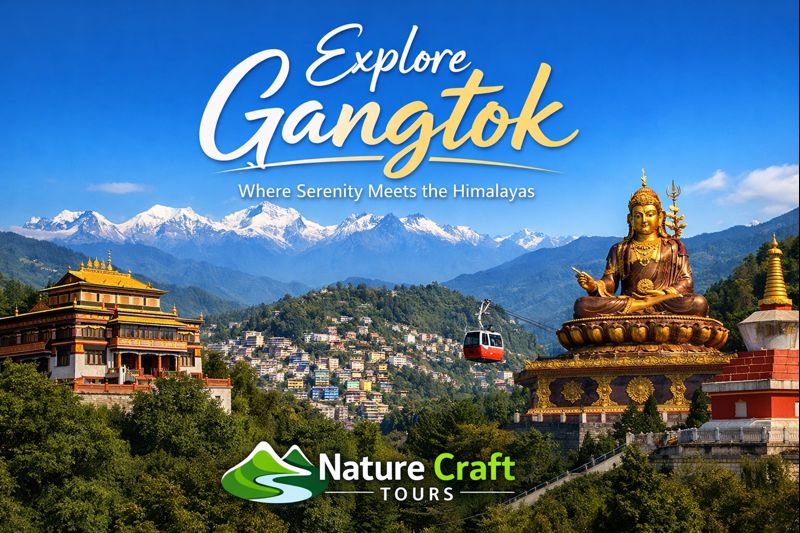
Gangtok is not a destination that reveals itself in haste. It is a city shaped by altitude, silence, discipline, and belief—perched on a ridge overlooking deep valleys and distant snowlines, yet grounded in a social order that values restraint over spectacle. To understand Gangtok is to move slowly: to walk its stepped lanes, observe its monasteries without intrusion, listen to the wind moving across prayer flags, and read the mountains not as scenery but as governing forces. This Himalayan capital does not compete for attention; it earns it through composure, continuity, and context.
Understanding Gangtok: Geographic and Strategic Overview
Gangtok is the capital city of the Indian state of Sikkim, located at an average elevation of approximately 1,650 metres above sea level. It sits along the eastern Himalayan range, facing the Teesta River basin and framed by forested ridges that gradually ascend toward the higher alpine zones of North Sikkim. Unlike many hill towns that developed as colonial retreats, Gangtok evolved as an administrative and cultural nucleus tied closely to trade routes connecting Tibet, Bhutan, and the plains of Bengal.
The city’s topography is decisive in shaping its urban character. Roads follow the contours of the mountains rather than cutting through them, resulting in layered neighbourhoods rather than linear sprawl. Construction regulations are strict, preserving sightlines and reducing landslide risk. The climate remains temperate for most of the year, with cool nights even in summer and winter temperatures moderated by cloud cover and forest density.
Historical Context: From Monastic Settlement to State Capital
Gangtok’s recorded history is relatively recent compared to other Himalayan centres, yet its political significance is substantial. Originally a small hamlet surrounding a monastery, it gained prominence in the late 19th century as Sikkim’s trade relations with Tibet expanded. British political interests later reinforced its administrative importance, though the city never developed the overt colonial architectural imprint seen elsewhere in the Himalayas.
Following Sikkim’s integration into India in 1975, Gangtok assumed the role of state capital, accelerating infrastructural development while retaining a measured pace of urbanisation. Government planning prioritised sanitation, environmental control, and social order—factors that continue to define the city’s reputation for cleanliness and civic discipline.
Cultural Fabric: Buddhism, Order, and Living Traditions
Gangtok’s cultural identity is deeply interwoven with Tibetan Buddhism, particularly the Nyingma tradition. Monasteries are not merely heritage structures; they function as living institutions guiding daily rhythms and social values. The sound of ceremonial horns, the presence of monks in maroon robes, and the omnipresent flutter of prayer flags are integral rather than ornamental.
The population reflects a mosaic of Lepcha, Bhutia, and Nepali communities, each contributing distinct linguistic, culinary, and ritual traditions. Festivals such as Losar, Saga Dawa, and Pang Lhabsol are observed with solemnity and restraint, prioritising spiritual meaning over display. Visitors who arrive during these periods encounter not performances but participation—provided they observe local etiquette.
Ecological Setting: Forests, Climate, and Himalayan Biodiversity
Gangtok occupies a critical ecological transition zone between subtropical forests and temperate Himalayan ecosystems. Surrounding hills support oak, rhododendron, magnolia, and fern species, while higher elevations host alpine flora and endemic medicinal plants. Seasonal cloud cover contributes to moisture retention, sustaining biodiversity but also requiring careful land management.
Wildlife in the broader region includes red pandas, Himalayan black bears, and numerous bird species, though these remain largely outside the urban perimeter. Environmental policies emphasise waste segregation, plastic control, and slope stabilisation—measures that are visible in daily civic life rather than confined to policy documents.
Best Time to Visit Gangtok
Spring (March to May)
Spring is widely regarded as the most balanced season to experience Gangtok. Temperatures remain comfortable, skies are generally clear, and rhododendrons bloom across surrounding hillsides. This period offers optimal conditions for sightseeing, short hikes, and cultural exploration without weather-related disruptions.
Summer and Monsoon (June to September)
Summer transitions quickly into the monsoon, bringing heavy rainfall and frequent cloud cover. While the landscape becomes intensely green, landslides and road closures can affect travel plans. This season suits travellers interested in slow, contemplative stays rather than extensive movement.
Autumn (October to November)
Post-monsoon autumn offers crisp air and long-distance mountain visibility. Snow peaks become prominent, and trekking routes reopen. Cultural festivals during this period provide insight into local traditions without peak-season congestion.
Winter (December to February)
Winters are cold but generally dry. While snowfall is rare within Gangtok itself, nearby higher-altitude areas may experience snow. This season appeals to travellers seeking quiet streets, clear skies, and a reflective atmosphere.
Ideal Duration of Stay
A minimum of three full days is recommended to understand Gangtok beyond surface impressions. This allows for unhurried exploration of monasteries, local markets, and viewpoints. Travellers using Gangtok as a base for excursions into East or North Sikkim should plan five to seven days to accommodate altitude acclimatisation and potential weather delays.
Routes and Accessibility
Gangtok is accessed primarily via road. The nearest airport is Bagdogra in West Bengal, approximately 125 kilometres away, connected by a mountain highway following the Teesta River. Rail travellers typically disembark at New Jalpaiguri before continuing by road. Travel time varies significantly depending on weather and traffic conditions.
Permits are required for certain border and high-altitude areas beyond Gangtok. These are regulated strictly and must be arranged through authorised channels, reinforcing the region’s emphasis on controlled tourism and environmental security.
Key Attractions and Places of Significance
Rumtek Monastery
Situated on a ridge overlooking the city, Rumtek Monastery serves as a major centre of Tibetan Buddhist learning. Its architecture reflects traditional monastic design, while its role as a spiritual authority continues to influence regional religious life.
Enchey Monastery
Closer to the city centre, Enchey Monastery provides insight into everyday monastic routines. Its annual masked dances attract local participation rather than tourist spectacle, offering an authentic cultural encounter.
MG Marg
Gangtok’s central promenade is notable not for commercial excess but for regulation. Vehicular traffic is prohibited, cleanliness is enforced, and architectural uniformity is maintained. The area reflects civic planning as much as leisure.
Institutes and Viewpoints
Cultural institutes, ropeways, and elevated viewpoints provide contextual understanding of Sikkim’s geography and heritage rather than isolated photo opportunities. These spaces are designed to educate as well as orient visitors.
Gangtok in the Broader Eastern India Travel Narrative
Travellers exploring eastern India often juxtapose mountain environments with riverine and deltaic landscapes. While Gangtok represents altitude, restraint, and spiritual continuity, other regions reveal ecological intensity of a different kind. For instance, journeys into mangrove ecosystems such as the Sundarban Tour offer insight into tidal forests, wildlife adaptation, and human resilience in low-lying terrain. Together, these regions illustrate the geographic diversity of eastern India.
Practical Insights for Responsible Travel
Visitors should approach Gangtok with awareness of altitude-related fatigue, particularly during the first day. Slow pacing, adequate hydration, and minimal exertion are advisable. Respect for local customs is essential—monasteries require modest dress and restrained behaviour, and photography may be restricted.
Waste management regulations are strictly enforced, and travellers are expected to comply. The city’s discipline is collective rather than imposed, and visitors who adapt to this ethos often find the experience deeply rewarding.
Gangtok as a Gateway to Extended Himalayan Exploration
Beyond its own boundaries, Gangtok functions as a staging point for journeys into East Sikkim, North Sikkim, and trans-Himalayan corridors. These routes introduce travellers to glacial lakes, high-altitude passes, and remote settlements where infrastructure yields to geography. Such extensions require preparation, patience, and respect for environmental limits.
Just as Gangtok opens pathways into the mountains, travellers from the plains often balance their itineraries with contrasting ecosystems. A thoughtfully planned Sundarban Tour Package following a Himalayan journey offers ecological and cultural contrast, deepening understanding of India’s environmental spectrum.
The Enduring Character of Gangtok
Gangtok does not present itself as a spectacle to be consumed. It is a city to be read—through its monastic rhythms, environmental discipline, and measured pace of life. For travellers willing to engage with its subtleties, Gangtok offers something increasingly rare: a destination where modern administration, ancient belief, and ecological awareness coexist without dilution.
In the larger narrative of Himalayan travel, Gangtok stands not as a retreat but as a living capital—one that governs quietly, preserves deliberately, and welcomes thoughtfully. To leave Gangtok is not to conclude a journey, but to carry forward an understanding shaped by altitude, restraint, and continuity.