Hazarduari Palace (Murshidabad):
The Thousand-Door Chronicle of Power and Transition
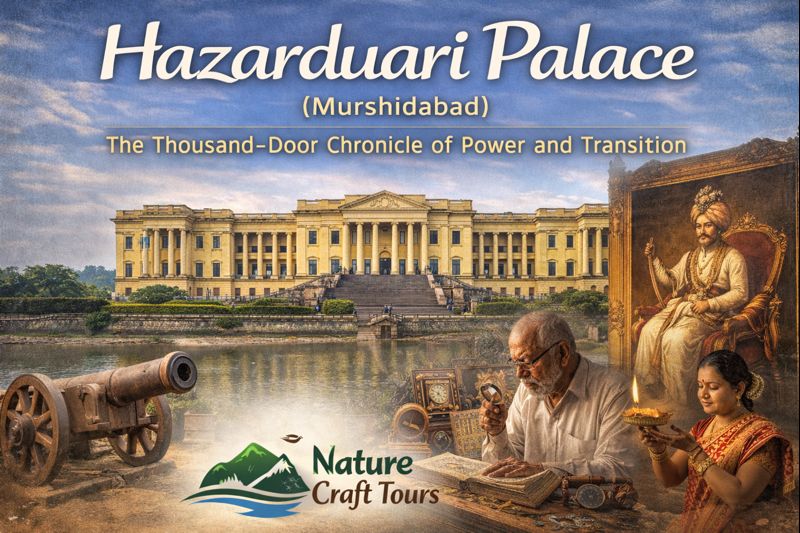
Some monuments are admired for their beauty; others are understood for their significance. Hazarduari Palace belongs firmly to the second category. Standing on the eastern bank of the Bhagirathi River in Murshidabad, this monumental palace is not merely an architectural landmark but a silent witness to one of the most transformative periods in Bengal’s history. To explore Hazarduari is to step into the administrative heart of a fading Nawabi power and the rising shadow of colonial authority.
As an explorer, one quickly realizes that Hazarduari Palace is not about ornamental excess alone. Its scale, symmetry, and spatial discipline speak of governance, protocol, and transition. Every corridor echoes decisions that shaped Bengal’s destiny, while every hall reflects a time when Murshidabad stood at the crossroads of indigenous rule and foreign influence.
Geographical Setting and Strategic Location
Hazarduari Palace occupies a commanding position along the Bhagirathi River, a lifeline that once connected Murshidabad to the wider Gangetic trade and administrative network. The palace complex is integrated into the historic urban fabric of Murshidabad, surrounded by mosques, cemeteries, administrative buildings, and river ghats.
This river-facing orientation was not accidental. The Bhagirathi symbolized authority, mobility, and economic control. From this vantage point, the Nawabs could oversee ceremonial processions, monitor river traffic, and project their power outward toward both the countryside and visiting foreign delegations.
Climate and Best Time to Visit
Murshidabad experiences a tropical climate characterized by hot summers, monsoon rains, and mild winters. Summer temperatures from April to June can be intense, making extended exploration uncomfortable. The monsoon season, from July to September, transforms the river landscape but brings humidity and occasional disruptions.
The most favorable time to visit Hazarduari Palace is between October and February. During winter, the weather remains pleasant, allowing visitors to explore the vast interiors and surrounding grounds comfortably. Soft winter light also enhances the palace’s architectural details and riverfront views.
Historical Context: Why Hazarduari Was Built
Hazarduari Palace was constructed in the early nineteenth century during the reign of Nawab Nazim Humayun Jah. By this time, Murshidabad had already lost much of its political autonomy, yet it remained symbolically important as the seat of the Nawabs of Bengal.
The palace was envisioned as an administrative and ceremonial center that reflected order, authority, and modern governance. Its construction marked a conscious shift away from traditional Indo-Islamic palace forms toward a more European-inspired architectural language, reflecting changing power dynamics and external influences.
The Meaning Behind “Hazarduari”
The name “Hazarduari” translates to “Palace of a Thousand Doors.” While not all doors function as passageways, their sheer number creates an illusion of openness, accessibility, and control. This design reinforced the idea of a ruler who was both omnipresent and administratively efficient.
Symbolically, the doors represented governance through visibility — nothing hidden, everything regulated. Practically, they also enhanced ventilation, light distribution, and movement within the massive structure.
Architectural Identity and Design Philosophy
Hazarduari Palace is a striking example of Indo-European architectural synthesis. Built primarily in brick and plastered in pale tones, the structure follows strict symmetry and proportion. Its long façade, rhythmic columns, and elevated plinth reflect European neoclassical sensibilities adapted to local climatic conditions.
The palace spans multiple floors, with expansive halls, long corridors, and structured courtyards. Unlike earlier palaces designed for seclusion, Hazarduari emphasizes openness and formality — characteristics aligned with administrative governance rather than royal intimacy.
Interior Spaces and Functional Zoning
The interior layout of Hazarduari Palace reflects clear functional zoning. Large halls were used for durbars, public audiences, and official ceremonies. Smaller chambers served administrative purposes, record-keeping, and controlled access to authority.
The spatial organization reinforces hierarchy — movement through the palace gradually transitions from public to restricted zones, mirroring the layers of governance practiced during the period.
Hazarduari as an Administrative Power Center
Unlike palaces built purely for residence, Hazarduari functioned as a nerve center of administration. It housed offices, courts, treasury spaces, and ceremonial halls. Decisions affecting taxation, justice, and regional governance were debated and executed within its walls.
This administrative role explains the palace’s disciplined design. There is little indulgence in ornamental excess; instead, the emphasis lies on order, clarity, and authority. Hazarduari represents governance architecture rather than royal extravagance.
Museum Collections and Historical Artifacts
Today, Hazarduari Palace functions as a museum, preserving artifacts that offer insights into Bengal’s political and cultural history. Displays include weapons, manuscripts, portraits, furniture, and decorative objects associated with the Nawabi court.
These collections are not merely objects of curiosity. They contextualize the palace as a working institution, allowing visitors to reconstruct how authority was projected, negotiated, and preserved during a period of profound transition.
Hazarduari and the Colonial Transition
Hazarduari Palace stands at a historical threshold. It was built at a time when indigenous power structures were increasingly constrained by external control. While the Nawabs retained ceremonial status, real authority gradually shifted elsewhere.
This duality is reflected in the palace itself — European architectural discipline housing an indigenous ruling institution. Hazarduari thus becomes a physical metaphor for Bengal’s political transformation.
Complete Tour Plan: Exploring Hazarduari Palace
A thoughtful visit to Hazarduari Palace is best planned over two days, allowing sufficient time to absorb both architectural detail and historical context.
Day One: Palace Architecture and Museum Exploration
Begin the day early to explore the palace interiors thoroughly. Walk through ceremonial halls, administrative chambers, and corridors to understand spatial hierarchy. Spend time in the museum galleries, reading contextual notes and observing artifacts closely. Late afternoon is ideal for exploring the palace exterior and river-facing grounds.
Day Two: Surrounding Heritage and Riverfront Context
The second day should focus on the palace’s surroundings. Explore adjacent historical structures, river ghats, and administrative zones to understand how Hazarduari functioned within a broader urban and political landscape. Conclude the visit with a quiet walk along the Bhagirathi, reflecting on the palace’s symbolic relationship with the river.
Connectivity and Travel Access
Hazarduari Palace is accessible via Murshidabad town, which is well connected by rail from Kolkata. Road travel offers scenic views of rural Bengal, while local transport allows easy movement between heritage sites.
Many travelers interested in Bengal’s layered history prefer to combine architectural exploration with nature-based journeys elsewhere in the state. Integrating a historical visit with a curated Sundarban Tour creates a balanced travel narrative, linking political history with ecological heritage.
Hazarduari in a Wider Bengal Travel Circuit
Hazarduari Palace occupies a unique position in Bengal’s heritage landscape. It represents governance rather than mythology, administration rather than devotion. This makes it essential for travelers seeking intellectual depth and historical clarity.
Extending a Murshidabad journey to include wetlands, forests, and riverine ecosystems adds perspective to Bengal’s story. Pairing Hazarduari with a carefully planned Sundarban Travel experience allows travelers to witness how power, trade, and environment shaped the region across centuries.
Why Hazarduari Palace Matters Today
Hazarduari Palace is not a monument frozen in time. It is a classroom of history, governance, and transformation. Its walls remind visitors that power is rarely permanent and that architecture often reveals truths that texts alone cannot convey.
For explorers who value understanding over spectacle, Hazarduari Palace offers a deeply rewarding experience. It stands as one of Bengal’s most important historical structures — not because of its doors alone, but because of the stories that pass silently through them.