Hee–Bermiok and Dentam Side Roads (West Sikkim):
A Field Explorer’s Account of Borderland Villages, Forest Corridors, and Living Heritage
Introduction: Entering the Lesser-Traveled Corridors of West Sikkim
The Hee–Bermiok and Dentam side roads of West Sikkim form one of the most understated yet culturally and ecologically significant travel belts in the eastern Himalayas. Removed from the primary tourist circuits of Pelling and Yuksom, these roads trace older village routes, forest margins, and Indo-Nepal border landscapes where everyday life unfolds with remarkable continuity. For the experienced traveler, researcher, or slow explorer, this belt offers insight into how geography, subsistence agriculture, and cross-border histories have shaped West Sikkim’s human and natural fabric.
Travel along these side roads is not about iconic viewpoints alone. It is about movement through layered spaces—cardamom groves replacing forests, prayer flags marking village thresholds, and rivers quietly defining political boundaries. The region rewards travelers who are attentive to details rather than destinations.
Regional Overview: Understanding the Hee–Bermiok–Dentam Belt
This travel belt stretches across the western flank of Sikkim, connecting interior village clusters to the border town of Dentam. Elevations range from approximately 900 meters in river valleys to over 1,900 meters along ridges and village plateaus. The terrain is defined by steep gradients, dense subtropical forests, and terraced agricultural slopes.
Hee and Bermiok function primarily as agrarian villages, while Dentam serves as a market and transit point near the Nepal border.
Topography and Landscape Character
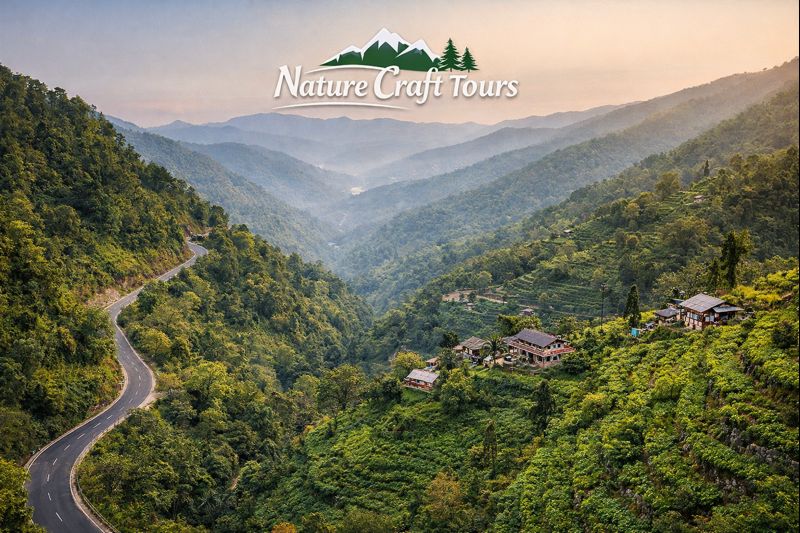
The landscape is deeply incised by rivers and seasonal streams flowing toward the Rangit basin. Forested slopes alternate with cultivated land, creating a mosaic of habitats. Roads often cling to cliff faces, opening sudden views across valleys where clouds drift at eye level.
Historical and Cultural Context
Historically, this belt lay along minor trade and migration routes linking Sikkim with eastern Nepal. While never a major commercial corridor, the region absorbed cultural influences from both sides of the border. This is reflected in architecture, dialects, agricultural practices, and shared religious customs.
Village Society and Cultural Continuity
Communities here are primarily of Nepali-speaking origin, with strong traditions of cooperative farming and collective labor. Seasonal agricultural cycles dictate social rhythms, while monasteries and village temples anchor spiritual life. Oral histories remain an important means of preserving local memory, particularly regarding land use and ancestral settlement.
Ecology and Biodiversity of the Side Roads
The Hee–Bermiok–Dentam belt lies within a biologically rich transition zone between subtropical and temperate ecosystems. The relative absence of heavy tourism has allowed much of the region’s biodiversity to remain intact.
Forest Types and Plant Life
Lower elevations support sal, bamboo, and mixed broadleaf forests, while higher areas transition to oak, chestnut, and alder. Large-scale cardamom cultivation dominates many slopes, creating semi-managed agroforestry systems that still support birdlife and small mammals.
Wildlife Observations
Barking deer, Himalayan palm civet, and porcupine are commonly reported by locals, while avifauna includes drongos, barbets, and raptors circling thermals above valleys. Early mornings along side roads often yield the richest wildlife sightings.
Route and Accessibility
The primary access point to this belt is via Gyalshing (Geyzing), the administrative center of West Sikkim. From Gyalshing, roads branch toward Hee and Bermiok before continuing to Dentam. These are mostly single-lane mountain roads, paved but narrow, with occasional rough stretches.
The nearest railhead is New Jalpaiguri, and the closest airport is Bagdogra. From either location, road travel of approximately 6–7 hours is required to reach Gyalshing, followed by local travel along the side roads.
Ideal Travel Duration
A minimum of three nights is recommended to explore the Hee–Bermiok–Dentam belt meaningfully. This allows time for village walks, forest exploration, and unhurried travel between settlements. Researchers, photographers, or travelers focused on cultural immersion may prefer a stay of four to five nights.
Best Time to Visit
Spring (March to May) and autumn (October to November) offer the most stable weather conditions. Spring brings flowering forests and agricultural activity, while autumn provides clearer skies and easier road conditions. Monsoon travel is possible but requires flexibility due to rainfall and landslides.
Key Attractions and Experiential Highlights
- Walking through cardamom plantations around Hee and Bermiok
- Village-to-village trails offering panoramic valley views
- Exploring Dentam’s borderland markets and riverside zones
- Birdwatching along early-morning forest roads
- Observing traditional agricultural practices
Dentam: Border Town and Cultural Crossroads
Dentam occupies a unique position as one of Sikkim’s westernmost towns. Its proximity to Nepal shapes daily life, trade patterns, and cultural exchange. The town functions as a supply hub for surrounding villages and as a point of transition between interior Sikkim and border landscapes.
Rivers flowing near Dentam mark both ecological and political boundaries, and riverside walks provide insight into how borders are experienced as lived spaces rather than abstract lines.
Practical Insights for Travelers
Travel in this belt requires a degree of self-sufficiency. Fuel stations, medical facilities, and communication networks are limited beyond Gyalshing. Travelers should carry essentials, plan routes conservatively, and respect local customs.
Those interested in understanding India’s broader ecological contrasts often pair Himalayan journeys with explorations of lowland ecosystems. For example, after experiencing West Sikkim’s forested mountains, some travelers choose to explore the mangrove wilderness through a Sundarban Tour, gaining perspective on how geography shapes livelihoods across vastly different terrains.
Cultural Sensitivity and Responsible Travel
The Hee–Bermiok–Dentam belt remains a living cultural landscape. Visitors are expected to observe monastic etiquette, seek permission before photographing people, and minimize environmental impact. Waste management is a growing concern, and travelers should practice strict carry-back principles.
Comparative Landscape Understanding
Experiencing this region highlights the diversity of India’s peripheral landscapes. While the Himalayas emphasize altitude, isolation, and forest-based livelihoods, other regions rely on water-dominated ecologies. Some seasoned explorers intentionally design itineraries that move between extremes, combining mountain travel with deltaic regions through options such as a Sundarban Tour Package from Kolkata, creating a fuller understanding of environmental adaptation.
Why These Side Roads Matter
The Hee–Bermiok and Dentam side roads of West Sikkim illustrate how marginal spaces often preserve the deepest insights into regional identity. Here, roads are not merely connectors but narratives—linking forests to fields, villages to borders, and past to present.
For travelers willing to move slowly and observe carefully, this belt offers more than scenery. It provides a grounded understanding of how communities negotiate terrain, tradition, and change in one of the Himalayas’ quieter corners. In doing so, it reaffirms the value of exploration that prioritizes context over spectacle and experience over itinerary.