Jaldapara National Park (Dooars Circuit):
Grasslands of the Rhino, Rivers of Renewal, and the Open Forest Frontier
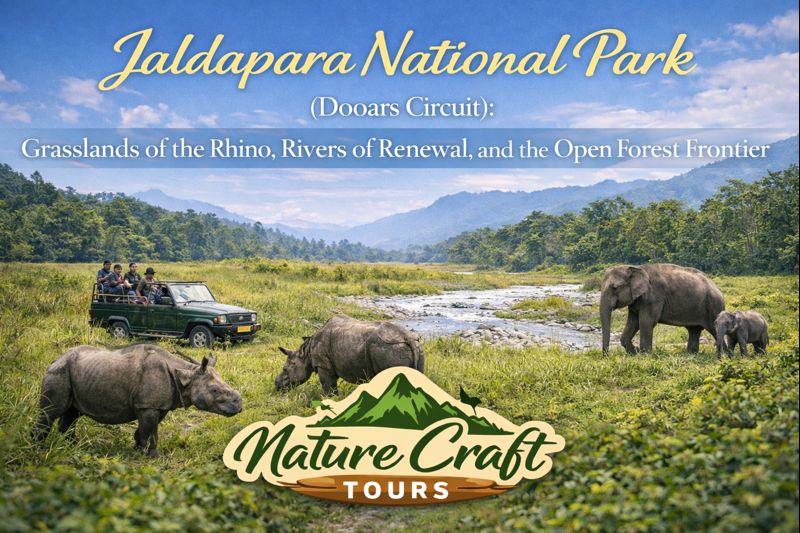
Jaldapara National Park occupies a distinctive position within the Dooars landscape of North Bengal. Situated in the Alipurduar district, this protected area represents one of India’s finest examples of a river-fed grassland ecosystem, shaped continuously by seasonal floods, open forest dynamics, and long-established wildlife corridors. Unlike dense tropical forests where visibility is limited, Jaldapara is defined by openness—wide meadows, braided rivers, and expansive floodplains where wildlife behavior can be observed in its most natural form.
For the explorer, Jaldapara is not simply a safari destination; it is a study in ecological balance. Here, grasslands must be maintained through flooding and controlled burning, rivers dictate movement patterns, and large herbivores determine the structure of the entire ecosystem. This detailed, research-based guide presents Jaldapara National Park as a living landscape—covering its geography, seasons, wildlife, cultural context, and a thoughtfully designed tour plan that allows travelers to understand rather than merely observe.
Geographical Setting and Landscape Identity
Jaldapara National Park lies along the banks of the Torsha River, close to the eastern edge of the Dooars belt and the Indo–Bhutan border. The park’s terrain is largely flat, composed of alluvial floodplains enriched annually by river overflow. These fertile deposits sustain tall elephant grass, reed beds, and open savannah-like expanses, making Jaldapara one of the most productive grassland habitats in eastern India.
The park is bordered by forested foothills to the north and agricultural land to the south, creating a sharp yet functional transition between wild and human-dominated spaces. This proximity highlights the importance of regulated tourism and conservation-sensitive planning, as wildlife movement often extends beyond park boundaries.
Climate Patterns and Best Time to Visit
Jaldapara experiences a humid subtropical climate, strongly influenced by monsoon rainfall and river systems. Seasonal timing plays a crucial role in shaping both visitor experience and wildlife visibility.
Winter (November to February)
Winter is the most favorable and widely recommended season for visiting Jaldapara National Park. Temperatures range between 8°C and 25°C, mornings are cool and often mist-laden, and grasslands remain open and accessible. Wildlife sightings increase during this period as animals frequent open areas and riverbanks.
Spring and Early Summer (March to April)
During spring, grass regeneration accelerates and herbivores remain highly active. Days grow warmer, but early morning and late afternoon safaris continue to offer rewarding experiences. Bird activity is particularly noticeable during this transitional season.
Monsoon Season (May to September)
The monsoon defines the ecological heartbeat of Jaldapara. Heavy rainfall causes the Torsha River to swell, flooding grasslands and rejuvenating soil fertility. For safety and conservation reasons, the park remains closed during this period, allowing habitats to recover and wildlife to breed undisturbed.
Ecological Significance of Jaldapara National Park
Jaldapara is globally significant for its population of Indian one-horned rhinoceros, one of the park’s flagship species. The success of rhino conservation here is directly linked to the health of its grasslands, which depend on regular flooding and careful management.
The park also serves as a vital ecological corridor connecting forests of the Dooars with protected areas in Bhutan. This continuity allows seasonal migration of elephants and supports genetic exchange among wildlife populations. Jaldapara’s importance lies not only in species numbers, but in its role as a functioning, interconnected ecosystem.
Wildlife Diversity and Habitat Zones
Indian One-Horned Rhinoceros
Jaldapara is best known for its robust rhino population. These massive herbivores are frequently observed grazing in open grasslands or resting near water sources. Their presence shapes vegetation patterns and influences the distribution of other species.
Elephants and Large Herbivores
Herds of Asian elephants move through Jaldapara, particularly during seasonal migrations. Gaur, sambar, chital, and hog deer are also common, each adapted to specific vegetation zones within the park.
Predators and Avifauna
Leopards and Bengal tigers inhabit the broader landscape, though sightings are infrequent due to extensive cover and wide-ranging behavior. Birdlife, however, is abundant, with grassland species, wetland birds, and forest-edge specialists forming a diverse avian community.
Safari Experience and Forest Interpretation
Jaldapara offers a structured safari system designed to balance wildlife viewing with habitat protection. Safaris move through designated routes that traverse grasslands, riverbanks, and forest edges, offering a comprehensive view of the park’s ecological zones.
Observation in Jaldapara emphasizes behavior rather than pursuit. Watching rhinos graze, elephants interact, or deer respond to subtle environmental cues transforms the safari into a learning experience rather than a checklist activity.
Cultural Landscape and Human Presence
The surroundings of Jaldapara are shaped by tea gardens, forest villages, and agricultural settlements. Many local communities have coexisted with wildlife for generations, developing adaptive strategies that reflect seasonal rhythms and ecological constraints.
Understanding this human dimension is essential. Jaldapara is not an isolated wilderness, but part of a larger living landscape where conservation success depends on community participation and responsible tourism.
Complete Explorer-Style Tour Plan for Jaldapara National Park
Day 1: Arrival and River Landscape Orientation
Arrive in the Jaldapara region via nearby transit hubs and settle into the forest fringe area. The first day should focus on orientation—observing the Torsha River, understanding grassland distribution, and noting the transition between cultivated land and protected forest.
Day 2: Morning Safari and Grassland Observation
Begin before sunrise for a guided safari through core grassland zones. This is the most productive period for observing rhinos and large herbivores. Post-safari hours can be spent reflecting on ecological patterns rather than moving rapidly between attractions.
Day 3: Birdlife, Wetlands, and River Systems
Dedicate the day to riverine and wetland habitats. Observe bird behavior, water flow patterns, and how seasonal flooding shapes vegetation. This slow-paced exploration deepens understanding of the park’s ecological processes.
Day 4: Tea Gardens and Community Interaction
Explore surrounding tea estates and villages. Learn about plantation history, labor systems, and how agricultural landscapes coexist alongside protected grasslands. This cultural perspective adds essential context to the wildlife experience.
Day 5: Final Forest Immersion and Departure
Conclude with an early morning walk near forest edges or riverbanks, focusing on soundscapes and subtle wildlife activity. Depart with a comprehensive understanding of Jaldapara’s role within the Dooars ecosystem.
Responsible Tourism and Conservation Ethics
Jaldapara’s future depends on responsible travel practices. Visitors must respect safari regulations, maintain silence in wildlife zones, and minimize ecological impact. Tourism here is not about volume, but about awareness and respect.
Jaldapara in the Broader Context of Nature Travel
Grassland ecosystems like Jaldapara offer a compelling contrast to India’s forested deltas and coastal wetlands. Many travelers seeking ecological diversity complement their Dooars journey with mangrove explorations such as the Sundarban Tour, where tidal rhythms replace river-fed grasslands.
Integrated travel planning platforms like Sundarban Tour demonstrate how combining grassland, forest, and delta ecosystems creates a deeper understanding of India’s natural complexity.
Jaldapara as a Living Grassland Sanctuary
Jaldapara National Park is defined by openness—of land, of movement, and of ecological process. Its grasslands breathe with the seasons, its rivers reshape the terrain, and its wildlife follows patterns refined over centuries. For the explorer, Jaldapara offers not spectacle alone, but insight.
To journey through Jaldapara is to witness an ecosystem in balance, where conservation is visible in every grazing rhino, every migrating herd, and every flood-renewed meadow. It is this quiet, enduring harmony that makes Jaldapara one of the most meaningful destinations in the Dooars circuit.