Key Monastery: A Cliffside Citadel of Faith Near Kaza in Spiti Valley
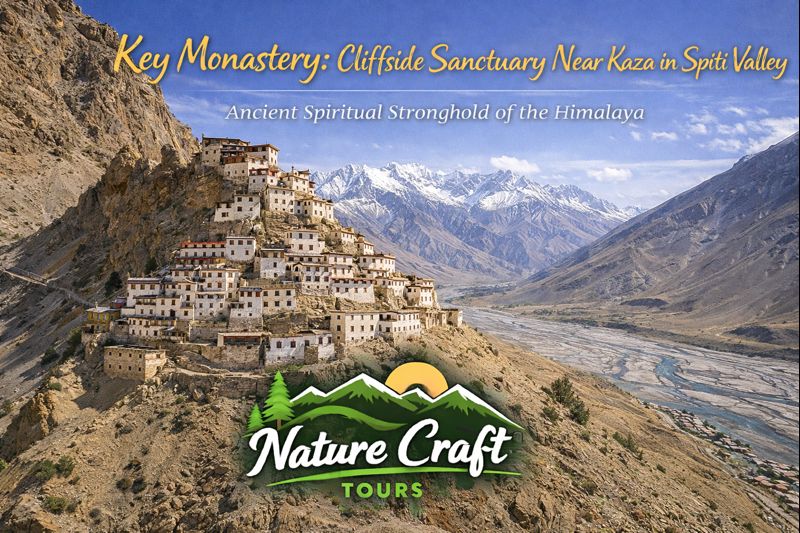
Rising dramatically from a conical hill above the Spiti River, Key Monastery is not merely the most prominent religious institution of the region—it is the visual, cultural, and spiritual anchor of central Spiti. Seen from a distance, the monastery resembles a whitewashed fortress carved directly out of rock, its stacked layers following the logic of survival as much as devotion. Located a short distance from Kaza, the administrative heart of Spiti Valley, Key Monastery represents the convergence of geography, faith, and history in one of the most demanding landscapes inhabited by humans.
The experience of approaching Key Monastery is shaped by scale and silence. The road ascends gradually, revealing the structure in stages—first as a distant silhouette, then as a complex of walls, prayer halls, courtyards, and living quarters clinging to the hillside. Prayer flags flutter against a vast sky, while the valley below remains austere and quiet. This is not a monument designed for visitors; it is a living monastic system that has endured invasions, earthquakes, climatic extremes, and centuries of isolation.
This travel narrative explores Key Monastery not as a single attraction, but as a functioning cultural institution embedded within the Spiti ecosystem. Using Kaza as the natural base, the article examines history, architecture, monastic life, seasonal access, and responsible ways to experience this sacred site. Key Monastery demands more than a brief stop. It invites understanding through patience and observation.
Destination Overview: Key Monastery in the Spiti Landscape
Geographical Setting and Elevation
Key Monastery stands at an elevation of approximately 4,166 meters above sea level, overlooking the Spiti River valley. Its position is both strategic and symbolic. From this vantage point, the monastery commands expansive views of surrounding villages, trade routes, and mountain corridors. The steep slopes on which it is built provide natural defense against weather and historical threats, while also reinforcing the sense of seclusion essential to monastic life.
The surrounding terrain is characteristic of the Trans-Himalayan cold desert—rocky, dry, and largely devoid of vegetation. This stark environment amplifies the monastery’s presence, making it appear as an extension of the mountain rather than a separate structure imposed upon it.
Relationship with Kaza
Kaza functions as the logistical and administrative base for exploring Key Monastery. Supplies, transport coordination, and acclimatization are best managed from Kaza before ascending to the monastery. Historically, the relationship between Kaza and Key has been symbiotic—administrative life below and spiritual authority above.
Historical Evolution of Key Monastery
Origins and Early Monastic Establishment
Key Monastery is believed to have been founded over a thousand years ago, during a period when Buddhism was spreading across the Himalayan and Trans-Himalayan regions. Its early role was not limited to religious practice; it functioned as a center of learning, manuscript preservation, and regional governance.
Over centuries, the monastery endured repeated destruction due to invasions and natural calamities. Each time, it was rebuilt, often stronger and more fortified than before. This cycle of destruction and reconstruction shaped its fortress-like architecture.
Periods of Conflict and Resilience
Key Monastery faced significant damage during regional conflicts involving neighboring powers and rival sects. Earthquakes and harsh winters further tested its survival. Rather than abandoning the site, the monastic community adapted, reinforcing structures and modifying layouts to suit changing conditions.
This resilience is central to Key’s identity. The monastery stands today not as a preserved relic, but as a living testament to continuity under pressure.
Architectural Character and Spatial Layout
Fortress-Style Construction
Unlike monasteries built on open plateaus, Key’s architecture reflects defensive necessity. Buildings are stacked vertically, forming irregular terraces that follow the natural contours of the hill. Narrow passageways, thick walls, and limited access points reveal a design shaped by both spiritual retreat and physical security.
Materials used include stone, mud, and timber—locally sourced and adapted for thermal efficiency. Whitewashed walls reflect sunlight, reducing heat absorption during intense daytime exposure.
Prayer Halls, Cells, and Courtyards
Inside, the monastery comprises multiple prayer halls adorned with murals, thangkas, and statues of Buddhist deities. Monk cells are modest and functional, emphasizing discipline and simplicity. Courtyards serve as communal spaces for teaching, debate, and ceremonial gatherings.
The spatial arrangement encourages inward focus. Even when visitors are present, the architecture maintains a sense of enclosure and contemplation.
Monastic Life at Key
Daily Rhythm and Discipline
Key Monastery is home to a community of monks ranging from young novices to senior teachers. Daily life follows a strict schedule of prayers, study, and communal responsibilities. Rituals begin early in the morning and continue through the day, punctuated by periods of silence and learning.
Education remains central. Monks study Buddhist philosophy, logic, rituals, and Tibetan language, ensuring the transmission of knowledge across generations.
Festivals and Ceremonial Life
Annual festivals draw monks from surrounding areas and villagers from across Spiti. Masked dances, ritual music, and elaborate ceremonies mark significant dates in the Buddhist calendar. These events are not staged for tourism; they are integral expressions of faith and community identity.
Cultural and Spiritual Significance
Key as a Regional Authority
Historically, Key Monastery functioned as a seat of spiritual authority for central Spiti. Decisions regarding land use, festivals, and social conduct often involved monastic consultation. This influence continues, though adapted to modern administrative frameworks.
Symbolism in the Landscape
The monastery’s position above the valley reflects Buddhist cosmological ideas—elevation symbolizing proximity to enlightenment. From Key, the vastness of Spiti becomes visible, reinforcing impermanence and humility.
Best Time and Season to Visit Key Monastery
Late Spring to Early Summer (May to June)
Snow begins to melt, and access roads gradually open. The contrast between lingering snow and exposed rock enhances visual drama. This period offers fewer visitors and a more contemplative atmosphere.
Peak Summer (July to September)
This is the most accessible season. Roads are stable, and monastic life is fully active. Festivals often occur during this time, providing cultural insight.
Autumn (October)
Clear skies and reduced visitor numbers define autumn. However, temperatures drop sharply, and snowfall can occur unexpectedly toward the end of the month.
Winter (November to April)
Heavy snowfall isolates the monastery. Travel is extremely difficult and generally not feasible for standard itineraries. Winter conditions explain much of Key’s architectural and cultural resilience.
Ideal Travel Duration and Planning
A visit to Key Monastery should be part of a broader Spiti itinerary centered on Kaza. A minimum stay of two nights in the area allows for acclimatization and unhurried exploration. Ideally, travelers should spend multiple hours at the monastery rather than treating it as a brief stop.
Route and Accessibility
Approach from Kaza
The road from Kaza to Key Monastery is short but steep, winding through exposed terrain. Travel time is modest, but altitude gain is significant. Slow movement and awareness of physical response are essential.
As with other geography-driven journeys—whether ascending Himalayan monasteries or navigating tidal wilderness during a Sundarban Trip—the approach itself sets the tone for the experience.
On-Site Movement
Within the monastery, movement involves climbing stairs and navigating uneven surfaces. Comfortable footwear and steady pacing are important.
Key Attractions and Highlights
Panoramic Valley Views
From the upper terraces, views extend across the Spiti River, villages, and distant mountains. These perspectives contextualize the monastery’s strategic placement.
Ancient Murals and Artifacts
Prayer halls contain murals and artifacts reflecting centuries of artistic tradition. These works are not museum exhibits; they remain part of active ritual life.
Ecological Context and Responsibility
Key Monastery exists within a fragile high-altitude ecosystem. Soil regeneration is slow, and water resources are limited. Visitor behavior directly affects environmental balance.
Minimal waste, respect for silence, and adherence to local guidelines are essential.
Practical Insights for Travelers
Acclimatization and Health
At over 4,000 meters, altitude effects are significant. Visitors should spend time acclimatizing in Kaza before ascending and avoid physical exertion immediately after arrival.
Cultural Sensitivity
Key Monastery is an active religious institution. Silence, modest attire, and respectful observation are mandatory. Photography should be discreet and permitted.
Preparation
Layered clothing, sun protection, and water are essential even in summer. Weather can change rapidly.
Key Monastery in the Context of Conscious Travel
Experiencing Key Monastery aligns with a form of travel that prioritizes understanding over consumption. This philosophy resonates with carefully structured journeys where ecology and culture guide pace, similar in intent to experiences like the Best Sundarban Tour Package, where environment shapes engagement.
Key Monastery as Endurance and Insight
Key Monastery is not defined by its isolation, but by its endurance. For over a millennium, it has remained a center of faith, learning, and resilience in one of the harshest inhabited landscapes on earth. Its walls hold history, its halls echo with prayer, and its position above the valley offers perspective—both literal and philosophical.
For travelers willing to approach with patience and respect, Key Monastery offers more than views or photographs. It offers insight into how belief, discipline, and environment can coexist in balance. Near Kaza, yet worlds apart from ordinary travel experiences, Key stands as one of the most profound cultural landmarks of the Himalaya.