Konark Sun Temple (UNESCO World Heritage Site):
Stone, Time, and the Sacred Geometry of Light
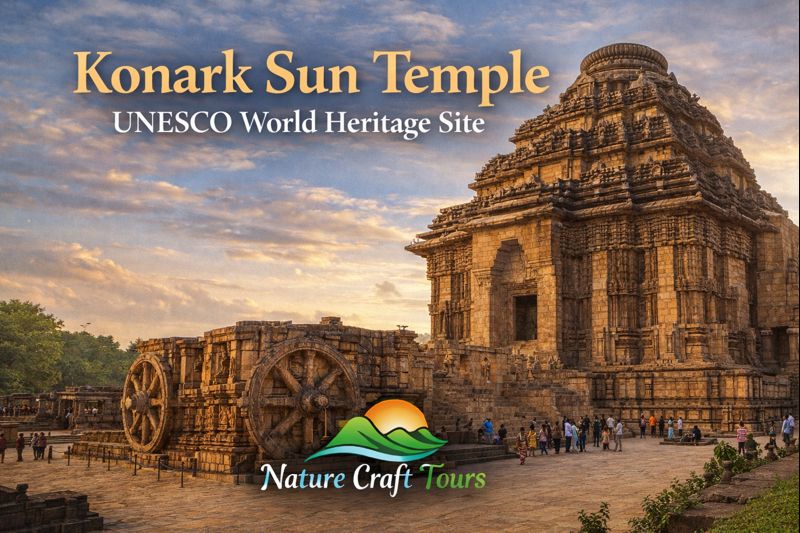
Rising from the coastal plains of Odisha with monumental silence, the Konark Sun Temple stands not merely as an archaeological marvel, but as a profound statement of human imagination, scientific knowledge, and spiritual aspiration. Designated as a UNESCO World Heritage Site, Konark is often described through superlatives—architectural masterpiece, celestial chariot, lost wonder—but such labels only partially convey its depth. To encounter Konark is to step into a civilisation where astronomy, ritual, art, and statecraft were fused into a single, audacious vision carved entirely in stone.
Unlike living pilgrimage centres where rituals continue uninterrupted, Konark belongs to a different category of sacred geography: one where the deity has withdrawn, but meaning has not diminished. The temple’s silence is itself instructive, inviting reflection on impermanence, cosmic cycles, and the relationship between human ambition and time. This article offers a deeply researched, experiential exploration of the Konark Sun Temple—its origins, symbolism, environment, and practical realities—written for travelers who seek understanding rather than spectacle.
Destination Overview: Konark and Its Sacred Coastal Setting
Konark is located along Odisha’s eastern coastline, not far from the Bay of Bengal. The choice of this setting was deliberate. In ancient cosmology, the rising sun over the eastern sea symbolized creation, renewal, and divine order. Konark, whose name is derived from “Kona” (corner) and “Arka” (sun), was envisioned as a place where solar energy, geography, and human devotion converged.
The temple complex dominates a relatively open landscape, allowing unobstructed interaction between light and stone. Unlike hilltop shrines or enclosed temple towns, Konark was designed to engage the sky directly. Even in its partially ruined state, the site retains a sense of vastness and clarity that distinguishes it from most medieval monuments in India.
Historical Background: Vision, Patronage, and Decline
Foundation Under the Eastern Ganga Dynasty
The Konark Sun Temple was commissioned in the 13th century by King Narasimhadeva I of the Eastern Ganga dynasty, a powerful maritime empire that controlled much of eastern India’s coastline. The dynasty’s prosperity depended heavily on sea trade, and Surya, the sun god, was revered as both a cosmic force and a protector of royal authority.
Constructing a temple of such scale was an assertion of political confidence as much as religious devotion. Konark was intended to project imperial power, scientific knowledge, and cultural refinement to both subjects and foreign visitors arriving by sea.
Gradual Abandonment and Structural Collapse
By the 16th century, the temple had begun to decline. The exact causes remain debated—coastal erosion, structural stress, shifting river courses, and political upheaval all likely played a role. Over time, the main tower collapsed, and active worship ceased. Unlike many temples that were repurposed or rebuilt, Konark was left largely abandoned, allowing nature and time to assert dominance.
This abandonment, while tragic, also preserved the site from later architectural alterations, allowing modern observers to study its original intent with remarkable clarity.
Architectural Concept: The Sun God’s Stone Chariot
Chariot Symbolism and Cosmic Motion
The entire temple was conceived as a colossal chariot of Surya, drawn by seven horses and mounted on twelve pairs of wheels. This was not mere decoration. The chariot symbolized the sun’s movement across the sky, the passage of time, and the cyclical nature of existence. Each element carried layered meanings drawn from astronomy, philosophy, and ritual practice.
The wheels, intricately carved with spokes and motifs, functioned as sundials, capable of indicating time with impressive accuracy. This integration of art and science reflects a worldview where observation of the natural world was inseparable from spiritual inquiry.
Stone as Medium and Message
Khondalite stone, abundant in the region, was chosen for construction. Its durability allowed for intricate carving, while its interaction with light enhanced visual depth. As sunlight moves across the temple throughout the day, carvings appear to shift, reinforcing the theme of motion central to Surya worship.
Sculptural Program: Life, Desire, and Cosmic Order
The sculptural richness of Konark is unparalleled. Thousands of figures cover the temple walls, depicting deities, celestial beings, musicians, dancers, animals, warriors, and scenes of courtly and domestic life. These are not random embellishments but components of a carefully structured visual narrative.
Human life, in all its complexity—joy, struggle, sensuality, devotion—is presented as part of a cosmic continuum. The presence of erotic sculptures, often misunderstood, reflects a philosophical acceptance of desire as a force that must be acknowledged rather than denied. At Konark, nothing is excluded from the cosmic order.
Cultural and Scientific Significance
Konark stands at the intersection of religion, science, and state ideology. Its alignment with the sun, astronomical precision, and mathematical planning demonstrate advanced knowledge systems that were deeply embedded in ritual culture. The temple functioned as a site of worship, education, and imperial symbolism simultaneously.
For travelers interested in how ancient societies interpreted natural forces, Konark offers insights comparable to other landscape-based cultural systems, such as those experienced in forest-and-water ecologies during a Sundarban Tour, though here expressed through stone and celestial geometry rather than living ecosystems.
The Temple in Its Ecological Context
The proximity of Konark to the sea shaped both its symbolism and its vulnerability. Salt-laden winds, shifting sands, and coastal humidity contributed to long-term structural stress. At the same time, the openness of the landscape allowed uninterrupted solar alignment, essential to the temple’s conceptual design.
Understanding Konark requires recognizing this tension between environmental exposure and spiritual aspiration—a reminder that monumental ambition must ultimately negotiate with natural forces.
Best Time to Visit Konark Sun Temple
Seasonal Considerations
The most favorable period to visit Konark is from October to February, when temperatures are moderate and humidity is lower. This season allows for extended exploration and careful observation of sculptural detail without physical discomfort.
Early mornings and late afternoons are ideal, as shifting sunlight enhances the depth and texture of carvings. Summer months can be extremely hot, while the monsoon season introduces humidity and occasional access challenges.
Ideal Travel Duration
While Konark itself can be explored in a single extended visit, a stay of two days in the surrounding region allows for a more reflective experience. This timeframe accommodates multiple visits at different times of day, enabling travelers to observe changes in light, atmosphere, and visitor patterns.
Route and Accessibility
Reaching Konark
Konark is accessible by road from major cities in Odisha, particularly Bhubaneswar and Puri. The journey passes through rural landscapes and coastal stretches, gradually transitioning from urban density to open terrain. This approach enhances the sense of arrival, reinforcing the temple’s isolation and scale.
On-Site Movement
The temple complex is best explored on foot. Walking slowly around the structure allows for close examination of carvings and alignment features. Visitors are encouraged to circle the monument rather than rush through designated viewpoints.
Key Highlights and Visitor Focus Points
- The massive stone wheels and their sundial functionality
- The remaining audience hall and subsidiary structures
- Detailed sculptural panels illustrating social and cosmic life
- Open sightlines emphasizing solar alignment
Practical Insights for Thoughtful Travelers
Carrying water, sun protection, and comfortable walking footwear is essential, particularly during warmer months. Photography is permitted, but respectful engagement with the site is encouraged. Rather than treating Konark as a backdrop, visitors gain more by approaching it as a text—one that rewards slow reading.
Travelers planning broader eastern India itineraries may find value in pairing monumental stone heritage with dynamic natural landscapes through a Sundarban Tour Package, gaining a richer understanding of how different environments shape cultural expression.
Konark as Stone Timepiece of a Civilization
The Konark Sun Temple endures not through ritual continuity, but through intellectual and aesthetic power. It stands as a stone timepiece—measuring not hours or days, but the lifespan of ideas, empires, and human ambition. Its ruins do not signify failure; they testify to the courage of a civilization willing to translate cosmic vision into material form.
For travelers who seek depth, Konark offers a rare encounter with a worldview that embraced science, art, spirituality, and impermanence as parts of a single, luminous whole.