Kongthong — The Whistling Village of Meghalaya:
A Living Cultural Soundscape
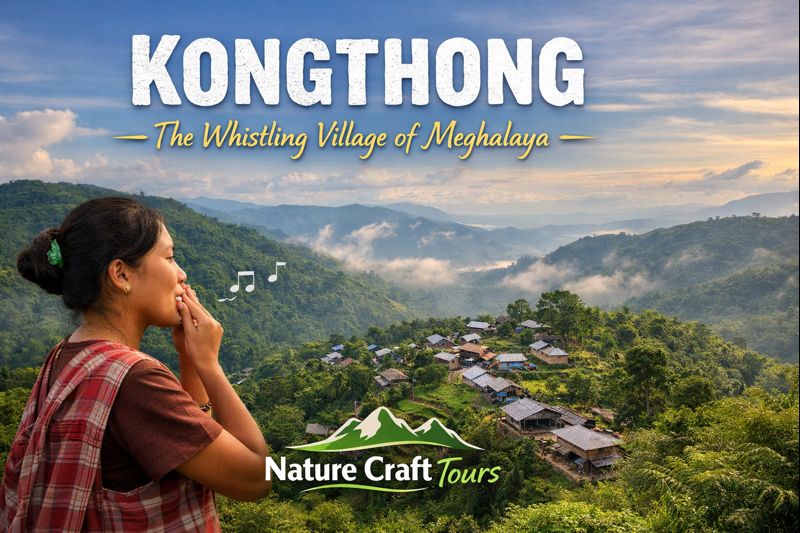
High in the rain-nourished hills of Meghalaya lies a village where human identity is not merely spoken, but sung, whistled, and carried on the wind. Kongthong, often described as “The Whistling Village,” is not a metaphorical title or a romantic exaggeration. It is a precise cultural truth rooted in one of the most extraordinary living traditions of South Asia. Here, names are not written first on paper or called aloud in ordinary speech. They are composed as melodies—distinct, personal, and unforgettable.
This is not a destination for hurried sightseeing or checklist tourism. Kongthong is a cultural special-interest destination, best approached with patience, intellectual curiosity, and respect for intangible heritage. The village does not reveal itself instantly; it unfolds gradually through sound, silence, memory, and lived tradition. For the traveler willing to listen rather than merely look, Kongthong offers a rare immersion into a community where music and identity are inseparable.
Understanding Kongthong: Geography, Setting, and First Impressions
Kongthong is located in the East Khasi Hills district of Meghalaya, approximately 60 kilometers from Shillong, the state capital. The village rests on a forested ridge overlooking deep valleys carved by seasonal streams. Surrounding landscapes are defined by subtropical broadleaf forests, mist-laden slopes, and shifting light that transforms the terrain throughout the day.
Unlike many villages shaped by road-side commerce or visual spectacle, Kongthong retains a quiet, inward-facing character. Houses are modest and functional, paths are narrow, and the natural environment remains largely unaltered by large-scale infrastructure. What distinguishes Kongthong is not architectural novelty, but its cultural soundscape—the subtle presence of whistled melodies echoing across hillsides.
For the field researcher or culturally inclined traveler, the first hours in Kongthong are marked by observation rather than interaction. One becomes aware that names are not shouted, that calls across distance take musical form, and that sound travels differently here—both physically and socially.
The Jingrwai Iawbei: Whistled Names as Cultural Identity
At the heart of Kongthong’s cultural uniqueness lies the tradition known as Jingrwai Iawbei, often translated as “songs sung in honor of the root ancestress.” Every child born in Kongthong receives a unique melodic name composed by the mother or grandmother. This name is not symbolic; it is functional and personal, used throughout the individual’s life.
These whistled names serve multiple purposes. Practically, they allow communication across steep terrain and dense forest, where spoken words would lose clarity. Culturally, they reinforce lineage, maternal heritage, and community cohesion within the matrilineal Khasi society.
Each melody is distinct, often containing subtle variations in pitch and rhythm that reflect family identity and emotional intent. No two jingrwai are identical, and to forget or misuse someone’s whistled name is considered a social misstep. The tradition requires memory, attentiveness, and respect—values deeply embedded in village life.
Matrilineal Society and the Role of Women in Kongthong
Kongthong is part of the broader Khasi cultural world, which follows a matrilineal system of inheritance. Property, clan affiliation, and lineage pass through the mother’s line, and women hold significant social authority within households and community structures.
This social framework is essential to understanding the jingrwai tradition. The melodic naming of children is closely associated with maternal creativity and emotional expression. It is the mother who composes the name, and it is often the grandmother who preserves and transmits the melody across generations.
For visitors, this cultural context challenges many conventional assumptions about gender roles in rural societies. Leadership, decision-making, and cultural preservation are deeply interwoven with women’s voices—both literal and symbolic.
Historical Context and Cultural Continuity
The origins of the whistling tradition are not recorded in written chronicles. Like much of Khasi history, it survives through oral transmission, collective memory, and lived practice. Elders suggest that jingrwai developed as a practical adaptation to geography long before modern communication tools existed.
What makes Kongthong exceptional is not merely the survival of this tradition, but its continued relevance. Even as mobile phones and road connectivity have reached the region, villagers continue to use whistled names in daily life. This persistence reflects a conscious cultural choice rather than isolation from modernity.
In recent decades, academic researchers, linguists, and ethnomusicologists have begun documenting Kongthong’s practices, recognizing their significance as intangible cultural heritage. However, the tradition remains community-owned, not performed for spectacle.
Planning a Journey to Kongthong
Best Time to Visit
The most suitable period to visit Kongthong is between October and April. Post-monsoon months offer clear views, manageable trails, and comfortable temperatures. Winter mornings can be cool, with mist enhancing the village’s acoustic atmosphere.
The monsoon season, from June to September, brings heavy rainfall that can make access difficult. While the landscape is lush during this time, travel disruptions are common, and cultural interaction may be limited by weather conditions.
Ideal Duration of Stay
A meaningful visit to Kongthong requires time. A minimum of two nights is recommended to move beyond surface observation. Longer stays allow travelers to understand daily rhythms, participate in conversations, and experience the subtleties of sound-based communication.
This is not a destination suited for day trips. The value of Kongthong lies in immersion rather than movement.
Route and Accessibility
Kongthong is accessed via Shillong, which is connected by road to Guwahati. From Shillong, the journey involves a combination of paved roads and narrower rural tracks. The final approach may require short walks, depending on weather and road conditions.
Travelers should plan logistics carefully and allow buffer time. The village’s remoteness is integral to its character and should be approached as part of the experience rather than an inconvenience.
Daily Life and Village Rhythm
Life in Kongthong follows a pace dictated by agriculture, weather, and social interaction. Mornings are quiet, with soft sounds of activity rather than loud conversation. Afternoons may involve community work, household tasks, or rest. Evenings often bring subtle musical exchanges as families call to one another across distances.
Visitors attentive to these rhythms will notice that sound is used sparingly and meaningfully. Silence is not absence here; it is a shared understanding.
Ecological Setting and Environmental Awareness
Kongthong’s cultural practices are inseparable from its ecological context. The surrounding forests influence not only livelihood but also communication styles. Whistled names are shaped by terrain acoustics, wind direction, and natural echoes.
Traditional agricultural practices coexist with forest conservation, reflecting an understanding of balance rather than extraction. Travelers with interest in sustainable rural systems will find Kongthong a valuable case study in human-environment interaction.
Cultural Sensitivity and Visitor Responsibility
Kongthong is not a performance space. Visitors are guests in a living community. Photography, recording, and note-taking should always be preceded by consent. Whistled names are personal identifiers, not tourist attractions.
Meaningful engagement involves listening more than speaking, observing more than documenting, and respecting boundaries that may not be explicitly stated.
Kongthong in a Broader Travel Context
Travelers exploring India’s cultural diversity often pair journeys to lesser-known destinations with experiences in contrasting landscapes. For example, those drawn to riverine cultures and human–nature relationships may also find resonance in destinations like the Sundarban Tour, where sound, silence, and ecological rhythms shape daily life in a different yet equally profound manner.
Similarly, understanding Kongthong’s intangible heritage enriches one’s appreciation of cultural continuity across India’s varied regions, whether in hills, forests, or deltas.
Practical Insights for Thoughtful Travelers
Travelers should prepare for limited amenities and prioritize flexibility. Basic facilities are available, but comfort should not be the primary expectation. What Kongthong offers is intellectual and cultural enrichment rather than conventional leisure.
Local guides or community facilitators can provide context, but independent observation remains essential. Reading, listening, and engaging respectfully will yield deeper understanding than structured itineraries.
Listening as a Form of Travel
Kongthong challenges modern travel habits that prioritize visual consumption over sensory engagement. It invites visitors to slow down, to listen carefully, and to reconsider how identity, place, and communication intersect.
In a world increasingly dominated by standardized names, digital alerts, and constant noise, the whistling village offers a quiet yet powerful reminder: culture is not always seen; sometimes, it is heard. For those willing to approach travel as an act of listening, Kongthong stands as one of India’s most intellectually rewarding destinations.
Such journeys, when approached thoughtfully, often inspire travelers to seek other culturally immersive experiences across the country, including carefully planned explorations like a Sundarban Tour Package, where landscape and tradition continue to shape human life in profound ways.