Lachung, North Sikkim
— A High-Altitude Valley Where Landscape, Culture, and Silence Coexist
Entering the Inner Himalaya
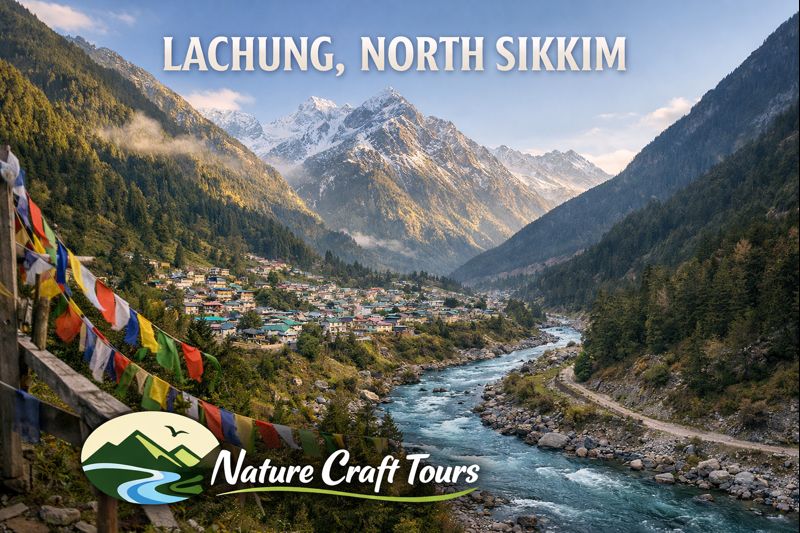
Far beyond the last commercial bustle of Sikkim’s capital, where roads narrow and mountains rise into layered walls of stone, lies Lachung—an isolated Himalayan settlement positioned at the confluence of high-altitude geography and living tradition. Lachung is not a destination that announces itself loudly. It reveals itself slowly, through shifting weather, winding rivers, prayer-flag-lined bridges, and a sense of distance that grows deeper with every kilometre travelled northward.
Located in North Sikkim at an elevation of approximately 8,600 feet, Lachung functions as both a geographical threshold and a cultural anchor. It is the gateway to the upper valleys of Yumthang, Yumesamdong, and Zero Point, and simultaneously a village that has preserved a rhythm of life shaped by climate, belief systems, and isolation. To approach Lachung is to leave behind the conveniences of urban travel and enter a terrain governed by weather, altitude, and mountain logic.
Geographical Setting and Environmental Context
Lachung is situated along the Lachung Chu river, a tributary of the Teesta, in a valley carved by glacial processes over millennia. The surrounding landscape is defined by steep mountain walls, alpine forests, and seasonal snow cover that reshapes accessibility throughout the year. Unlike lower Himalayan towns, Lachung experiences pronounced climatic variation, with winters marked by heavy snowfall and summers characterised by cool temperatures and rapid cloud movement.
The ecological zone transitions sharply as one ascends toward Lachung. Subtropical vegetation near lower altitudes gives way to temperate conifer forests dominated by fir, pine, and rhododendron species. Beyond the village, the terrain opens into high-altitude meadows and cold desert zones, where vegetation becomes sparse and geological features dominate visual perception.
Historical and Cultural Foundations of Lachung
Village Governance and Traditional Codes
Lachung holds a unique position in Sikkimese social history due to its traditional self-governance system. The village historically followed a codified set of customary laws known locally as the Lachungpa system, which regulated land use, community responsibilities, and social conduct. These rules, deeply influenced by Tibetan Buddhist ethics, emphasised collective welfare over individual ownership.
Even today, remnants of this governance philosophy are visible in how communal spaces are maintained and how seasonal activities are coordinated. The emphasis on harmony with nature is not a symbolic concept here but a practical necessity shaped by harsh environmental conditions.
Buddhism and Spiritual Landscape
Religion forms an integral part of daily life in Lachung. The village is home to several small monasteries and chortens that serve both spiritual and social functions. Prayer flags stretch across bridges and rooftops, carrying mantras into the wind, while morning and evening prayers mark the passage of time more distinctly than clocks.
Festivals, though modest in scale, follow the Tibetan Buddhist calendar and are deeply rooted in agricultural and seasonal cycles. These events provide insight into how belief systems adapt to extreme geography, reinforcing resilience and collective identity.
Route and Accessibility: Reaching Lachung
Access to Lachung begins from Gangtok, the capital of Sikkim. The journey covers approximately 120 kilometres and typically requires a full day of travel due to terrain, weather, and mandatory administrative procedures. The route follows the Teesta river valley initially before ascending sharply toward higher altitudes.
Travelers pass through key transit points such as Chungthang, a strategic settlement located at the confluence of the Lachen Chu and Lachung Chu rivers. Beyond Chungthang, the road narrows significantly, and landslide zones are common during monsoon months.
Permits are mandatory for all visitors, as Lachung lies within a protected and restricted region. These permits are issued through registered local authorities and require advance planning. The controlled access has played a significant role in limiting unregulated tourism and preserving environmental stability.
Ideal Travel Duration and Itinerary Structure
A realistic exploration of Lachung and its surrounding valleys requires a minimum of two nights and three days from Gangtok. This duration allows for acclimatisation, seasonal weather adjustments, and unhurried observation of the region’s landscapes.
A typical itinerary allocates the first day to transit and altitude adaptation, the second day to exploring Yumthang Valley and nearby high-altitude zones, and the third day for return travel. Rushing this sequence often results in altitude discomfort and reduced experiential depth.
Best Time and Seasonal Characteristics
Spring (March to May)
Spring marks the gradual reopening of Lachung after winter isolation. Snow begins to melt, and alpine flowers—particularly rhododendrons—bloom across slopes and valleys. Temperatures remain cool, and visibility improves significantly, making this one of the most favourable periods for travel.
Summer and Monsoon (June to September)
During summer, rainfall intensifies, especially along lower sections of the route. While the landscape appears lush and dramatic, landslides and road closures are common. Travel during this season demands flexibility and an understanding of weather-related disruptions.
Autumn (October to November)
Autumn offers stable weather, clear skies, and crisp air. Snowfall usually begins toward late November, particularly at higher elevations. This season provides some of the clearest views of surrounding peaks and valleys.
Winter (December to February)
Winter transforms Lachung into a snow-bound settlement. Heavy snowfall often restricts access entirely. While visually striking, winter travel is limited to specific periods when roads are cleared, and temperatures can drop well below freezing.
Key Attractions and Natural Highlights
Yumthang Valley
Often referred to as a seasonal grazing ground, Yumthang Valley lies approximately 25 kilometres from Lachung. The valley’s wide basin, framed by snow-covered ridges, changes character dramatically with seasons. In spring, it becomes a natural botanical corridor, while in winter it remains buried under thick snow layers.
Yumesamdong and Zero Point
Beyond Yumthang, the terrain rises toward Yumesamdong, commonly known as Zero Point. This area represents the last accessible civilian zone before the Tibetan plateau. Oxygen levels decrease sharply, and vegetation disappears almost entirely, leaving a stark, elemental landscape.
Lachung Village Walks
Exploring Lachung on foot reveals details often overlooked during transit-focused visits. Traditional wooden houses, prayer wheels along pathways, and riverbanks used for daily chores provide insight into village life shaped by altitude and seasonality.
Ecological Sensitivity and Conservation Context
Lachung lies within an ecologically fragile zone where recovery from environmental disturbance is slow. Alpine ecosystems are particularly vulnerable to waste accumulation, unregulated foot traffic, and vehicle emissions. The region’s restricted access policies are designed not to exclude visitors but to regulate impact.
Responsible travel practices—such as waste minimisation and adherence to designated routes—are not optional considerations here but essential behaviours aligned with the region’s long-term sustainability.
Practical Travel Insights
Altitude acclimatisation is critical when travelling to Lachung. Sudden ascent can lead to symptoms ranging from mild headaches to severe altitude sickness. Hydration, limited physical exertion, and gradual movement are essential preventive measures.
Electricity supply may be inconsistent, and mobile connectivity is limited. Travelers should prepare for communication gaps and avoid dependency on digital navigation tools.
Clothing requirements vary sharply across seasons. Even during summer, temperatures drop significantly after sunset, and layered clothing is advisable year-round.
Contextual Travel Reflection
For travelers who regularly explore India’s diverse ecological regions—from deltaic mangrove systems to Himalayan plateaus—the contrast between environments highlights the country’s geographical depth. A journey through Lachung’s alpine silence offers a perspective distinctly different from lowland ecosystems such as the eastern delta, where waterways and wildlife define movement patterns, as experienced during a Sundarban Tour.
Similarly, understanding varied regional travel structures—from high-altitude permit-based itineraries to river-based explorations like a Sundarban Tour Package—reveals how geography shapes tourism logistics across India.
Lachung as a Measured Encounter
Lachung does not cater to hurried travel ambitions or checklist tourism. It demands patience, preparedness, and respect for both environment and community. In return, it offers a rare clarity—of landscape, of silence, and of the subtle relationship between humans and high-altitude terrain.
For those willing to engage with its rhythms rather than impose their own, Lachung remains one of North Sikkim’s most instructive destinations—a place where geography educates, culture endures, and the Himalaya reveals itself without spectacle, yet with profound presence.