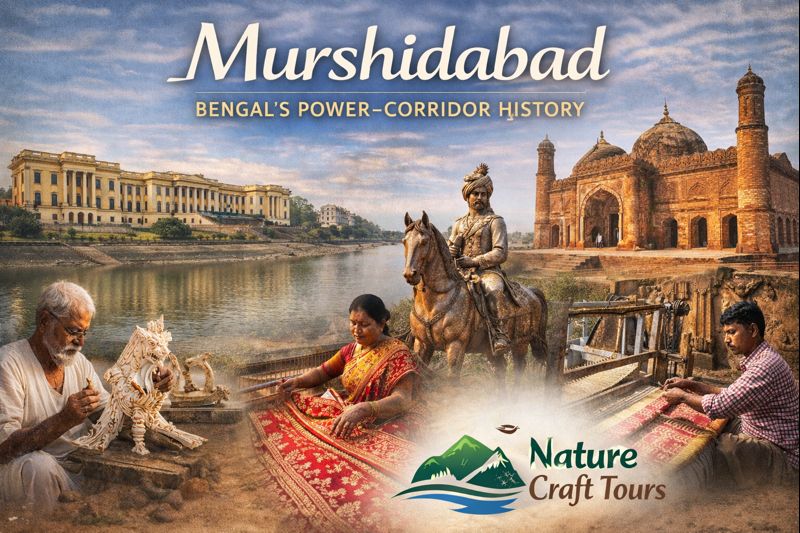
There are places where history survives not as distant memory but as a living atmosphere, layered into streets, riverbanks, palaces, and silent ruins. Murshidabad is one such destination. Situated along the eastern bank of the Bhagirathi River in West Bengal, Murshidabad once stood at the very heart of Bengal’s political and economic power. To explore Murshidabad is to walk through corridors where imperial ambition, administrative brilliance, betrayal, and transformation shaped the destiny of an entire subcontinent.
As an explorer, Murshidabad reveals itself slowly. It does not overwhelm with grandeur alone; instead, it invites the traveler to piece together narratives of Nawabs, merchants, soldiers, and courtiers. This is a land where decisions taken in palace halls altered the course of Indian history, eventually paving the way for colonial dominance. Murshidabad remains one of Bengal’s most historically charged landscapes, offering depth far beyond conventional sightseeing.
Geographical Setting and Strategic Importance
Murshidabad’s rise was deeply tied to geography. Located along the Bhagirathi, a distributary of the Ganges, the region enjoyed excellent riverine connectivity. This allowed efficient movement of goods, troops, and administrative communication. The fertile plains surrounding the river supported extensive agriculture, while trade routes connected Murshidabad to northern India, the Deccan, and overseas markets.
This strategic positioning transformed Murshidabad into Bengal’s administrative and commercial nerve center during the Mughal and Nawabi periods. European trading companies, bankers, and local merchants gravitated toward the city, turning it into one of the richest urban centers of eighteenth-century India.
Climate and Best Time to Visit
Murshidabad experiences a tropical climate with hot summers, monsoon rains, and mild winters. Summers, from April to June, can be extremely warm, often exceeding comfortable travel conditions for prolonged outdoor exploration. The monsoon season, between July and September, brings lush greenery but also humidity and occasional flooding in low-lying areas.
The most favorable time to visit Murshidabad is between October and February. Winter offers pleasant temperatures, clear skies, and ideal conditions for exploring monuments, riverbanks, and historical sites without fatigue.
From Mughal Province to Nawabi Capital
Murshidabad emerged as Bengal’s capital in the early eighteenth century when the provincial administration was shifted from Dhaka. This move marked the beginning of Murshidabad’s golden era. The city soon became synonymous with power, wealth, and refined court culture. Nawabs governed vast territories from here, overseeing taxation, justice, military affairs, and international trade.
Under Nawabi rule, Murshidabad evolved into a cosmopolitan center. Persian administrative traditions blended with Bengali cultural elements, creating a distinct political and social identity. Court rituals, architectural patronage, and urban planning reflected the ambitions of rulers determined to assert autonomy while nominally acknowledging imperial authority.
Economic Power and Global Trade Links
Murshidabad was not merely an administrative capital; it was an economic powerhouse. The region’s textile industry, particularly silk and muslin, attracted traders from across Asia and Europe. Banking houses and financiers played a crucial role in funding state activities, military campaigns, and international commerce.
This concentration of wealth inevitably drew the attention of European trading companies. Their growing involvement in Murshidabad’s economy gradually altered power dynamics, setting the stage for political confrontation and eventual colonial dominance.
Architectural Legacy of Authority
Murshidabad’s architecture mirrors its political history. Grand palaces, mosques, cemeteries, and administrative buildings reflect shifts in power, taste, and ideology. Unlike fortified capitals, Murshidabad emphasized ceremonial authority and administrative control rather than defensive architecture.
Hazarduari and the Language of Power
Among Murshidabad’s most iconic structures stands a vast palace known for its monumental scale and European-influenced design. With countless doorways, expansive halls, and ceremonial courtyards, the building symbolized authority, openness, and governance. It served as a space where political negotiations, judicial proceedings, and courtly rituals unfolded.
The architectural vocabulary here reflects a transitional era — blending Indo-Islamic traditions with emerging colonial aesthetics. This fusion captures the uncertainty and complexity of a period when indigenous power structures faced unprecedented external pressures.
Sacred Spaces and Royal Patronage
Murshidabad’s religious architecture demonstrates the Nawabs’ patronage of faith and learning. Mosques, tombs, and shrines were constructed not only as places of worship but also as statements of legitimacy and continuity. These structures often occupy elevated positions along the river, reinforcing the symbolic link between spiritual authority and political power.
Plassey and the Turning Point of History
No exploration of Murshidabad is complete without acknowledging its role in one of the most consequential events in Indian history. The Battle of Plassey marked a decisive shift in power, fundamentally altering Bengal’s political landscape. Decisions taken in court chambers, alliances forged through diplomacy, and betrayals executed in secrecy culminated in a transformation whose consequences extended far beyond Bengal.
Murshidabad, once the seat of autonomous authority, gradually lost its political significance. Administrative power shifted elsewhere, and the city entered a phase of slow decline. Yet, its historical importance remained intact, preserved in monuments and memory.
Cultural Life and Social Fabric
Despite political decline, Murshidabad retained its cultural richness. Music, poetry, crafts, and culinary traditions continued to flourish. The city became a repository of refined tastes shaped by court culture, Persian influences, and local Bengali traditions.
Ivory carving, silk weaving, and metalwork emerged as distinctive crafts, sustained by hereditary artisan communities. These crafts offer insights into how cultural production adapts even when political power fades.
Complete Tour Plan: Exploring Murshidabad in Depth
A comprehensive Murshidabad tour ideally spans three days, allowing travelers to absorb its layered history without rushing.
Day One: Arrival and Riverfront Heritage
Arrive in Murshidabad by morning and settle into your accommodation. Begin exploration along the Bhagirathi riverfront, observing how geography shaped the city’s development. Visit major palace complexes and administrative buildings to understand the scale of Nawabi governance. Evening walks along the river offer reflective moments amid historical surroundings.
Day Two: Political History and Cultural Institutions
The second day focuses on political narratives. Explore sites associated with court administration, judicial authority, and military organization. Museums and preserved halls provide context through artifacts, manuscripts, and archival material. In the afternoon, visit craft neighborhoods to observe traditional silk weaving and ivory carving techniques.
Day Three: Sacred Architecture and Surrounding Landscapes
Dedicate the final day to religious and funerary architecture. These sites reveal how rulers envisioned legacy and remembrance. After lunch, explore nearby countryside areas to understand the agrarian base that supported Murshidabad’s prosperity. Depart by evening with a nuanced understanding of Bengal’s power history.
Connectivity and Travel Access
Murshidabad is accessible by rail and road from Kolkata. Rail connectivity remains the most convenient option for most travelers, while road journeys provide scenic views of rural Bengal. The town’s compact layout makes local travel manageable.
Many travelers interested in Bengal’s historical arc choose to complement heritage exploration with ecological journeys elsewhere in the state. Combining Murshidabad’s political history with a nature-focused experience such as a Sundarban Tour creates a well-balanced understanding of how power and environment shaped Bengal’s identity.
Murshidabad in a Broader Bengal Itinerary
Murshidabad occupies a crucial position in Bengal’s historical narrative. It represents the transition from indigenous sovereignty to colonial control, offering lessons in governance, diplomacy, and economic dependency. Unlike purely archaeological sites, Murshidabad remains a living town where history coexists with daily life.
Travelers seeking comprehensive insight into Bengal often extend their journeys beyond political centers to natural landscapes. Pairing Murshidabad with a carefully planned Sundarban Tour Package allows exploration of both historical power corridors and ecological frontiers within a single travel framework.
Why Murshidabad Matters for the Thoughtful Explorer
Murshidabad is not a destination of superficial appeal. Its value lies in understanding — understanding how wealth concentrates, how power shifts, and how cultures endure through change. The city’s palaces and ruins do not merely commemorate past glory; they challenge visitors to reflect on the forces that shape societies.
For explorers interested in history as lived experience rather than static display, Murshidabad offers profound rewards. It stands as a testament to Bengal’s once-central role in global affairs and remains essential for anyone seeking to comprehend the deeper currents of Indian history.