Natural Bridge (Howrah Bridge):
A Tide-Timed Geological Photo Stop on Shaheed Dweep
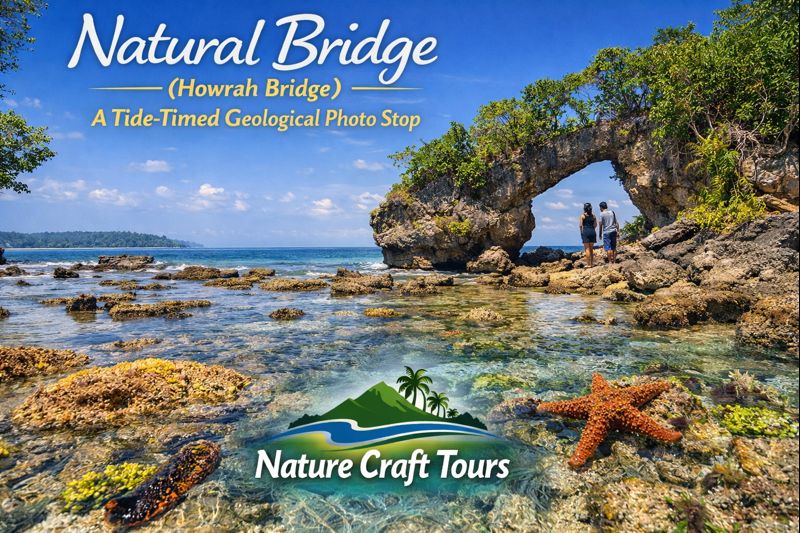
Natural Bridge (Howrah Bridge), Shaheed Dweep: Where Tides, Time, and Stone Converge
On the quiet western edge of Shaheed Dweep lies one of the Andaman Islands’ most intellectually engaging natural landmarks—Natural Bridge, locally known as Howrah Bridge. Unlike man-made bridges that symbolize engineering triumphs, this structure represents something far older and far more patient: the slow, persistent artistry of geology shaped by tides, salt, wind, and time. It is not a destination defined by scale or grandeur, but by precision. The Natural Bridge exists only fully during a narrow window of low tide, making it a tide-timed geological phenomenon rather than a casual sightseeing spot.
For explorers who seek understanding rather than spectacle, this location offers an exceptional opportunity to observe coastal geomorphology, intertidal ecology, and the relationship between land and sea in a fragile island environment. This in-depth guide presents the Natural Bridge not merely as a photo stop, but as a carefully timed natural experience that rewards preparation, awareness, and respect for natural cycles.
Geographical Location and Geological Context
The Natural Bridge is located near Laxmanpur Beach on Shaheed Dweep (formerly Neil Island), facing the open waters of the Andaman Sea. The structure is composed primarily of limestone and calcareous sandstone—sedimentary rocks formed over thousands of years through the accumulation of marine organisms and mineral deposits.
Unlike volcanic rock formations found elsewhere in the Andaman chain, this bridge owes its existence to erosion rather than eruption. Repeated tidal action, chemical weathering from saltwater, and mechanical abrasion from waves gradually hollowed out weaker sections of rock, leaving behind a resilient arch. This process continues even today, making the bridge a dynamic, evolving structure rather than a static monument.
Why It Is Called a “Tide-Timed” Landmark
The Natural Bridge is accessible only during low tide. At high tide, the surrounding rocks are submerged, and wave action makes approach unsafe. During low tide, the sea retreats to reveal an exposed rocky platform, allowing visitors to walk carefully toward the arch. This dependency on tidal timing makes the experience highly sensitive to daily tide charts and seasonal sea conditions.
Best Time to Visit: Tides, Seasons, and Daily Timing
Visiting the Natural Bridge requires more planning than most island attractions. Success depends on understanding both seasonal conditions and daily tidal cycles.
Seasonal Window: October to May
The months between October and May offer the safest and clearest conditions. During this period, sea visibility is high, wave intensity is moderate, and tidal predictions are more reliable. These months are ideal for geological observation and photography.
Daily Timing: Low Tide Is Essential
The bridge is typically accessible for a limited window of approximately one to two hours during low tide. Local guides monitor tide charts closely and plan visits accordingly. Arriving too early or too late may result in partial visibility or complete inaccessibility.
This precise timing requirement mirrors the careful scheduling needed for environmentally sensitive journeys such as a Sundarban Tour, where tidal patterns dictate navigation and wildlife observation.
Reaching Natural Bridge: Step-by-Step Route
Step 1: Arrival at Shaheed Dweep
Travelers reach Shaheed Dweep via ferry from Port Blair. The island’s compact size ensures that most destinations are within short driving distances.
Step 2: Journey to Laxmanpur Area
The Natural Bridge is approached from Laxmanpur Beach. From the parking area, visitors walk across a sandy stretch before stepping onto exposed reef rocks during low tide.
Step 3: Guided Walk Across the Intertidal Zone
The final approach involves navigating uneven limestone surfaces. Footwear with strong grip is essential. A local guide is strongly recommended, not only for safety but also for interpreting the geological and ecological features encountered along the way.
Intertidal Ecology: More Than a Rock Formation
The journey to the Natural Bridge doubles as an exploration of the intertidal zone—one of the most biologically dynamic environments on Earth. As the tide recedes, shallow pools form among the rocks, creating microhabitats for marine organisms.
These tide pools often contain sea anemones, small fish, crabs, sea cucumbers, and occasionally starfish. The presence of such organisms indicates high water quality and minimal industrial disturbance.
A Living Classroom of Marine Adaptation
Intertidal species survive extreme conditions, including temperature fluctuations, salinity changes, and exposure to air. Observing these adaptations provides insight into evolutionary resilience, similar to the survival strategies seen in mangrove ecosystems explored during a Sundarban Tour Package.
Photography at Natural Bridge: Light, Angles, and Timing
The Natural Bridge is renowned as a photographic subject, but capturing its essence requires more than a camera.
Best Light Conditions
Late morning to early afternoon during low tide offers optimal lighting. Sunlight penetrates the arch, casting textured shadows that highlight the rock’s layered structure.
Composition and Perspective
Wide-angle lenses capture the full arch and surrounding reef platform, while close-up shots reveal fossil fragments, erosion patterns, and marine life within tide pools.
Complete Tour Plan: A Focused Geological Exploration
Day 1: Arrival and Coastal Orientation
Arrive at Shaheed Dweep and spend the day acclimatizing. Visit nearby beaches to understand tidal behavior and consult local guides regarding the next day’s low tide schedule.
Day 2: Natural Bridge Exploration
Begin early and reach Laxmanpur Beach well before low tide. Carefully cross the exposed reef with a guide, observe intertidal pools, and spend adequate time studying the bridge structure.
Return before the tide rises, ensuring safety and minimal ecological disturbance.
Day 3: Comparative Coastal Study
Visit other beaches on Shaheed Dweep to compare sediment types, wave exposure, and shoreline vegetation. This contextualizes the uniqueness of the Natural Bridge.
Special Attractions of Natural Bridge
Geological Rarity
Natural arches formed by marine erosion are rare in the Andaman Islands, making this bridge a significant geological feature.
Tide-Dependent Accessibility
The necessity of precise timing enhances the experience, transforming a simple visit into a carefully planned expedition.
Educational Value
The site offers direct insight into coastal processes, sedimentary rock behavior, and intertidal ecosystems.
Responsible Exploration and Safety Guidelines
Visitors must avoid touching marine life, stepping on corals, or removing natural materials. The rocks can be slippery, and sudden tidal changes are possible. Respect for local guidance ensures both personal safety and ecological preservation.
Who Should Visit Natural Bridge?
This destination is ideal for explorers, photographers, geology enthusiasts, educators, and travelers who value structured, knowledge-driven experiences over casual sightseeing.
When Time Reveals Stone
The Natural Bridge of Shaheed Dweep is not always visible. It appears only when the sea allows it, reminding visitors that nature operates on its own schedule. This dependency on tides transforms the visit into an exercise in patience, awareness, and humility.
In an era of instant access, the Natural Bridge stands as a reminder that some of the most meaningful encounters require timing, respect, and the willingness to wait. When the tide recedes and stone emerges, the island briefly reveals a chapter of Earth’s long geological story—one that rewards those who arrive prepared to listen.