Netaji Subhas Chandra Bose Dweep (Ross Island):
Heritage Ruins in a Tropical Setting
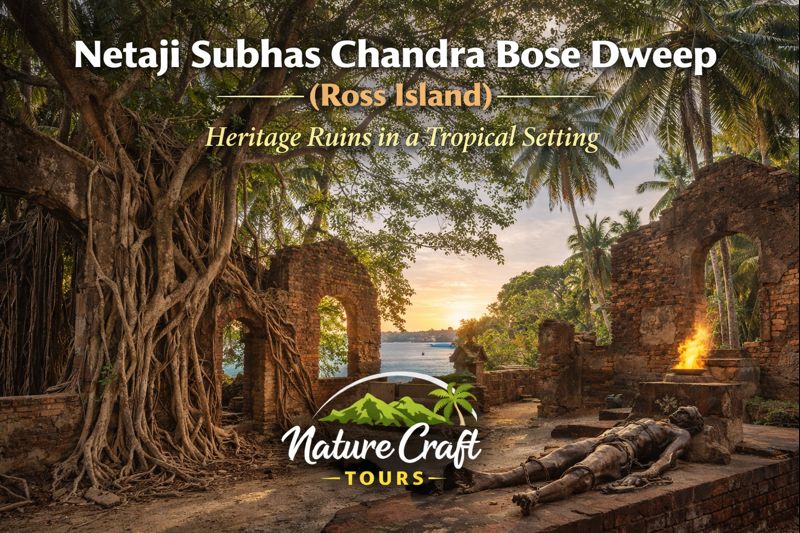
Netaji Subhas Chandra Bose Dweep, formerly known as Ross Island, is one of the most evocative heritage landscapes in the Andaman Islands. Situated just off the coast of Port Blair, this small island carries an extraordinary historical legacy wrapped in dense tropical vegetation and surrounded by tranquil blue waters. It is a place where colonial ambition, military power, political upheaval, and natural reclamation coexist in profound silence.
For the explorer, Netaji Subhas Chandra Bose Dweep is not merely an excursion site but a living narrative—where time has slowed, structures have decayed with dignity, and nature has gently reclaimed what history once imposed. This detailed, research-oriented guide presents the island as a destination of historical inquiry, ecological awareness, and contemplative travel, supported by a carefully structured tour plan.
Geographical Location and Environmental Setting
Netaji Subhas Chandra Bose Dweep lies approximately two kilometers east of Port Blair harbor. Though small in area, the island occupies a strategically prominent position within the natural harbor, offering unobstructed views of surrounding waters. Its low elevation, coral-based foundation, and tropical climate define both its ecological character and its historical vulnerabilities.
The island is enveloped by shallow reefs and calm seas, making it easily accessible by short boat rides. Dense tropical growth, including banyan roots, palms, and creepers, dominates the landscape today—transforming once-formal colonial spaces into an open-air ruin gallery.
Historical Background: From Colonial Capital to Forgotten Outpost
During the British colonial period, Ross Island served as the administrative headquarters of the Andaman Islands. It was developed as a self-contained settlement housing senior officials, military personnel, and essential services. Carefully planned infrastructure included administrative offices, residential quarters, churches, clubs, bakeries, water treatment systems, and power generation facilities.
The island represented colonial authority in its most refined form—orderly, insulated, and detached from indigenous realities. Its elevation above surrounding settlements symbolized both physical and administrative dominance.
However, this carefully constructed colonial world was fragile. Natural disasters, particularly earthquakes, gradually weakened structures. The most destructive seismic events rendered much of the island uninhabitable, leading to its abandonment as an administrative center.
Transition Through War and Political Change
The island’s significance did not end with colonial decline. During the Second World War, control of the Andaman Islands shifted dramatically. Netaji Subhas Chandra Bose Dweep became associated with a critical chapter in India’s freedom movement, marking a symbolic transfer of authority during wartime upheaval.
This period transformed the island’s identity from colonial stronghold to a site of political symbolism. Though structures continued to deteriorate, their historical meaning deepened, layered with narratives of resistance and geopolitical change.
Architectural Remains and Ruins
Administrative Buildings
The remnants of administrative offices reveal carefully planned layouts, thick masonry walls, and arched corridors. These structures once housed decision-makers who governed the islands from relative comfort, isolated from mainland India.
Today, vines creep through window frames, and tree roots penetrate walls—creating striking contrasts between human design and natural persistence.
Residential Quarters
The ruins of officers’ residences reflect colonial domestic life, complete with verandas, garden layouts, and drainage systems. These homes were built to replicate mainland comforts within a remote island environment.
Church and Community Spaces
Religious and social structures served as centers of community life. Their skeletal remains, softened by vegetation, evoke a quiet dignity that contrasts sharply with their once-formal functions.
Nature’s Reclamation: Ecology of the Island
One of the most compelling aspects of Netaji Subhas Chandra Bose Dweep is the manner in which nature has reclaimed built spaces. Tropical plants, banyan roots, mosses, and coastal shrubs dominate the ruins, turning the island into a living laboratory of ecological succession.
Flora and Vegetation
The island supports a mix of coastal and inland plant species. Large trees anchor shallow soils, while creepers weave through abandoned structures. This vegetation stabilizes the island’s surface while slowly dismantling masonry through biological processes.
Fauna and Birdlife
Birds, reptiles, and small mammals inhabit the island, benefiting from limited human disturbance. The ruins provide nesting spaces, shaded habitats, and vantage points for avian species.
Best Time to Visit Netaji Subhas Chandra Bose Dweep
Seasonal Overview
The most suitable time to visit the island is between October and April. During these months, weather conditions are stable, seas remain calm, and visibility is high—ideal for boat transfers and outdoor exploration.
The monsoon season, extending from May to September, brings heavy rainfall and rough seas. While the island appears dramatically lush during this period, access may be restricted due to safety considerations.
Time of Day
Morning visits offer cooler temperatures and softer light for photography. Afternoon visits provide warmer illumination, enhancing the textures of ruins and vegetation. Early evening departures allow visitors to return before changes in sea conditions.
Comprehensive Tour Plan
Day 1: Departure from Port Blair
The journey begins with a short boat ride from Port Blair harbor. The crossing itself offers panoramic views of the coastline, naval facilities, and surrounding islands—providing geographical context.
Arrival and Orientation Walk
Upon arrival, visitors are advised to begin with a slow orientation walk. Informational displays outline the island’s historical phases, allowing travelers to frame their exploration.
Heritage Exploration Circuit
A guided walking circuit covers major ruins, including administrative buildings, residential quarters, and community structures. Guides often explain architectural details, colonial planning concepts, and historical events associated with each site.
Ecological Observation and Reflection
After historical exploration, time is reserved for observing how vegetation interacts with ruins. This phase encourages reflection on impermanence, resilience, and the relationship between human ambition and natural systems.
Return to Port Blair
The return journey provides a moment to absorb the experience. Many travelers find the silence of the island lingers long after departure.
Special Attractions of the Island
Open-Air Heritage Ruins
Unlike enclosed museums, the island offers immersive, open-air exploration. Visitors walk through history rather than observe it from behind glass.
Natural Amphitheater of History
The integration of ruins, forest, and sea creates a natural amphitheater where history is experienced spatially rather than textually.
Strategic Viewpoints
Elevated points on the island provide sweeping views of Port Blair harbor, highlighting the island’s former strategic significance.
Educational and Interpretive Value
Netaji Subhas Chandra Bose Dweep serves as a multidisciplinary learning site. Historians examine colonial administration; architects study adaptive decay; ecologists observe natural reclamation; and political scholars analyze wartime symbolism.
For students and researchers, the island demonstrates how history, geography, and ecology intersect within a confined space.
Responsible Exploration and Conservation Ethics
As a protected heritage site, the island requires respectful conduct. Visitors are encouraged to remain on designated paths, avoid touching fragile structures, and refrain from removing natural or historical materials.
Minimal infrastructure ensures that the island remains preserved in its authentic state. Responsible travel practices help maintain this balance between access and conservation.
Why Netaji Subhas Chandra Bose Dweep Matters Today
In an age of rapid development and curated tourist experiences, this island stands apart. It resists commercialization, offering instead a quiet, introspective encounter with history.
The island reminds visitors that power, however absolute it may appear, is temporary. Nature, time, and collective memory ultimately reshape all human endeavors.
An Island Where History Breathes
Netaji Subhas Chandra Bose Dweep is not defined by grandeur or spectacle. Its strength lies in restraint, silence, and authenticity. The ruins do not demand attention—they invite contemplation.
For explorers seeking depth over distraction, the island offers a rare experience: a place where colonial history, national identity, and tropical ecology converge seamlessly. It is a journey into the past, guided by the quiet authority of nature reclaiming its own.