Odisha’s Lesser-Known Craft Clusters
— Beyond the Famous Villages
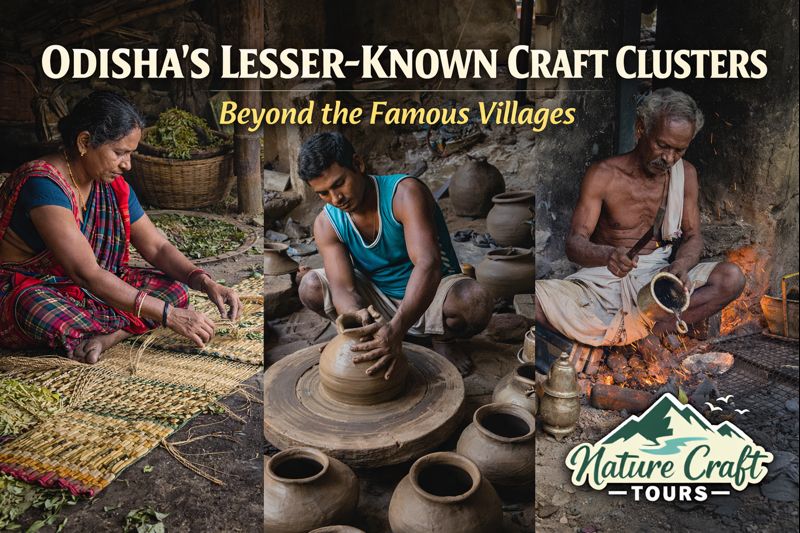
Odisha’s craft heritage is often represented through a small number of well-known villages and state-promoted centres. While these locations deserve recognition, they form only the visible surface of a much wider artisanal landscape. Beyond the celebrated names lie dozens of lesser-known craft clusters—scattered across forest fringes, river plains, coastal belts, and interior plateaus—where traditional skills continue quietly, sustained by family lineages, local ritual needs, and regional markets rather than tourism alone.
The hook “Beyond the Famous Villages” points toward a deeper exploration of Odisha’s material culture. These clusters are not destinations shaped for display. They are working landscapes where craft is embedded in daily life, agricultural cycles, and social identity. Travelling through them requires patience, cultural sensitivity, and an interest in process rather than product alone. For the traveller-researcher, these clusters offer rare insight into how craft traditions survive, adapt, and sometimes struggle in contemporary rural India.
Destination Overview: Mapping Odisha’s Hidden Craft Geography
Odisha’s lesser-known craft clusters are spread across diverse ecological and cultural zones. From the riverine plains of western Odisha to the tribal uplands of the south and the transitional coastal interiors, craft production responds directly to local resources—clay, wood, fibre, metal, stone, and natural dyes.
Unlike famous craft villages that have become centralised hubs, these clusters are often small, sometimes consisting of only a few extended families within a village. Their work is rarely showcased in state emporiums or export exhibitions, yet it remains integral to local ritual life, domestic use, and regional trade networks.
Understanding this geography requires moving away from single-site travel. Instead, it involves connecting multiple small locations, each contributing a specific skill or material tradition to Odisha’s broader craft ecosystem.
Why These Craft Clusters Remain Lesser-Known
Several factors contribute to the relative invisibility of these clusters. Geographic remoteness plays a role, particularly in forested and upland regions with limited road access. Equally important is the nature of production itself: many crafts are utilitarian or ritual-specific, produced for local consumption rather than decorative markets.
In some cases, artisans deliberately avoid exposure, preferring stable local demand over volatile external markets. In others, the absence of intermediaries, documentation, or digital presence limits wider recognition. These dynamics make the clusters ideal for slow, research-oriented travel rather than quick visits.
Key Lesser-Known Craft Traditions and Their Regions
While each cluster has unique characteristics, certain traditions recur across Odisha’s interior. The following examples illustrate the diversity and depth of these lesser-known practices.
Ritual Clay and Terracotta Work of Interior Villages
Beyond well-documented terracotta centres, numerous interior villages produce ritual clay objects used exclusively in local festivals, ancestor worship, and seasonal rites. These include votive figures, symbolic animals, and household deities. Production follows ritual calendars rather than commercial schedules, making timing crucial for visitors.
Woodcraft in Forest-Edge Settlements
In forest-adjacent regions of central and western Odisha, small clusters of artisans carve agricultural tools, ritual masks, and household objects from locally sourced wood. Unlike decorative carving traditions, these objects prioritise durability and symbolic function. Designs are often inherited orally, with minimal written patterns.
Natural Fibre Craft in Riverine and Coastal Interiors
Fibre crafts using reeds, grasses, and plant fibres flourish in lesser-known clusters away from major towns. Baskets, mats, fishing implements, and storage containers are produced primarily for local use. These crafts demonstrate sophisticated knowledge of plant ecology and seasonal harvesting.
Metal and Bell-Metal Micro-Clusters
Small-scale metalwork persists in pockets of Odisha where ritual objects, musical instruments, and agricultural tools are still locally manufactured. These clusters often rely on recycled metal and traditional casting methods. Their output rarely reaches urban markets but remains central to village economies.
Cultural and Historical Significance
These lesser-known craft clusters represent continuity rather than revival. Many predate colonial trade disruptions and modern market systems, having evolved alongside regional kingdoms, temple networks, and tribal polities. Craft knowledge was historically transmitted through caste, clan, or guild systems, linking artisans to specific ritual and social roles.
Colonial-era economic restructuring and post-independence industrialisation altered demand patterns, but many clusters adapted by narrowing their focus rather than abandoning practice. As a result, the crafts that survive today are often highly specialised and context-specific.
Ecology and Craft: Material Knowledge of the Landscape
The relationship between ecology and craft is particularly visible in these clusters. Clay quality varies with river systems; fibre strength depends on soil and rainfall; wood selection reflects forest composition. Artisans possess detailed environmental knowledge, understanding when materials can be harvested without damaging regeneration cycles.
This ecological literacy is rarely documented formally, yet it underpins sustainable production. For travellers, observing material sourcing and preparation offers insight into environmentally embedded craftsmanship.
Craft Travel as an Experiential Journey
Exploring Odisha’s lesser-known craft clusters is not a linear itinerary. It involves short walks through villages, conversations at workspaces, and extended observation of processes that unfold slowly. Unlike exhibition-based craft tourism, these visits prioritise context over consumption.
Such travel aligns with broader experiential journeys across eastern India. Just as a Sundarban Tour introduces travellers to everyday life shaped by tides and mangroves rather than spectacle, Odisha’s hidden craft clusters reveal creativity embedded in routine and necessity.
Best Time and Season to Explore Craft Clusters
The most suitable period for visiting these clusters is between October and February. Post-monsoon months allow safe travel to interior villages and coincide with key agricultural and ritual cycles that influence craft production.
Summer months may limit activity due to heat and reduced material availability, while monsoon travel can be restricted by road conditions. Seasonal awareness is essential, as some crafts are produced only during specific times of the year.
Ideal Travel Duration
A meaningful exploration requires a minimum of five to seven days, depending on the number of clusters visited. Each location demands time for orientation, relationship-building, and observation. Rushed visits risk misinterpreting practices or missing critical stages of production.
Researchers or culturally inclined travellers may extend their journey over ten days or more, combining multiple regions into a thematic exploration of material culture.
Route Planning and Accessibility
Most lesser-known craft clusters are accessed via secondary roads branching from district towns. Rail connectivity provides access to regional hubs, but final approaches often require local transport and walking.
Flexibility in routing is essential. Village schedules, weather, and local events may alter access. Engaging local guides or community contacts enhances both navigation and understanding.
Practical Insights for Responsible Craft Travel
Visitors should approach these clusters with humility and respect. Workshops are often private household spaces rather than public studios. Permission should always be sought before photography or detailed documentation.
Purchasing items directly from artisans supports local economies, but visitors should avoid bargaining that undervalues labour. Understanding the time and material investment behind each object fosters ethical exchange.
Travellers accustomed to structured cultural itineraries such as a Sundarban Tour Package may find craft cluster travel more open-ended. Here, learning unfolds through interaction rather than curated narratives.
Contemporary Challenges and Adaptation
Lesser-known craft clusters face multiple challenges, including declining local demand, youth migration, and competition from industrial substitutes. Yet adaptation is ongoing. Some artisans diversify products subtly, while others integrate new tools without altering core techniques.
Importantly, survival often depends less on external promotion and more on maintaining relevance within local cultural systems. Recognising this distinction is crucial for travellers and researchers alike.
Reading Odisha’s Craft Heritage Beyond the Obvious
Odisha’s lesser-known craft clusters remind us that cultural heritage does not always announce itself through fame or visibility. Much of the state’s creative knowledge persists quietly, embedded in landscapes, rituals, and everyday labour.
For travellers willing to move beyond familiar names and promotional circuits, these clusters offer profound insight into how tradition survives through adaptation rather than display. To explore them is to engage with Odisha’s craft heritage at its most intimate and resilient level—where making remains a way of life, not a performance.