Pelling (West Sikkim)
— Himalayan Balcony of History, Monasteries, and Kanchenjunga Horizons
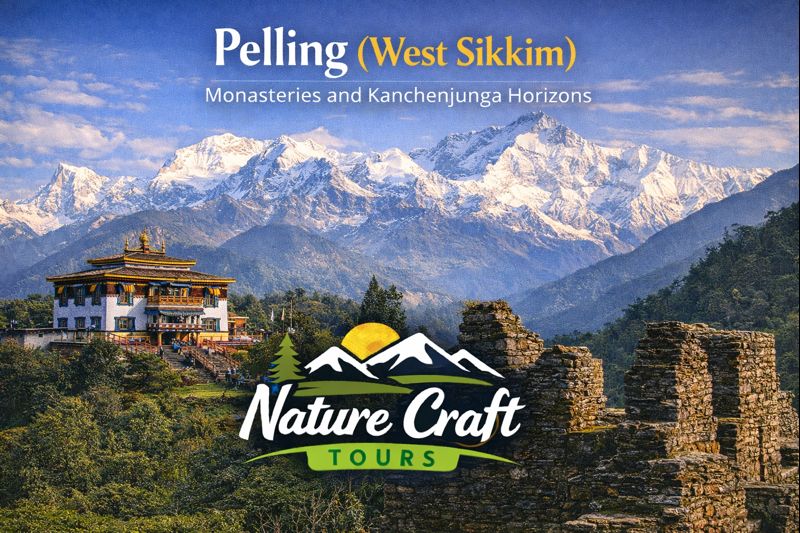
Where the Mountains Speak in Layers
Pelling, perched on a forested ridge of West Sikkim, is not merely a viewpoint town; it is a geographical and cultural threshold where history, spirituality, and the Himalayan landscape converge with unusual clarity. At an altitude of roughly 2,150 metres, Pelling commands some of the closest and most uninterrupted views of Mount Kanchenjunga and its surrounding peaks, placing it among the most visually significant destinations in the eastern Himalaya.
Yet to reduce Pelling to a scenic lookout would be to overlook its deeper narrative. This region is the historical heartland of the former Kingdom of Sikkim, where early monasteries, royal legacies, sacred lakes, and ancient pathways coexist within dense forests and quiet villages. Pelling invites the traveller not to rush from point to point, but to read the land—its monasteries etched into hillsides, its ruins absorbed by moss, and its viewpoints shaped by both tectonic force and human reverence. This article explores Pelling as a layered destination, where landscape is inseparable from memory.
Destination Overview: Geography, Setting, and Orientation
Geographical Position in West Sikkim
Pelling is located in the western district of Sikkim, overlooking the deep valleys of the Rangit river and facing the Kanchenjunga massif almost directly. Its strategic ridge-top position provides sweeping panoramas that extend across snowbound summits, forested slopes, and distant settlements scattered along the mountainsides.
The region’s terrain is dramatic yet accessible. Unlike high-altitude passes or remote valleys, Pelling balances elevation with connectivity, allowing travellers to experience Himalayan scale without the physiological strain associated with extreme altitudes.
Altitude, Climate, and Seasonal Character
Pelling’s altitude gives it a cool, temperate climate. Summers remain mild, with clear mornings often giving way to drifting clouds by afternoon. Winters are cold but generally manageable, with occasional snowfall at higher elevations. The monsoon season transforms the landscape into a dense, emerald expanse, though cloud cover may temporarily obscure mountain views.
This climate variability contributes to Pelling’s changing visual moods—each season revealing a different interpretation of the same terrain.
Historical Context: Cradle of the Sikkimese Kingdom
Birthplace of Sikkim’s Monarchical Legacy
West Sikkim, including the Pelling region, holds exceptional historical importance as the cradle of the former Kingdom of Sikkim. This area witnessed the coronation of Sikkim’s first Chogyal (king) in the 17th century, establishing a theocratic monarchy that would shape the region’s political and spiritual identity for centuries.
The legacy of this era is still visible in the monasteries, sacred sites, and oral traditions preserved in the region.
Rabdentse: The Forgotten Capital
Near Pelling lie the ruins of Rabdentse, the second capital of the Kingdom of Sikkim. Once a fortified city, Rabdentse now exists as moss-covered stone walls and pathways reclaimed by forest. Its quiet decay does not diminish its significance; instead, it offers a powerful meditation on impermanence and the cyclical nature of power.
Walking through these ruins, one senses how history in Sikkim is absorbed into the landscape rather than preserved behind glass.
Cultural and Spiritual Significance
Monasteries as Living Institutions
Pelling is surrounded by some of Sikkim’s most revered monasteries, many affiliated with Tibetan Buddhist lineages. These monasteries are not static monuments; they function as centres of learning, ritual, and community life. Daily prayers, seasonal festivals, and monastic education continue largely uninterrupted by tourism.
Their placement—often on ridges or forest clearings—reflects traditional Buddhist principles of harmony between spiritual practice and natural surroundings.
Pemayangtse Monastery
Pemayangtse Monastery, one of the oldest and most significant monasteries in Sikkim, stands near Pelling as a testament to the region’s spiritual authority. Historically reserved for ordained monks of high standing, the monastery played a central role in royal ceremonies and religious governance.
Its architecture, murals, and ritual objects provide insight into the doctrinal depth of Sikkimese Buddhism and its historical ties to Tibetan traditions.
Ecological Landscape: Forests, Rivers, and Biodiversity
Temperate Forest Systems
The forests around Pelling are dense and biodiverse, comprising broadleaf species, conifers, bamboo, and seasonal undergrowth. These forests support a range of birdlife, insects, and small mammals, making the region ecologically significant as well as visually striking.
Seasonal changes bring shifts in colour, sound, and visibility, enhancing the sense that Pelling is a living landscape rather than a static backdrop.
Rangit River Valley
Below Pelling, the Rangit river cuts through deep gorges, shaping both the physical and cultural geography of West Sikkim. The river has historically influenced settlement patterns, agriculture, and travel routes, and it remains an important ecological corridor.
Route and Accessibility
Access from Gangtok
Pelling is accessible by road from Gangtok, with travel time typically ranging between five and six hours, depending on traffic and weather conditions. The journey involves descending into river valleys and ascending through forested hills, offering varied scenery along the way.
The route passes through towns such as Jorethang and Geyzing, which serve as regional hubs for West Sikkim.
Approach from the Plains
Travellers from the plains usually reach Pelling via Siliguri and then proceed through the Rangpo corridor into Sikkim. While the journey is long, road conditions have improved steadily, making Pelling a viable destination for extended itineraries.
Best Time and Season to Visit
Spring (March to May)
Spring offers some of the clearest mountain views, along with blooming rhododendrons and moderate temperatures. This season is ideal for photography and outdoor exploration.
Autumn (September to November)
Post-monsoon months bring crisp air and exceptional visibility of the Kanchenjunga range. The landscape remains lush, and the reduced cloud cover enhances sunrise and sunset experiences.
Monsoon and Winter Considerations
The monsoon season brings dramatic greenery but frequent cloud cover. Winter months are quieter and colder, with occasional snowfall adding a different character to the region.
Ideal Travel Duration and Itinerary Planning
Pelling deserves a minimum stay of two to three days to explore its monasteries, ruins, viewpoints, and surrounding forests without haste. When combined with other West Sikkim destinations, it forms the cultural backbone of a longer Himalayan journey.
Travellers who appreciate ecological contrast often pair highland destinations like Pelling with lowland wilderness experiences. For instance, those who have explored tidal forests through a Sundarban Tour may find Pelling’s temperate forests and alpine vistas a compelling counterbalance.
Key Attractions and Special Highlights
Kanchenjunga Viewpoints
Pelling is renowned for its sunrise and sunset views of Kanchenjunga. On clear mornings, the massif appears close enough to touch, its changing colours reflecting the movement of light across snow and rock.
Rabdentse Ruins
The ruins offer a quiet, reflective walk through history, surrounded by forest and framed by distant peaks. Interpretive pathways help contextualise the site without intruding on its atmosphere.
Sacred Lakes and Waterfalls
Several sacred lakes and waterfalls lie within reach of Pelling, each associated with local legends and ritual significance. These sites underscore the integration of natural features into spiritual belief systems.
Practical Insights for Travellers
Cultural Etiquette
When visiting monasteries and sacred sites, modest dress and respectful behaviour are essential. Photography should be discreet and guided by local norms.
Clothing and Preparation
Layered clothing is recommended year-round, as temperatures can shift quickly. Good walking shoes are advisable for exploring ruins and forest trails.
Environmental Responsibility
Pelling’s appeal lies in its preserved environment. Visitors should minimise waste, avoid disturbing wildlife, and respect conservation guidelines.
Pelling in a Broader Travel Perspective
Pelling represents the historical and spiritual core of West Sikkim. It offers context rather than spectacle, depth rather than distraction. Travellers seeking comprehensive understanding often integrate such mountain regions with journeys into entirely different ecosystems, including deltaic landscapes experienced through options like a Sundarban Tour Package.
Pelling as a Landscape of Memory and View
Pelling is not defined by a single attraction. Its significance unfolds gradually—through dawn light on Kanchenjunga, through quiet hours spent in monasteries, and through walks among ruins where history blends into forest. It is a place where the Himalaya is not merely seen, but understood as a living continuum of culture, belief, and ecology.
For the reflective traveller, Pelling offers more than scenery. It offers perspective—a sense of how landscapes remember, and how those who listen closely can still hear their stories.