Pemayangtse Monastery (West Sikkim):
A Sacred Chronicle of Faith, History, and Himalayan Silence
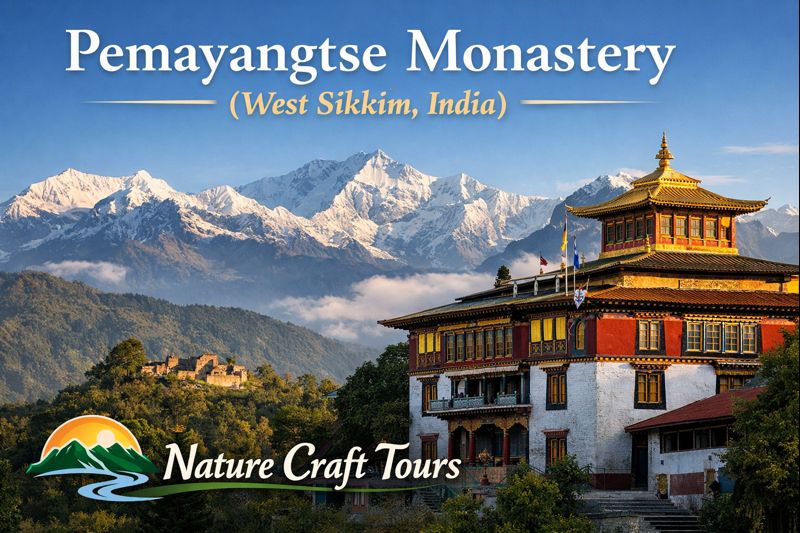
High on a forested ridge above the gentle valley of Pelling, where clouds drift slowly across cedar and magnolia canopies, stands Pemayangtse Monastery—one of the oldest, most revered, and spiritually influential monastic institutions in Sikkim. More than a religious monument, Pemayangtse represents the intellectual and ceremonial heart of Sikkimese Buddhism, preserving centuries of ritual, art, and philosophy that continue to shape the cultural identity of the region.
This is not a destination defined by spectacle or crowds. Pemayangtse reveals itself gradually—through the low murmur of monks reciting ancient texts, the scent of butter lamps burning steadily in dim halls, and the commanding silence of the Himalayas framing every prayer flag and painted wall. For the serious traveler, researcher, or contemplative explorer, Pemayangtse Monastery offers an immersive encounter with living history rather than a fleeting visual experience.
Destination Overview: Where Faith and Landscape Converge
Pemayangtse Monastery is located in West Sikkim, approximately 2 kilometers from the town of Pelling, at an elevation of around 2,085 meters above sea level. The monastery overlooks the historic Rabdentse ruins, the former capital of the Kingdom of Sikkim, and enjoys unobstructed views of the snow-bound Kanchenjunga massif on clear days.
Established in the early 18th century, Pemayangtse belongs to the Nyingma order of Tibetan Buddhism, the oldest of the four major schools. Historically, it was reserved exclusively for monks of pure Tibetan lineage, emphasizing its elite spiritual status. Even today, its rituals, ceremonial calendar, and monastic discipline reflect a conservative adherence to classical Nyingma traditions.
Architecturally, the monastery complex is composed of a main prayer hall, multiple subsidiary shrines, residential quarters for monks, and open courtyards used during ritual performances. Its whitewashed walls, sloping wooden roofs, and intricate murals blend harmoniously with the surrounding forest, creating an environment where built form and landscape appear inseparable.
Historical Significance: The Monastery and the Kingdom of Sikkim
Pemayangtse Monastery was founded in 1705 by Lama Lhatsun Chempo, one of the three revered lamas responsible for the consecration of the first Chogyal (king) of Sikkim. From its inception, the monastery served as a spiritual advisor to the Sikkimese monarchy and played a central role in state rituals, coronations, and royal ceremonies.
Its proximity to Rabdentse was deliberate. The monastery functioned not only as a religious institution but also as a guardian of political legitimacy. Monks from Pemayangtse were entrusted with maintaining ritual continuity during times of dynastic transition, reinforcing the divine authority of the monarchy through sacred rites.
Over the centuries, despite political changes and external influences, Pemayangtse retained its religious autonomy. Even after the integration of Sikkim into the Indian Union in 1975, the monastery continued its role as a cultural anchor, safeguarding manuscripts, ritual objects, and ceremonial knowledge that might otherwise have been lost.
Sacred Art and Architecture: A Visual Theology
The Main Prayer Hall
The central prayer hall of Pemayangtse Monastery is a repository of sacred art. Inside, walls are adorned with meticulously painted murals depicting Buddhist cosmology, protector deities, lineage masters, and scenes from the life of Guru Padmasambhava. These are not decorative embellishments but pedagogical tools, intended to guide monks and devotees through complex philosophical concepts.
Dominating the hall is a statue of Guru Padmasambhava, revered as the second Buddha in Tibetan Buddhism. The statue is flanked by representations of his eight manifestations, each symbolizing a distinct spiritual attribute. The atmosphere within the hall is solemn, illuminated softly by oil lamps and filtered daylight.
Zangdog Palri: The Celestial Palace
One of Pemayangtse’s most extraordinary features is the three-dimensional wooden model of Zangdog Palri, the celestial abode of Guru Padmasambhava. Crafted entirely by monks over several years, this intricate structure rises multiple levels and incorporates hundreds of miniature figures, temples, and symbolic elements.
Zangdog Palri is not merely an artistic masterpiece; it is a meditative diagram rendered in architectural form. Each tier represents a stage of spiritual realization, making the structure both a visual marvel and a contemplative aid.
Cultural Life and Living Traditions
Pemayangtse Monastery is not a static heritage site. It is a living institution where daily rituals, seasonal festivals, and long-term monastic education continue uninterrupted. The monks follow a rigorous schedule of prayers, debates, meditation, and scriptural study that begins before dawn and extends into the evening.
Among the most significant cultural events hosted here is the annual Cham dance festival, usually held in February or March. During this event, masked monks perform ritual dances that symbolize the victory of wisdom over ignorance. Each movement, costume, and drumbeat is encoded with layers of symbolic meaning, understood fully only through doctrinal knowledge.
For visitors, witnessing these ceremonies offers a rare opportunity to observe Buddhist philosophy expressed through movement and sound rather than text alone.
Ecological Context: Monastery in the Forested Himalayas
The ecological setting of Pemayangtse is integral to its spiritual identity. The monastery is surrounded by temperate broadleaf forests composed of oak, chestnut, maple, and rhododendron species. These forests provide habitat for a variety of birds and small mammals, contributing to the region’s biodiversity.
Traditional Buddhist principles of non-harm and interdependence are reflected in the monastery’s relationship with its environment. Sacred groves around the complex are protected, and resource use is minimal. This ecological mindfulness has helped preserve the landscape even as tourism has increased elsewhere in the region.
Complete Tour Planning Guide
Best Time and Season to Travel
The most suitable time to visit Pemayangtse Monastery is between March and May, and again from September to November. During spring, the forests bloom with rhododendrons, while autumn offers clear skies and panoramic mountain views. Monsoon months bring heavy rainfall and frequent fog, which can obscure visibility and complicate travel.
Ideal Travel Duration
A minimum of two days in the Pelling–Pemayangtse area is recommended for meaningful exploration. This allows time not only for the monastery but also for nearby historical sites and contemplative walks. Travelers interested in cultural immersion may find three to four days more appropriate.
Route and Accessibility
Pemayangtse is accessible via road from Gangtok, with a journey time of approximately five to six hours depending on conditions. The nearest major railhead is New Jalpaiguri, and the closest airport is Bagdogra, both located in North Bengal. From these transit points, travelers proceed by road through scenic mountain routes.
Those who explore diverse Indian ecosystems often notice how Himalayan monastic landscapes contrast sharply with lowland environments such as the mangrove forests encountered during a Sundarban Tour, underscoring the remarkable ecological diversity of the subcontinent.
Key Attractions Around Pemayangtse
Beyond the monastery itself, the surrounding region offers several sites of interest. The Rabdentse ruins provide insight into Sikkim’s royal past, while forest trails around Pelling offer quiet walks with occasional wildlife sightings. Scenic viewpoints reveal changing moods of the Kanchenjunga range throughout the day.
These layered experiences—spiritual, historical, and ecological—make West Sikkim a compelling destination for travelers seeking depth rather than checklist tourism, much like travelers who combine Himalayan journeys with thoughtfully curated experiences such as a Sundarban Tour Package to understand India’s cultural and environmental contrasts.
Practical Insights for Thoughtful Travelers
Visitors should dress modestly and maintain silence within prayer halls. Photography may be restricted in certain areas, and it is advisable to observe and follow posted guidelines. Weather can change rapidly, so layered clothing is recommended throughout the year.
Engaging respectfully with monks, observing rituals without intrusion, and allowing time for quiet observation greatly enhance the experience. Pemayangtse is best approached not as a sightseeing stop, but as a place for reflection and learning.
Conclusion: Pemayangtse as an Enduring Spiritual Landscape
Pemayangtse Monastery stands as a testament to the resilience of spiritual traditions in a changing world. Its continued relevance lies not in monumental scale, but in its unwavering commitment to ritual continuity, philosophical depth, and harmonious coexistence with nature.
For the discerning traveler, Pemayangtse offers something increasingly rare: an authentic encounter with living heritage, where silence speaks as eloquently as prayer, and history remains inseparable from daily life. In the layered landscapes of West Sikkim, this monastery endures as both sanctuary and chronicle—a place where the past is neither forgotten nor fossilized, but gently, deliberately lived.