Quiet Odisha Beaches
— Choosing the Coast by Mood, Not Popularity
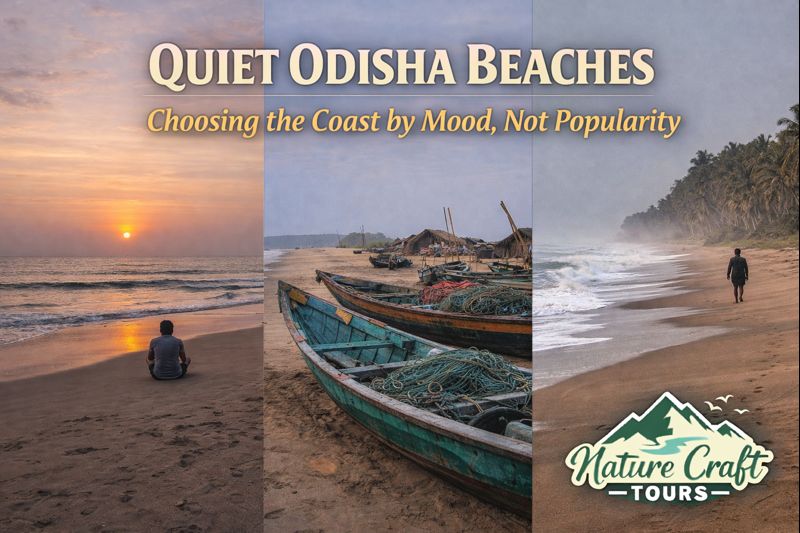
Odisha’s coastline stretches for nearly five hundred kilometres along the Bay of Bengal, yet only a small fraction of this long shore is widely recognised on tourist maps. Beyond the familiar names lie beaches shaped less by crowds and commerce and more by wind, tide, fishing cycles, and seasonal silence. These quieter beaches are not defined by nightlife, infrastructure, or promotional visibility. Instead, they are defined by mood — solitude, reflection, gentle rhythm, or raw exposure to the elements.
The hook “Choose by Mood, Not Popularity” offers a fundamentally different way of reading Odisha’s coast. Rather than asking which beach is famous, the traveller asks a more personal question: what kind of coastal experience is needed right now? A beach for long solitary walks, a beach for observing fishing life, a beach for sitting quietly with the sound of waves, or a beach where the horizon feels vast and uninterrupted. Odisha’s lesser-known beaches provide these choices in abundance, if approached with patience and intention.
Destination Overview: Odisha’s Quiet Coastal Geography
Odisha’s coastline is geographically diverse, shaped by river deltas, estuaries, mangrove systems, sandbars, and open sea-facing stretches. Unlike highly urbanised coasts, large portions of Odisha’s shore remain rural, with fishing villages, casuarina belts, and agricultural land extending almost to the sand.
The quiet beaches are distributed across several districts — Balasore, Bhadrak, Kendrapara, Jagatsinghpur, Puri outskirts, Ganjam, and parts of southern Odisha. What they share is not uniformity, but absence of saturation. Access is often via secondary roads, movement is dictated by tide and weather, and daily life continues independently of visitors.
These beaches are not empty spaces; they are lived landscapes where the sea is a workplace, a food source, a ritual presence, and occasionally a threat. Understanding them requires attention to both natural and human rhythms.
A Mood-Based Approach to Beach Travel
Choosing a quiet beach in Odisha is less about compiling a checklist and more about aligning with an emotional and sensory state. Each stretch of coast offers a distinct atmosphere shaped by geography, settlement patterns, and exposure to the open sea.
Beaches for Solitude and Reflection
Some Odisha beaches extend for kilometres with minimal habitation. These are ideal for travellers seeking silence, long walks, and uninterrupted horizons. The soundscape is dominated by wind and waves rather than human activity. Such beaches are best visited during early mornings or late afternoons, when light softens and the shore feels expansive.
Beaches for Observing Coastal Life
Other quiet beaches lie adjacent to fishing villages, where daily routines shape the shoreline. Nets are repaired on sand, boats are pulled ashore with collective effort, and the tide determines work hours. These beaches are not silent, but their sounds are functional — voices calling, oars striking wood, gulls circling catch.
Beaches for Raw, Untamed Coastlines
Certain stretches of Odisha’s coast are exposed directly to the Bay of Bengal with little natural shelter. Here, waves are stronger, sandbars shift frequently, and the sea asserts itself visibly. These beaches appeal to travellers drawn to elemental landscapes rather than comfort.
Ecological Character of Quiet Odisha Beaches
Ecologically, Odisha’s quieter beaches are part of a dynamic coastal system. Seasonal erosion and deposition continuously reshape the shoreline. Casuarina plantations, sand dunes, and patches of coastal vegetation act as buffers against storms and cyclones.
Many beaches serve as nesting or resting grounds for migratory birds, particularly during winter months. The absence of artificial lighting and heavy foot traffic makes these areas ecologically significant, even if not formally protected.
River mouths and estuarine beaches add another layer of complexity. Here, freshwater meets saltwater, creating nutrient-rich zones that support fish populations and birdlife. Observing these transitions requires time and attentiveness.
Cultural and Historical Context of the Quiet Coast
Historically, Odisha’s coast was deeply connected to maritime trade, fishing traditions, and coastal pilgrimage. Many quiet beaches lie near old navigation routes or temple corridors that once linked inland settlements to the sea.
Fishing communities maintain inherited knowledge of currents, weather signs, and seasonal patterns. Their relationship with the sea is practical and ritualistic — boats are often blessed, and certain stretches of coast hold spiritual significance.
Colonial and post-independence development concentrated infrastructure around select ports and towns, leaving vast stretches of coastline relatively unchanged. This historical unevenness is what allows quiet beaches to exist today.
Best Time and Season to Explore Quiet Beaches
The most suitable period for visiting Odisha’s quiet beaches is between October and March. Post-monsoon months offer stable weather, clear skies, and manageable sea conditions. Winter brings migratory birds and cooler temperatures, ideal for walking and observation.
The monsoon season dramatically alters the coast. Beaches may appear more dramatic, with rough seas and shifting sand, but access can be limited and conditions unsafe for prolonged stays. Summer months are hotter and quieter, with early mornings and evenings offering the best experience.
Ideal Travel Duration
Quiet beach travel benefits from unhurried schedules. A minimum of two nights allows the traveller to experience changing light, tide, and mood. For those seeking deeper immersion, four to six days along multiple beaches provides contrast and perspective.
Rather than staying long in one place, some travellers may prefer slow movement along the coast, spending short periods at different beaches chosen by daily inclination rather than pre-planned attraction lists.
Route and Accessibility
Most quiet beaches in Odisha are accessed via district roads branching from national or state highways. Rail connectivity to nearby towns provides broader access, followed by road travel to the coast.
Final approaches often involve narrow roads, village paths, or short walks through coastal vegetation. Public transport may be infrequent, making flexible travel arrangements preferable.
Key Highlights of Quiet Odisha Beaches
The highlights of these beaches are experiential rather than monumental. Sunrise and sunset quality, shoreline textures, interaction with local life, and the sense of space define their appeal.
On some beaches, tidal flats reveal intricate patterns of shells and sand ripples. On others, fishing boats create shifting compositions against the sea. In many places, the absence of signage or facilities becomes the defining feature.
Comparative Coastal Perspective
Travellers familiar with other slow coastal landscapes may notice parallels. Just as a Sundarban Tour invites visitors to read mangroves and waterways through patience and observation, Odisha’s quiet beaches require similar restraint. The reward lies not in spectacle, but in subtle change and personal connection to place.
Practical Insights for Mood-Based Beach Travel
Quiet beaches demand self-reliance. Visitors should carry essentials such as water, sun protection, and basic supplies, as facilities may be minimal or absent.
Swimming should be approached cautiously, as currents can be strong and lifeguards are rarely present. Observing local behaviour and sea conditions provides important cues.
Photography should respect local privacy, particularly near fishing villages. Engaging in brief, respectful conversations often yields deeper insight than distant observation.
Those accustomed to structured itineraries such as a Sundarban Tour Package may initially find the openness of quiet beaches unfamiliar. Over time, this lack of structure often becomes the greatest luxury.
Why Quiet Beaches Matter in Contemporary Travel
In an era where coastal tourism is increasingly commodified, quiet beaches represent an alternative ethic. They remind travellers that not every shoreline needs branding or development to be meaningful.
These beaches support local livelihoods without overwhelming them, preserve ecological balance through low-impact use, and offer travellers space to recalibrate their relationship with time and environment.
Letting Mood Lead the Coastline Choice
Quiet Odisha beaches cannot be ranked or compared easily, because their value is subjective. One traveller may seek isolation, another may seek gentle human presence, and a third may seek exposure to elemental forces.
By choosing beaches based on mood rather than popularity, the traveller enters into a more honest dialogue with the coast. Odisha’s quieter shores offer this possibility generously — asking only for patience, awareness, and respect in return.