Raghurajpur Heritage Village (Puri District):
A Living Museum of Sacred Art, Craft Lineages, and Ritual Continuity
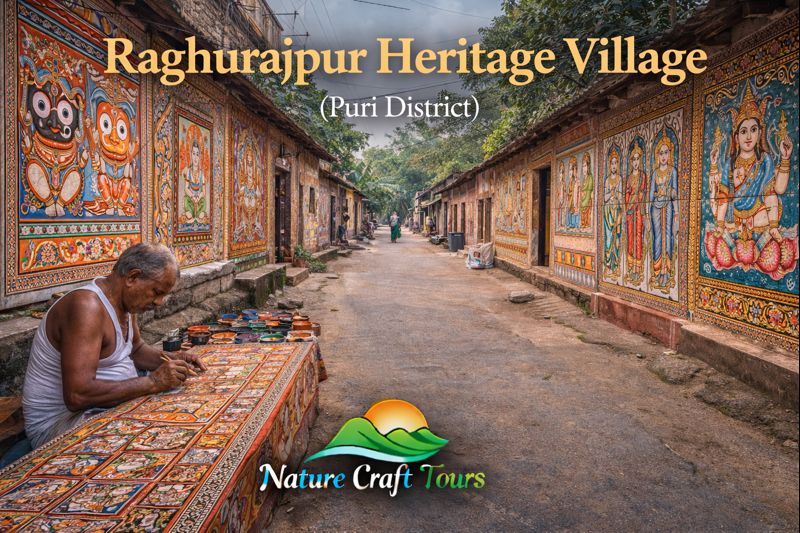
Raghurajpur is not a village one merely visits; it is a village one enters with awareness. Situated in the Puri district of Odisha, this compact settlement represents one of India’s rarest cultural landscapes—a place where art is not an occupation but a hereditary responsibility, and where every household participates in the preservation of ritual knowledge passed down through generations. Recognized as a heritage village, Raghurajpur functions as a living museum, yet remains deeply rooted in everyday rural life.
Unlike heritage sites defined by monuments or ruins, Raghurajpur’s significance lies in continuity. The village is inhabited entirely by artisan families, each associated with specific classical art forms closely linked to the Jagannath cultural sphere of coastal Odisha. Painting, dance, sculpture, and performance coexist here not as isolated disciplines but as interdependent expressions of sacred tradition. This article offers a deeply researched, field-informed exploration of Raghurajpur—its spatial layout, artistic systems, historical context, and practical travel considerations—intended for travelers who seek cultural depth rather than surface-level encounters.
Destination Overview: Understanding Raghurajpur as a Heritage Settlement
Raghurajpur is located on the banks of the Bhargavi River, a distributary of the Mahanadi, and lies a short distance from the pilgrimage city of Puri. Despite its proximity to major religious and tourist centers, the village has retained a distinct identity shaped by artisanal specialization and ritual obligation.
The village is small in scale, with a single main street lined by traditional houses on either side. These homes are not merely residences; they function as studios, classrooms, and galleries. Walls, courtyards, and entrances are often adorned with murals and motifs, transforming the entire settlement into a cohesive artistic environment.
Spatial Design and Village Layout
The Linear Street and Temple Axis
Raghurajpur follows a linear village layout, organized along a central street that culminates in a village temple. This alignment is not accidental. Traditional Odia village planning often integrates ritual pathways with residential zones, ensuring that daily life remains oriented toward sacred space.
The street itself functions as a shared cultural platform. Festivals, processions, and performances unfold here, reinforcing collective participation. The absence of modern congestion allows architectural details and painted surfaces to remain visually prominent.
House Architecture and Artistic Surfaces
Houses in Raghurajpur are built in traditional styles, with sloping roofs, open verandas, and inner courtyards. Exterior walls are frequently used as canvases for mural painting, depicting mythological narratives, ritual symbols, and seasonal themes.
These murals are not decorative afterthoughts; they serve as visual storytelling tools, reinforcing cultural memory within domestic space.
Artistic Traditions of Raghurajpur
Pattachitra: Narrative Painting as Sacred Practice
Raghurajpur is internationally renowned for Pattachitra, a classical painting tradition characterized by bold lines, natural pigments, and mythological storytelling. Themes are drawn primarily from Jagannath mythology, the Ramayana, and the Mahabharata.
The process of creating Pattachitra is ritualized. From the preparation of cloth and pigments to the final brushstroke, each stage follows inherited techniques. Artists often begin training in early childhood, learning not only technique but iconographic discipline.
Palm Leaf Engraving and Miniature Work
In addition to cloth painting, artisans practice palm leaf engraving, producing intricate narrative panels using fine metal tools. These works demand exceptional precision and patience, reflecting a different rhythm of craftsmanship compared to painted forms.
Palm leaf manuscripts historically served as vehicles for religious texts and genealogies, linking this craft directly to Odisha’s literary heritage.
Traditional Sculpture and Toy-Making
Wood and stone sculpture form another layer of artistic expression in Raghurajpur. Artisans create ritual icons, temple elements, and narrative figures, often destined for religious use rather than display.
Traditional toy-making, using wood and natural colors, adds a playful yet symbolic dimension to the village’s output, reflecting mythological characters and rural life.
Performing Arts and Intangible Heritage
Gotipua Dance Tradition
Raghurajpur holds a special place in the history of Gotipua dance, a classical Odia performance tradition involving young male dancers dressed as female characters. This form is widely regarded as a precursor to Odissi dance.
Training in Gotipua involves physical discipline, musical understanding, and narrative expression. Performances are closely linked to temple festivals and ritual calendars.
Music, Chanting, and Oral Transmission
Music and oral storytelling accompany visual and performing arts. Hymns, rhythmic chanting, and narrative recitation reinforce mythological knowledge, ensuring that artistic practice remains embedded within a broader cultural system.
Historical Context and Cultural Significance
The origins of Raghurajpur’s artisan community are deeply connected to temple economies of medieval Odisha. Artists were historically patronized by temples, particularly the Jagannath Temple at Puri, to produce ritual objects, paintings, and performance elements.
This patronage system ensured both economic stability and artistic standardization. Even as political structures changed, the village retained its cultural function, adapting to new contexts while preserving core practices.
Ecological Setting and Riverine Environment
Raghurajpur’s location near the Bhargavi River influences both lifestyle and artistic materials. Seasonal flooding historically enriched soil and supported agriculture, while river routes facilitated movement of goods and ideas.
The village’s ecological setting reinforces its rhythm of life—quiet, cyclical, and closely tied to natural processes rather than industrial schedules.
Key Attractions and Experiential Highlights
- Hand-painted village streets and house murals
- Live demonstrations of Pattachitra and palm leaf engraving
- Gotipua dance practice and performance spaces
- Village temple and ritual centers
- Interaction with multi-generational artisan families
Best Time to Visit Raghurajpur
Seasonal Considerations
The most suitable time to visit Raghurajpur is between October and February. During this period, temperatures are moderate, humidity is manageable, and village activity is vibrant. Festivals and cultural events often coincide with this season, enhancing the visitor experience.
Summer months can be hot and humid, while monsoon season brings lush surroundings but may limit movement due to rainfall.
Ideal Travel Duration
A half-day visit allows for a basic introduction, but a full day is recommended for meaningful engagement. Travelers interested in observing artistic processes, attending performances, or engaging in detailed conversations with artisans should allocate additional time.
Route and Accessibility
Reaching the Village
Raghurajpur is accessible by road from Puri and Bhubaneswar. The approach transitions from urban and pilgrimage zones into rural landscapes, reinforcing the sense of entering a distinct cultural space.
Movement Within the Village
The village is compact and entirely walkable. Exploration on foot allows for close observation of artwork, architecture, and daily life without intrusion.
Raghurajpur in a Broader Cultural Journey
Raghurajpur pairs naturally with temple-centered and riverine destinations of Odisha. Travelers interested in deeper ecological and cultural contrasts may also explore forested and deltaic landscapes through journeys such as a Sundarban Tour, gaining perspective on how artistic and ecological traditions evolve across eastern India.
Similarly, combining Raghurajpur with wider regional itineraries via a Sundarban Tour Package allows travelers to experience both refined cultural expression and raw natural systems within a single travel arc.
Practical Insights for Respectful Travel
Visitors should approach Raghurajpur with cultural sensitivity. Photography should be conducted with permission, and interactions should respect the working environment of artisans. Purchasing artwork directly from artists supports continuity without commercialization pressure.
Quiet observation, thoughtful questions, and unhurried movement enhance both understanding and mutual respect.
Raghurajpur as Living Cultural Continuum
Raghurajpur is not preserved behind glass; it lives, works, and evolves within tradition. Its significance lies not in antiquity alone but in uninterrupted transmission—of skill, belief, and collective memory.
For travelers seeking to understand how culture survives through practice rather than display, Raghurajpur offers one of India’s most compelling examples. It stands as a reminder that heritage is strongest when it remains lived, shared, and renewed each day.