Rayagada Region — Tribal Highlands and Market Anthropology of Southern Odisha
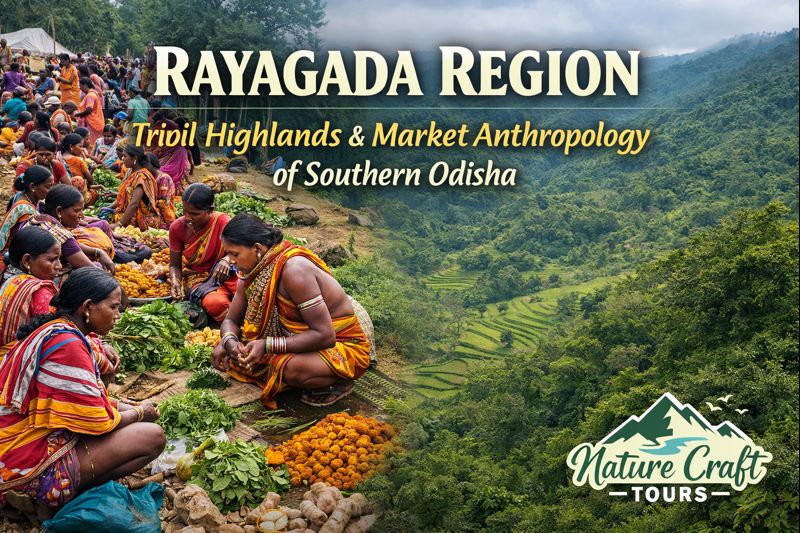
In the far south-western reaches of Odisha lies the Rayagada region, a landscape defined not by single landmarks but by layered human geographies. Here, forested highlands, shifting cultivation, weekly markets, and ancient trade paths intersect to form one of eastern India’s most complex tribal zones. Rayagada is not a destination that reveals itself through panoramic viewpoints alone; it must be read through conversations, market rituals, agricultural cycles, and the rhythms of movement between hills and valleys.
The hook “Tribal Highlands and Market Anthropology” captures the essence of Rayagada more accurately than any scenic description. This is a region where terrain shapes culture, and culture in turn structures economic exchange. Markets are not merely places of commerce but social institutions; highlands are not just physical elevations but living cultural boundaries. For the traveller willing to observe patiently, Rayagada offers an immersive encounter with India’s tribal heartland in its most active and contemporary form.
Destination Overview: Locating Rayagada within Odisha’s Cultural Map
Rayagada district occupies a strategic position along Odisha’s southern frontier, bordering Koraput, Kalahandi, Gajapati, and the northern fringes of Andhra Pradesh. The region forms part of the Eastern Ghats hill system, characterised by broken ridges, forested plateaus, and river valleys that feed the Nagavali and Vamsadhara basins. Elevations vary significantly within short distances, creating ecological and cultural micro-zones.
Unlike Odisha’s coastal districts, Rayagada developed historically through inland trade routes linking the Deccan plateau with the Bay of Bengal. This position facilitated the movement of forest produce, salt, metal goods, and agricultural surplus long before modern administrative boundaries existed. Today, these historic routes survive in altered forms through weekly haats, village paths, and regional road networks.
Rayagada town functions as an administrative and transport hub, but the cultural core of the region lies in its surrounding blocks such as Muniguda, Kashipur, Bissam Cuttack, and Padmapur. These areas remain predominantly tribal, with settlement patterns closely aligned to water availability, soil conditions, and forest access.
The Tribal Highlands: Landscape as Cultural Framework
The highlands of Rayagada are not continuous mountain chains but a series of elevated plateaus separated by deep valleys and seasonal streams. These plateaus support both settled agriculture and shifting cultivation, depending on slope, soil depth, and forest density. Villages are typically positioned on gentle ridges, offering protection from floods while maintaining access to cultivable land below.
The Dongria Kondh, Kutia Kondh, Saora, and other communities inhabiting these highlands maintain distinct relationships with their environment. Agricultural practices, crop choices, and forest use are governed by inherited ecological knowledge rather than standardised farming models. Millet varieties, pulses, and oilseeds dominate cultivation, reflecting both nutritional logic and environmental adaptation.
Movement between villages and markets follows age-old paths that contour hills rather than cut through them. These paths shape social interaction, marriage networks, and ritual exchange. For travellers, walking or driving along these routes offers insight into how geography continues to structure daily life.
Market Anthropology: Weekly Haats as Living Institutions
Markets in Rayagada are not daily commercial spaces but periodic social events. Weekly haats rotate across different locations, allowing surrounding villages to converge on designated days. These markets serve economic, social, and cultural functions simultaneously, making them central to understanding the region.
Structure and Rhythm of Tribal Markets
A typical Rayagada haat begins at dawn. Vendors arrive on foot, bicycles, or shared vehicles, carrying forest produce, agricultural goods, livestock, and handmade items. The market layout is informal but patterned: grain sellers cluster together, forest produce occupies shaded edges, while fish, meat, and fermented products remain slightly apart due to handling requirements.
Transactions are conducted in small quantities, often accompanied by conversation and negotiation that extends beyond price. Barter still exists in limited forms, particularly among forest produce traders. The market thus functions as a site of information exchange, dispute resolution, and social reaffirmation.
Products as Cultural Indicators
The diversity of goods reflects Rayagada’s ecological range. Hill millets, turmeric roots, tamarind, mahua flowers, and leafy greens indicate seasonal availability and forest health. Handwoven baskets, agricultural tools, and earthenware reflect household economies rather than tourist-oriented craft production.
For an observer, these products act as cultural texts. They reveal dietary patterns, labour division, and the continuing relevance of forest-based livelihoods. Markets therefore become informal ethnographic archives, updated weekly.
Historical Layers: Trade, Administration, and Resistance
Rayagada’s present cultural landscape is shaped by multiple historical layers. Pre-colonial trade networks connected the region to the Kalinga plains and the Deccan interior. During colonial rule, administrative interventions attempted to regulate forest use and taxation, often disrupting traditional systems.
Resistance to external control has been a recurring theme. Tribal movements in the nineteenth and twentieth centuries were frequently rooted in disputes over land, forest rights, and market access. These histories are not confined to archives; they survive in oral narratives, ritual songs, and collective memory.
Post-independence development introduced railways, mining interests, and administrative centres. While these brought connectivity, they also intensified negotiations over resource use. Understanding Rayagada requires acknowledging this ongoing dialogue between tradition and modernity.
Best Time and Season to Travel
The most suitable period to explore the Rayagada region is between October and February. Post-monsoon months offer clear skies, active markets, and accessible highland routes. Agricultural activity during this period allows visitors to observe cultivation and harvesting practices.
The monsoon season, from July to September, transforms the landscape into a lush green mosaic but also makes travel challenging due to swollen streams and muddy roads. Summer months are warmer, particularly in lower valleys, though highland areas remain relatively temperate during mornings and evenings.
Ideal Travel Duration and Exploration Strategy
A comprehensive exploration of Rayagada’s tribal highlands and markets requires at least four to five days. This duration allows travellers to attend multiple weekly markets, visit different ecological zones, and avoid rushing through culturally sensitive spaces.
Extended stays of seven days or more are ideal for those interested in deeper anthropological observation, photography, or field-based research. The region rewards slow movement and repeated encounters.
Route and Accessibility
Rayagada town is well-connected by rail, lying on the important east-coast rail corridor that links Odisha with Andhra Pradesh. Road connectivity extends to major block headquarters, though interior villages often require secondary roads or foot access.
Private vehicles provide flexibility, particularly for reaching weekly markets that operate on fixed days. Public transport is available but follows limited schedules. Travellers should plan routes with buffer time, accounting for terrain and local conditions.
Comparative Regional Perspective
For travellers accustomed to structured ecological tourism, the Rayagada region offers a contrasting experience. Just as a Sundarban Tour introduces visitors to deltaic life shaped by tides and mangroves, Rayagada reveals upland societies organised around forests, hills, and periodic markets. Both landscapes require contextual understanding, but their cultural logics differ profoundly.
Practical Insights for Field-Oriented Travel
Visitors should approach Rayagada with cultural sensitivity and preparation. Market photography should be discreet and undertaken only with consent. Engaging local guides enhances understanding of market schedules, village protocols, and safe routes.
Essential supplies should be carried, as interior areas have limited services. Communication networks may be inconsistent in highland zones. Respect for local rhythms—market days, agricultural cycles, and ritual observances—is crucial for meaningful interaction.
Travellers familiar with curated itineraries such as a Sundarban Tour Package will find Rayagada far less formalised. Here, observation replaces itinerary, and patience becomes the primary travel skill.
Cultural and Ecological Significance
Rayagada stands as a living example of how ecology and economy intertwine. Tribal knowledge systems continue to regulate forest use, seed preservation, and market exchange. These systems are not static traditions but adaptive strategies responding to environmental and social change.
From an ecological perspective, the region’s forests play a critical role in watershed protection and biodiversity conservation. Cultural practices linked to sacred groves and ritual landscapes contribute to informal conservation mechanisms.
Reading Rayagada through Hills and Markets
The Rayagada region cannot be summarised through scenic descriptions alone. Its true character emerges in the convergence of hill paths and market spaces, where geography shapes culture and commerce reinforces community. To travel here is to witness anthropology in motion, unfolding weekly in open-air markets and daily along forest trails.
For those seeking an immersive understanding of India’s tribal highlands, Rayagada offers a rare opportunity. It demands attentiveness, respect, and time, but rewards the traveller with insights that extend far beyond the journey itself.