Sandhan Valley (Sahyadri)
— Canyon Trek Experience Carved by Water and Time
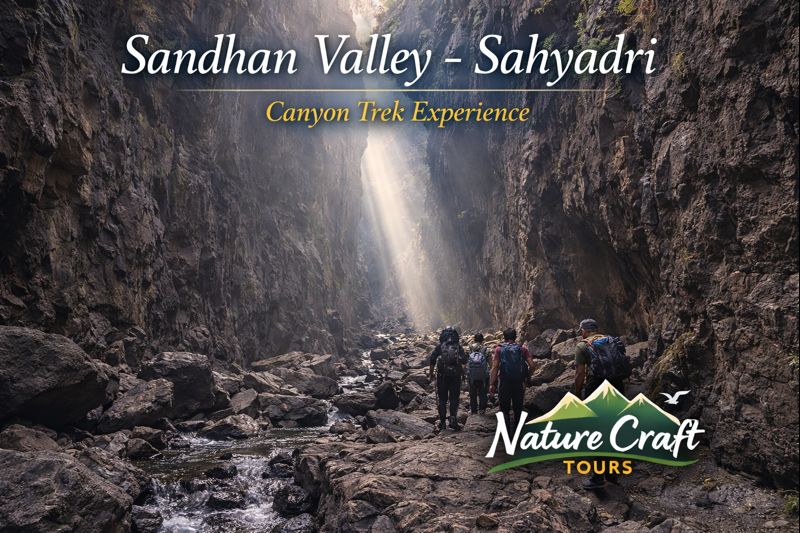
Hidden deep within the rugged folds of the Sahyadri mountain range lies Sandhan Valley, a landscape that defies conventional ideas of trekking in India. Often described as a canyon, Sandhan is not a valley in the pastoral sense, nor a trail marked by sweeping viewpoints and gradual ascents. It is instead a narrow, rock-cut corridor shaped by centuries of water flow, where movement depends as much on balance and patience as on physical endurance. This is a place where geology dictates the rhythm of travel and where silence, shadow, and stone dominate the experience.
To walk through Sandhan Valley is to move inside the mountain rather than over it. Towering basalt walls rise sharply on both sides, sometimes narrowing to just a few feet apart, filtering sunlight into shifting patterns of gold and grey. Seasonal streams carve their way along the canyon floor, turning the trek into an immersive journey through water, rock, and changing light. Unlike high-altitude treks or forested trails, Sandhan offers an enclosed, almost introspective form of exploration—one that demands attention to terrain and respect for natural forces.
Geographical Location and Landscape Context
Sandhan Valley is located in the Ahmednagar district of Maharashtra, within the northern section of the Sahyadri range, a part of the Western Ghats system. The valley lies between the villages of Samrad and Dehne, with Samrad serving as the most common access point for trekkers. This region marks a transition zone between the high-rainfall escarpments of the Western Ghats and the drier Deccan Plateau, resulting in sharp contrasts in vegetation, water availability, and landform.
The valley itself is a natural gorge formed in basalt rock, characteristic of the Deccan Traps. Over millennia, monsoon-fed streams have eroded fractures in the rock, gradually widening them into the canyon seen today. The result is a deeply incised passage with steep walls, uneven footing, and a microclimate distinct from the surrounding plateau. Temperatures inside the valley are often cooler, humidity higher, and light levels lower than on the rim above.
Geological Formation and Canyon Structure
Basaltic Origins and Erosion Processes
Sandhan Valley owes its existence to the layered basalt formations of the Deccan volcanic province. These layers, formed by successive lava flows millions of years ago, vary in hardness and fracture patterns. Seasonal water flow exploited these weaknesses, gradually carving a narrow channel through the rock. Unlike river valleys that widen over time, Sandhan retained its narrow profile due to the resistant nature of basalt.
The canyon walls display visible stratification, with horizontal bands marking different lava flows. In places, vertical joints and angular breaks reveal how tectonic stress and cooling fractures guided erosion. For those attentive to detail, the valley offers a clear lesson in geomorphology—one best understood by slow movement and close observation.
Microclimate Within the Canyon
The depth and narrowness of Sandhan Valley create a microclimate markedly different from the surrounding plateau. Sunlight reaches the canyon floor only during certain hours, and even then indirectly. Moisture lingers longer after rainfall, supporting mosses, ferns, and algae that are absent on the exposed rim.
This microclimate has direct implications for trekking conditions. Slippery rocks, sudden temperature changes, and reduced visibility are common, especially during and immediately after the monsoon. Understanding these factors is essential for safe and responsible travel through the valley.
The Canyon Trek Experience
Trekking through Sandhan Valley is not a linear hike but a sequence of negotiated movements—stepping across water channels, descending rock steps, squeezing through narrow gaps, and occasionally wading through knee-deep streams. The terrain demands constant engagement, making the experience mentally as well as physically immersive.
Unlike open trails where the horizon guides movement, Sandhan offers limited forward visibility. Progress is measured not by distance covered but by sections completed. This enclosed nature fosters a heightened awareness of sound, texture, and balance. The echo of footsteps, the feel of cold water against rock, and the shifting quality of light become defining elements of the journey.
Best Time and Season to Visit
Monsoon: The Valley at Its Most Dramatic
The monsoon season, from late June to September, transforms Sandhan Valley into a flowing canyon. Streams become active, waterfalls appear along the walls, and the valley floor is often partially submerged. This period showcases the valley’s true character, shaped directly by water movement.
However, monsoon trekking here carries significant risks. Flash flooding, reduced traction, and limited escape routes make experience and local guidance essential. Trekkers accustomed to navigating water-dominated landscapes—such as tidal creeks and mangrove channels encountered during a Sundarban Trip—will better appreciate the need for caution and situational awareness.
Post-Monsoon and Winter: Stability and Visibility
From October to February, water levels recede, and the valley becomes more stable and accessible. This period offers the best balance between safety and visual appeal. Rock surfaces dry out, visibility improves, and the risk of sudden flooding diminishes significantly.
Winter temperatures remain comfortable, though the canyon interior can be cool, especially in early morning and late afternoon. For first-time visitors, this season is generally considered the most suitable.
Ideal Travel Duration and Trek Planning
Sandhan Valley is typically undertaken as a one-day trek, though some itineraries include overnight stays on the plateau near Samrad village. A full traversal of the canyon, including approach and exit, requires several hours, depending on group size, water levels, and individual pace.
An ideal plan allows for an early start, ensuring sufficient daylight within the canyon. Rushing through Sandhan undermines both safety and experience. The valley rewards deliberate movement, pauses for assessment, and time spent understanding the terrain rather than merely passing through it.
Route and Accessibility
Samrad village serves as the primary entry point to Sandhan Valley. It is accessible by road from major cities such as Mumbai and Pune, with the final stretch involving rural roads and gradual ascent into the Sahyadri foothills. The village itself remains small and agriculturally oriented, with limited infrastructure.
From Samrad, trekkers descend into the valley through a defined entry point, often requiring local knowledge to identify safely. The exit route typically leads toward Dehne village, though return paths may vary depending on water conditions and group logistics.
Key Highlights and Natural Features
Narrow Rock Corridors
One of Sandhan Valley’s most striking features is its constricted passages, where canyon walls draw so close that only a narrow strip of sky is visible overhead. These sections emphasize the scale and power of geological forces, offering an experience closer to canyoning than conventional trekking.
Seasonal Water Channels
Water defines Sandhan’s character. Even outside peak monsoon, shallow streams and pools remain, shaping movement and dictating pace. In certain sections, water-polished rock surfaces bear witness to centuries of seasonal flow.
Light and Shadow Dynamics
The play of light within the canyon is subtle yet powerful. As the sun moves overhead, narrow shafts of light illuminate select portions of the valley floor, creating transient visual moments that reward attentive observation.
Ecological Characteristics
Vegetation within Sandhan Valley is sparse compared to forested treks, yet highly specialized. Mosses, lichens, and small ferns thrive in damp, shaded sections, while grasses and shrubs dominate the rim above. Faunal presence is limited but includes amphibians, insects, and occasional reptiles adapted to rocky habitats.
The valley’s enclosed nature limits large wildlife movement, reinforcing its sense of isolation. This ecological restraint mirrors the valley’s broader character—life persists here not through abundance, but through adaptation.
Cultural and Historical Context
The Sahyadri range has long served as both a barrier and a refuge in regional history. Nearby hill forts, villages, and trade routes reflect centuries of movement through challenging terrain. While Sandhan Valley itself does not host major historical structures, its surroundings bear the imprint of Maratha-era travel and settlement patterns.
Local communities view the valley primarily as part of their environmental landscape rather than as a recreational asset. Seasonal grazing, water access, and weather patterns shape their interaction with the terrain, offering insight into long-term coexistence with a demanding environment.
Practical Insights for Responsible Trekkers
Sandhan Valley demands preparation grounded in realism. Proper footwear with strong grip, minimal but adequate gear, and awareness of weather forecasts are essential. Helmets are often recommended in narrow sections where loose rock may be dislodged.
Group size should be managed carefully, as congestion within the canyon can increase risk. Noise discipline, waste management, and respect for local guidance are not optional considerations but fundamental responsibilities.
Travelers familiar with fragile and regulated environments—such as mangrove forests explored through a Best Sundarban Tour Package—will recognize similar ethical obligations here. The margin for error in confined natural systems is small.
Sandhan Valley as an Experiential Landscape
What distinguishes Sandhan Valley from many trekking destinations is its inward focus. There are no sweeping panoramas or distant peaks to conquer. Instead, the experience unfolds step by step, shaped by immediate surroundings and constant adaptation.
For researchers, photographers, and seasoned trekkers, Sandhan offers an opportunity to engage deeply with terrain-driven travel. It is a reminder that exploration does not always mean expansion outward; sometimes it requires moving carefully through narrow spaces shaped by forces far older than human presence.
Walking Through Stone and Time
Sandhan Valley is not a trek for accumulation—for ticking off summits or capturing postcard views. It is a passage, both physical and conceptual, through a landscape where water and rock negotiate space over centuries. To traverse it is to submit, briefly, to geological time and natural constraint.
For those willing to accept its demands, Sandhan offers a rare form of travel: immersive, humbling, and deeply grounded in the realities of terrain. It stands as one of the Sahyadri’s most distinctive experiences, not because it is easy or dramatic, but because it is honest in what it asks and precise in what it gives.