Satkosia Gorge Region
— River-Forest Drama
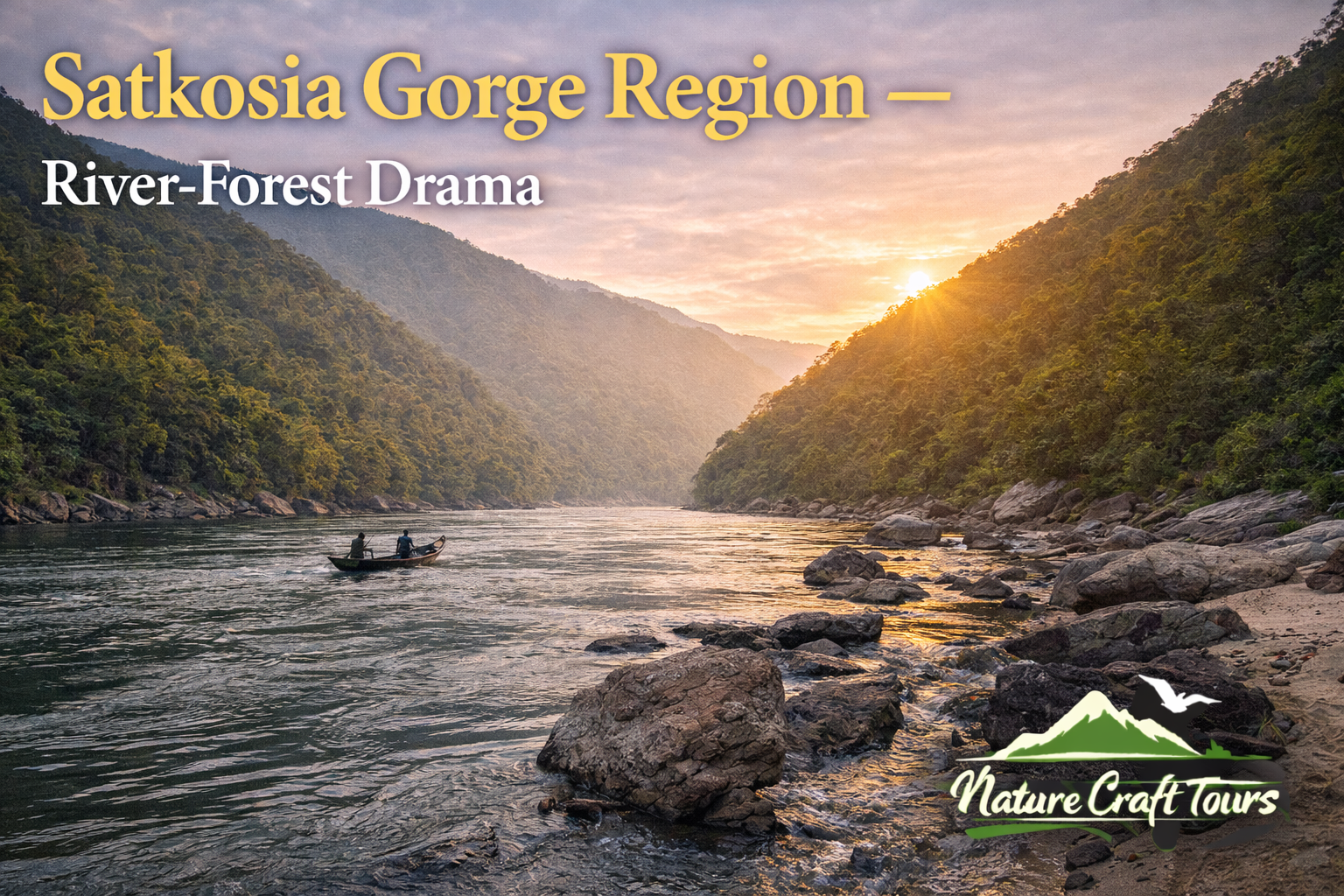
Satkosia is not a destination that reveals itself easily. It unfolds gradually, through the slow narrowing of a river valley, the thickening of forests, and the rising walls of ancient rock that compress water into force and movement. Located in central Odisha, the Satkosia Gorge marks the point where the Mahanadi River breaks through the Eastern Ghats, creating one of eastern India’s most dramatic river–forest landscapes.
This region is defined by contrast and tension. The river, wide and placid upstream, becomes focused and powerful as it enters the gorge. Forests that feel expansive and open elsewhere turn dense and enclosing along the slopes. Human settlements thin out, replaced by long stretches of wilderness where sound is carried by water, wind, and birds rather than engines or crowds. Satkosia is not a place of casual sightseeing; it is a landscape of immersion, shaped by geology, ecology, and time.
Geographical Setting: Where the Mahanadi Meets the Eastern Ghats
The Satkosia Gorge lies at the confluence of two dominant geographical forces: the Mahanadi River and the Eastern Ghats mountain system. For hundreds of kilometers, the Mahanadi flows through plains and plateaus, gathering volume and momentum. At Satkosia, it encounters resistant rock formations of the Eastern Ghats, forcing the river into a narrow passage carved over millions of years.
The gorge extends for roughly 22 kilometers, flanked by steep forested hills that rise sharply from the riverbanks. This compression transforms the river’s character, increasing current speed and depth variation. The surrounding terrain is rugged, with limited access points, reinforcing the sense of enclosure and isolation.
Satkosia’s geography makes it both visually striking and ecologically significant. The convergence of river and hill creates microhabitats that support diverse plant and animal life.
The Drama of the Gorge: Water, Rock, and Movement
What distinguishes Satkosia from other river landscapes is the visible struggle between water and stone. The river does not simply pass through the gorge; it negotiates it. Flow patterns shift constantly, responding to seasonal rainfall, upstream releases, and natural obstructions.
During the monsoon, the gorge becomes a channel of immense energy, with swollen waters rushing between cliffs. In winter, the river calms, revealing rocky outcrops, sandy banks, and quieter pools. These seasonal changes dramatically alter both scenery and access.
This dynamism gives Satkosia its sense of drama. It is not static beauty, but a landscape in motion.
Forest Systems and Vegetation Zones
The forests surrounding the Satkosia Gorge form part of a larger central Indian forest belt. Dominated by mixed deciduous species, these woodlands change character with elevation, slope orientation, and proximity to water.
Lower slopes and riverbanks support denser growth, benefiting from moisture and alluvial soil. Higher slopes are drier, with open canopy forests and grass patches. Seasonal leaf fall creates shifting light patterns that influence undergrowth and wildlife movement.
These forests act as ecological corridors, allowing animals to move between habitats with minimal human interference. The continuity of forest cover is one of Satkosia’s greatest strengths as a protected landscape.
Wildlife and Ecological Significance
Satkosia supports a wide range of fauna adapted to forest and river environments. Large mammals use the forested slopes and valleys as refuge, while reptiles, amphibians, and aquatic species inhabit the river and its margins.
Birdlife is particularly notable, with riverine species occupying sandbanks and forest birds inhabiting canopy layers. Raptors are frequently observed riding thermals above the gorge, using elevation and airflow to patrol territory.
The river itself supports fish populations that form the base of aquatic food webs. Seasonal exposure of sandbanks creates nesting and basking sites, adding to the region’s ecological complexity.
Human History and Cultural Presence
Human presence in the Satkosia region has historically been sparse and adaptive. Small communities settled along the periphery, relying on forest produce, fishing, and limited agriculture. The gorge itself was never heavily populated, due to its terrain and seasonal unpredictability.
Local cultural narratives often reference the river and surrounding hills as powerful forces, deserving respect rather than domination. This worldview aligns closely with modern conservation principles, even though it emerged independently.
In recent decades, conservation initiatives have sought to protect Satkosia’s ecological integrity while acknowledging the needs and rights of local communities.
Experiencing Satkosia: Immersion Over Itinerary
Travel in the Satkosia Gorge region is defined by immersion rather than checklist sightseeing. The landscape encourages slow movement and extended observation. Long stretches of riverbank, forest trails, and viewpoints offer space for reflection rather than constant activity.
For travelers accustomed to water-dominated ecosystems shaped by tidal rhythms—such as those explored during a Sundarban Tour—Satkosia presents a different form of river drama. Here, water is constrained by rock rather than guided by tides, producing force and depth rather than spread and flux.
This contrast highlights the diversity of river systems across eastern India.
Key Attractions and Natural Highlights
The gorge itself is the primary attraction, best appreciated from multiple vantage points. Boat journeys along calmer stretches reveal towering cliffs and forest reflections on water, while viewpoints from higher ground emphasize scale and enclosure.
Sandbanks provide quiet resting places for birds and animals, especially in winter. Forest trails offer opportunities to observe plant diversity and animal signs, though encounters are subtle rather than guaranteed.
Rather than isolated landmarks, Satkosia offers a continuous landscape experience where movement through space is central.
Seasonal Changes and Their Impact
Seasonality plays a crucial role in shaping Satkosia’s character. Monsoon months transform the gorge into a powerful channel of water, limiting access but enhancing visual intensity. Forests become dense and vibrant, though movement is restricted.
Winter brings stability. Water levels drop, clarity improves, and access becomes easier. Wildlife activity is more visible, and temperatures are comfortable for exploration.
Summer months are warmer, with reduced water flow and exposed riverbanks. Early mornings and late afternoons remain suitable for observation, though midday heat can be intense.
Best Time and Season to Travel
Optimal Conditions for Exploration
The most suitable time to visit the Satkosia Gorge region is between November and February. During this period, weather conditions are moderate, forest trails are accessible, and river levels allow for safe movement and observation.
Monsoon visits are not recommended for general travelers due to strong currents and limited accessibility. Summer visits require careful planning to manage heat exposure.
Ideal Travel Duration
Satkosia rewards time investment. A minimum of two to three days allows visitors to experience different sections of the gorge, observe seasonal patterns, and engage with the landscape at a measured pace.
Short visits tend to miss the depth and variation that define the region.
Route and Accessibility
The Satkosia region is accessible by road from major towns in central Odisha. Access routes approach the gorge from different sides, each offering distinct perspectives on terrain and vegetation.
Road conditions vary, particularly in interior sections, reinforcing the need for careful travel planning. Limited infrastructure preserves the area’s wilderness character but requires self-sufficiency from visitors.
Practical Insights for Responsible Travel
Visitors should approach Satkosia with respect for both environment and remoteness. Noise should be minimized, waste strictly avoided, and wildlife observed from a distance.
Preparation is essential. Weather conditions, limited services, and long travel times require realistic expectations. The reward lies in authenticity rather than convenience.
Satkosia in the Broader Context of Indian River Landscapes
India’s rivers express themselves differently across regions—meandering through plains, branching into deltas, or cutting through mountains. Satkosia represents the mountain river phase, where energy is concentrated and landscapes are sculpted rather than spread.
When contrasted with deltaic environments explored through experiences like a Sundarban Tour Package, Satkosia underscores how geography dictates river behavior and human interaction.
Both systems highlight the need for context-specific understanding and conservation.
Satkosia as a Landscape of Tension and Balance
Satkosia Gorge is defined by tension—between river and rock, movement and restraint, wilderness and human presence. Yet within this tension lies balance. The gorge channels immense natural force while supporting fragile ecosystems and quiet human histories.
For travelers seeking depth rather than distraction, Satkosia offers a rare opportunity to engage with landscape as process rather than backdrop. It demands patience, awareness, and humility, rewarding those qualities with insight into how rivers shape land and life when allowed to remain largely themselves.
In a world increasingly defined by speed and simplification, Satkosia stands as a reminder that some landscapes are meant to be entered slowly, understood gradually, and remembered deeply.