Shimla’s Heritage Core:
Walking The Ridge, Mall Road, and the Colonial Heart of the Hills
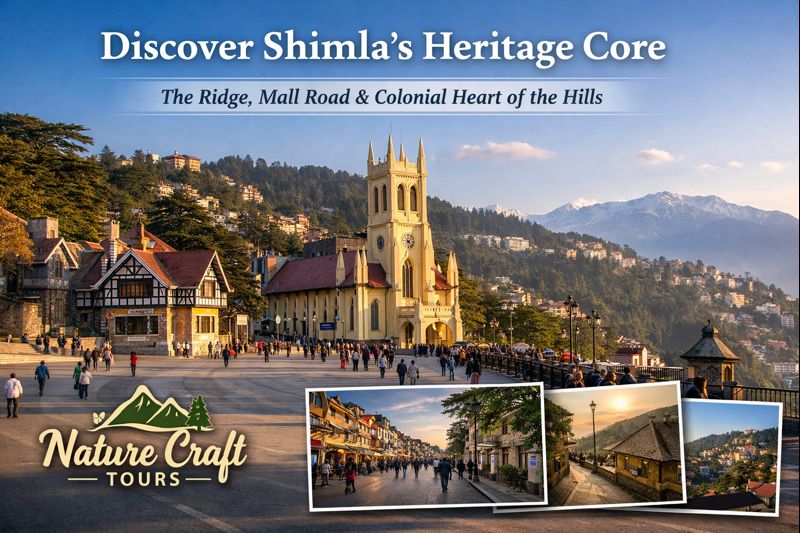
Shimla is often introduced through its altitude, its cool air, and its reputation as a classic hill station. Yet the city’s most revealing story is not found in a single viewpoint or a distant excursion. It is written, line by line, in a compact heritage precinct where public space, architecture, and everyday life still interact at walking pace. This precinct—anchored by The Ridge, Mall Road, and the surrounding colonial-era civic spine—functions like an open-air archive. Here, the past is not sealed behind museum glass; it is embedded in street gradients, stone retaining walls, timbered roofs, and the social rituals of evening promenades.
To explore Shimla’s heritage core well, one must travel as a reader travels through a long book: slowly, attentively, and with patience for detail. The Ridge may appear at first glance as a simple open plaza with mountain views, and Mall Road as a cheerful pedestrian promenade lined with shops. But together they represent a carefully planned hill-town system shaped by climate, governance, engineering constraints, and cultural taste. They also reveal how Shimla has negotiated modern pressures—tourism volumes, construction demand, traffic management, and environmental strain—without completely losing the coherence of its historic center.
This travel narrative focuses on the Ridge–Mall Road axis and the immediately connected heritage structures that form the city’s urban “core.” It is designed for the traveler who prefers meaning over speed, context over checklists, and the kind of immersion that comes from standing still long enough to notice how a city breathes.
A Destination Overview: Why Shimla’s Core Matters
Shimla sits along a narrow Himalayan ridge, a geography that dictates everything: how the town expands, how roads curve, where buildings can safely anchor, and which public spaces become central. The heritage core occupies one of the most stable and socially important portions of that ridge line. From a planning perspective, it is a “spine” city—developed along contours to reduce steep climbs and to keep movement feasible in snow, rain, and fog. From a cultural perspective, it is Shimla’s public stage, where residents and visitors share space in a way that hill towns increasingly struggle to preserve.
The historic center also holds special significance because it reflects a distinct era of South Asian urban development: the period when hill stations were shaped into administrative and social enclaves. In Shimla’s case, this transformation produced a dense assembly of civic buildings, churches, theatres, libraries, and residences, built in styles adapted from Europe but modified for monsoon rains and winter cold. The resulting architectural language—stone bases, pitched roofs, deep verandas, and orderly facades—still gives the central precinct its recognizable character.
Importantly, Shimla’s heritage core is not a static relic. It remains functional. People come here for government work, schooling, daily errands, cultural events, and simple leisure walks. That continuity of use is the real reason the area feels alive. Heritage is not only about preserving buildings; it is about preserving the relationship between buildings and the life that moves through them.
The Core as a Walkable System
The most rewarding way to experience this area is on foot. The Ridge and Mall Road are designed for pedestrians, and the heritage precinct reveals its logic only when you move at the speed it was built for. Walking allows you to understand the contour-hugging lanes, the engineered retaining walls that hold slopes in place, and the way open spaces have been positioned to relieve density and to offer sunlight in colder months.
If you do one thing before arriving, let it be a mental adjustment: Shimla’s core is not a destination to “cover.” It is a district to inhabit briefly—through morning light, midday bustle, and evening calm.
The Ridge: Shimla’s Open-Sky Amphitheatre
The Ridge is Shimla’s central civic expanse—broad, elevated, and unusually open for a ridge-top town. It functions as a public platform where the city reveals its most iconic silhouette: long views, a wide horizon, and a skyline punctuated by prominent heritage structures. Historically, such open spaces were essential in hill towns for gatherings, ceremonies, and social events. In Shimla, the Ridge became the ultimate shared ground—part promenade, part civic square, part lookout.
What makes the Ridge distinctive is how it manages to feel both ceremonial and ordinary. There are moments when it resembles a grand plaza—during public celebrations, performances, or seasonal events. And there are moments when it becomes intimate—when the air turns crisp, the crowd thins, and the only sound is a loose conversation drifting in the wind.
Reading the Ridge Through Light and Weather
The Ridge changes character with the seasons and even with the hour. In the early morning, the space can feel almost contemplative. Shop shutters are still half-closed, and the Ridge belongs to walkers who prefer quiet observation. In late afternoon and early evening, it transforms into a social corridor; locals and visitors arrive to walk, talk, and watch the town’s daily theatre unfold.
In winter, when cold air settles and clouds move quickly, the Ridge can feel like a high balcony above shifting weather. In the monsoon, it becomes a lesson in hill-town resilience—umbrellas, slick stone surfaces, and the steady rhythm of foot traffic that continues despite the rain. In autumn, the atmosphere often clears, and distant mountain profiles become sharper. That clarity is not only visual; it influences mood. Shimla, in such weather, feels more like a highland capital than a tourist town.
The Church as a Landmark and a Lens
One of the Ridge’s defining structures is its prominent church, whose presence shapes the skyline and anchors the space culturally. Architecturally, the building reflects a European Gothic vocabulary adapted to the hills: vertical emphasis, pointed forms, and a facade designed to stand out against an open sky. As a traveler, stand at a distance first and observe proportions. Then approach slowly and notice the materials, the patterns, and the way the structure has been positioned to command attention without overwhelming the open square.
Churches in hill stations were not only places of worship; they also functioned as markers of civic identity, community gathering points, and symbols of a planned colonial social order. In Shimla’s case, that layered role still echoes—whether you enter quietly or simply observe from outside.
Public Space as Social Heritage
It is tempting to treat heritage only as architecture. The Ridge reminds you that heritage can also be a social practice. Evening walks, family strolls, informal conversations, and small street performances are part of the place’s identity. Such practices are fragile; they survive only when a city protects pedestrian space and resists the urge to convert every open area into traffic or commercial overflow.
When you stand on the Ridge, you are not just looking outward at the landscape. You are also looking inward at how a hill city chooses to live.
Mall Road: The Promenade That Defines Shimla’s Rhythm
Mall Road is not merely a street. It is a social institution—an extended promenade built for walking, conversation, and public life. Unlike roads designed primarily for vehicles, Mall Road was shaped to support the pace of a hill station: slow movement, steady foot traffic, and the kind of urban leisure that emerges when walking is not an inconvenience but a central experience.
As you walk along Mall Road, you will notice that the city’s energy changes in segments. Some stretches are more administrative, shaped by offices and civic buildings. Others become commercial, lined with shops and cafés. But even in busy sections, the street retains a promenade character. People are not simply “going somewhere”; they are participating in the place itself.
Architectural Continuity Along the Curve
The buildings along Mall Road offer a study in hill-adapted construction. Sloped roofs handle rain and occasional snow. Stone bases and masonry walls provide stability and thermal insulation. Verandas and overhangs help manage sunlight and precipitation. Many facades maintain orderly proportions, reflecting an older aesthetic of civic restraint rather than modern signage-driven chaos.
A useful way to observe is to look beyond shopfronts and notice upper floors—windows, rooflines, and structural rhythms. The “heritage” is often more visible above eye level, where contemporary commercial layers have not fully obscured older design.
The Human Geography of a Pedestrian Street
Mall Road attracts a diverse cross-section of the town. Students move between institutions. Residents run errands. Visitors pause to browse, to drink tea, to take photographs. This mixture is valuable: it keeps the street from becoming a single-purpose tourist corridor. In many hill stations, central promenades risk turning into pure consumption spaces. Mall Road still functions as a daily-use artery, and that is part of its charm.
If you want a more grounded experience, walk Mall Road in the mid-morning, before the peak evening crowd. Observe how the street serves routine needs. Then return near sunset when the promenade becomes more social and performative. The contrast will teach you more about Shimla than a dozen viewpoints.
The Heritage Core Beyond the Main Axis
The Ridge and Mall Road form the visible “front stage” of central Shimla, but the heritage core extends into adjoining lanes, slopes, and institutional precincts. This is where the town’s historical function becomes clearer. Shimla was not built only for leisure. It was built for administration, governance, and cultural life. The surrounding heritage buildings—libraries, theatres, old offices, and residences—represent an era when the town served as a seasonal center of power.
When you step off the main promenade into quieter stretches, you begin to notice how engineering and planning were used to tame steep terrain. Stone stairways connect levels. Retaining walls support slopes. Trees are not merely decorative; they stabilize soil, moderate microclimates, and soften the built environment. This landscape–architecture relationship is fundamental to understanding Shimla.
Institutional Buildings and the Idea of a Hill Capital
In a hill station that functioned as a seasonal capital, institutions had to be self-sufficient and resilient. Administrative structures were designed to endure weather, to provide space for large gatherings, and to convey authority. Even when you view such buildings from outside, you can sense the design intention: symmetry, solidity, controlled ornamentation, and an emphasis on permanence.
For the modern traveler, these sites offer more than aesthetics. They provide context. You begin to understand why Shimla developed as it did, why its core is so structured, and why the Ridge–Mall Road axis remains central. The “heritage core” is not a random collection of pretty buildings; it is a coherent urban system created for a specific political and climatic purpose.
Cultural Spaces: Theatre, Debate, and the Social City
Hill stations cultivated cultural life—music, theatre, readings, and debate—partly as social necessity in isolated highland settings. Shimla’s historic cultural spaces reflect that tradition. Even if you are not attending a performance, pause outside such venues and observe location and accessibility. Cultural buildings are often placed where foot traffic naturally flows, because their survival depends on social visibility. This is another reason the pedestrian spine matters: it is not only about commerce; it is about community.
If your schedule allows, look for exhibitions, performances, or public lectures. Experiencing heritage as a living activity—rather than as a static photograph—deepens your sense of place.
A Complete Tour Plan for the Heritage Core
Best Time and Season to Travel
For a heritage-focused walk through Shimla’s core, the most balanced seasons are generally spring and autumn. Spring brings mild temperatures and a refreshed landscape, making long walks comfortable. Autumn often offers clearer skies and crisp air, improving visibility and enhancing architectural photography.
Summer can still be rewarding because Shimla’s temperatures remain cooler than the plains, but visitor volume typically increases and the pedestrian core becomes crowded in late afternoons. Winter creates a distinctive atmosphere—quiet, cold, sometimes snow-touched—but it can also bring slippery surfaces, occasional travel disruptions, and shorter daylight hours. The monsoon season, while beautiful in its own way, requires careful footing and patience with fog or rain.
Ideal Travel Duration
To truly experience the Ridge, Mall Road, and the heritage core, allocate three days as a minimum. This duration allows you to see the same spaces under different light conditions, to explore adjoining heritage lanes without rushing, and to include cultural stops such as museums, galleries, or performances if available.
A suggested pacing approach:
- Day 1: Orientation walk on Mall Road and sunset time at the Ridge.
- Day 2: Deeper heritage exploration—institutions, quieter lanes, and architectural observation.
- Day 3: Leisure and return visits—choose your preferred spots, revisit for photography, and explore small local eateries without haste.
Route and Accessibility
Shimla is connected by road networks to major northern Indian cities, and rail approaches (including scenic routes) are also commonly used by travelers who prefer gradual ascent and landscape transitions. Once within central Shimla, the heritage core is most effectively navigated on foot. This is not a compromise; it is the intended way the district works.
If you arrive with heavy luggage, consider reaching your accommodation first and then exploring the core unburdened. Walking becomes more enjoyable when your hands are free and your attention is not divided.
A Walk-First Itinerary Inside the Core
Here is a practical, experience-focused route pattern that fits naturally with the heritage precinct:
- Morning: Begin with Mall Road while shops are opening and crowds are thinner. Observe upper-floor architecture and rooflines.
- Late morning: Move toward adjacent heritage institutions and quieter lanes. Look for old masonry, retaining walls, and slope engineering.
- Afternoon: Choose an indoor heritage stop—museum, gallery, or cultural venue—to balance walking with rest.
- Evening: Return to the Ridge for changing light and social life. The space is as much about people as it is about views.
This pattern builds a relationship with the place rather than simply “covering” it.
Key Attractions and Highlights Within the Heritage Core
The Ridge as a Panorama and a Public Square
The Ridge remains Shimla’s defining open space. Its value lies in its scale and civic role. It offers views, but it also offers an understanding of how a hill station creates a “center” despite narrow ridge geography. Spend time here without an agenda. Observe how families use the space, how vendors position themselves, and how pedestrians move in informal patterns. These details are part of the Ridge’s living heritage.
Mall Road as an Urban Experience
Mall Road’s highlight is its continuity. It allows you to walk through a coherent urban zone without the constant interruption of traffic. Notice how the street bends with the hill contour, how stairways connect down-slope areas, and how public benches and viewpoints create natural pauses. In a mountain town, “rest points” are a form of design intelligence.
Colonial-Era Civic and Cultural Buildings
The core includes multiple heritage structures that represent old administrative and cultural functions. Even when access inside is restricted or timed, the exterior observation remains valuable. Look for the relationship between buildings and their surroundings: how trees have been retained, how courtyards have been planned, and how entrances face pedestrian flow. These are not random decisions; they reflect an older urban logic.
View Corridors and Micro-Viewpoints
Beyond grand vistas, Shimla’s core offers small “view corridors” where lanes open unexpectedly toward valleys. These micro-viewpoints are often more intimate than famous lookouts. They also reveal how the town has been designed to offer relief from density—small openings that restore perspective.
Cultural, Historical, and Ecological Significance
Shimla’s heritage core carries layered significance. Historically, it reflects an era when mountain towns were shaped to serve governance and elite social life. Culturally, it demonstrates how imported architectural styles were adapted to local materials and climate. Ecologically, it highlights the delicate relationship between a ridge-top settlement and the surrounding forested landscape.
This ecological dimension is often overlooked. Hill stations depend on fragile systems—water supply, slope stability, forest cover, and drainage. The older planning principles, though imperfect, often respected certain constraints: contour-following roads, retained trees, and building placements that acknowledged steep terrain. Modern pressures—construction expansion and high seasonal visitor loads—can strain these systems. Observing the heritage core with ecological awareness means noticing drainage channels, vegetation patterns, and the way the town manages slope risk.
India’s landscapes are extraordinarily diverse, and traveling between them can sharpen appreciation. After time in highland environments like Shimla, many travelers become more attentive to other ecological worlds—such as deltaic mangrove regions. If your travel calendar includes an entirely different ecosystem, you may find the contrast instructive; for instance, a journey toward the tidal forests connected with Sundarban Tourism can highlight how settlement patterns change when land is flat, waterlogged, and shaped by tides rather than slopes.
Practical Insights for Travelers
How to Walk Comfortably and Safely
Choose footwear with reliable grip. Hill-town pavements can be uneven, and weather changes can make surfaces slick. If you plan extended walks, pace yourself: the altitude and gradients may feel mild at first and more demanding later in the day. Carry water, but avoid heavy bags during long promenades. The core is most enjoyable when your movement is light.
Timing Strategies to Avoid Crowds
The heritage core has predictable crowd patterns. Early morning offers calm and clear observation of architecture. Midday can be busy but manageable. Late afternoon and evening are the most crowded, especially in peak seasons. A good strategy is to do “detail walking” in the morning and “social walking” in the evening—architecture first, atmosphere later.
Photography and Respectful Observation
Photographing heritage districts is best done with patience and discretion. Look for diagonal light in the morning or late afternoon, when facades reveal texture. Avoid obstructing pedestrian flow. If you photograph people, do so respectfully and without intrusive closeness. Heritage districts belong to residents first; visitors are temporary participants.
Food, Breaks, and Sustainable Choices
Take breaks in a way that supports the pedestrian nature of the district. Choose sitting pauses that do not create litter. Carry a small reusable bottle where feasible. In hill towns, waste management can be challenged by terrain and seasonal volume. Small choices matter more than travelers often realize.
Blending Heritage Walks with Wider Himachal Exploration
The Ridge–Mall Road experience can serve as the cultural foundation of a longer Himachal itinerary. Once you understand Shimla’s historic core, you will read nearby towns differently—recognizing how planning, climate, and history interact across the region. Some travelers pair hill-station heritage with nature-heavy itineraries elsewhere in India; if you seek a different rhythm after mountain promenades, routes that include forests, rivers, or wetlands can provide a refreshing contrast, including thoughtfully arranged options such as a Sundarban Tour Package from Kolkata for those who want to experience India’s mangrove landscape in a structured way.
A Three-Day Heritage-Focused Plan
Day 1: First Encounter with the Core
Arrive and settle. In the late afternoon, begin with Mall Road to understand the promenade’s curve and the positioning of key junctions. Walk steadily, not quickly. Let your mind build a map: where the Ridge opens up, where lanes descend, where the street widens into small resting zones. End the day at the Ridge near sunset. Do not rush photographs; allow the space to reveal its shifting light and mood.
Day 2: Deep Heritage Reading
Start early. Move through Mall Road when the day is still assembling itself. Then step into adjoining heritage lanes and institutional zones. Look for structural details: timber supports, stone patterns, roof pitches, and the ways buildings align with contours. Allocate time for an indoor cultural stop—museum, gallery, or theatre venue if open. Return to the Ridge in the evening for a second experience; the same space, seen twice, becomes more meaningful.
Day 3: Slow Travel and Personal Connections
Use the final day to revisit the places that felt most “true” to you. Some travelers discover that their favorite moments were not the grand views but the quiet corners: a small viewpoint between buildings, a stairway that descends into a calmer lane, or an early morning walk where the town feels almost private. End your visit with a final promenade. Heritage is not a souvenir; it is an impression carried forward.
Shimla’s Core as an Experience, Not a Checklist
Shimla’s Ridge, Mall Road, and heritage core are best understood as a single living environment—a ridge-top city center that combines public space, pedestrian culture, and architectural continuity. The Ridge offers openness and civic identity; Mall Road offers rhythm and social life; the adjoining heritage precinct offers depth, reminding you that this hill station was once a working capital, not merely a scenic retreat.
To walk here attentively is to understand how geography shapes culture, how climate shapes architecture, and how public space shapes community. Shimla’s heritage core is not perfect, and modern pressures are real. Yet the district still possesses something increasingly rare: a coherent, walkable heart where history remains part of everyday life. If you leave with one lesson, let it be this—Shimla is most beautiful when you stop trying to “see it all” and instead allow its streets to tell their story at their own pace.