Shingba Rhododendron Sanctuary:
A Living Alpine Archive near Yumthang Valley
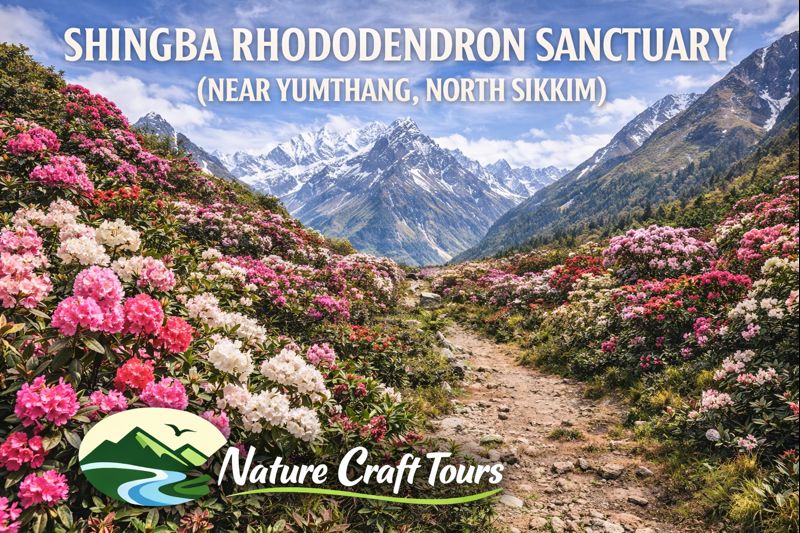
Hidden within the upper reaches of North Sikkim, where altitude governs ecology and seasons dictate access, the Shingba Rhododendron Sanctuary stands as one of the Eastern Himalaya’s most botanically significant protected landscapes. Often visited briefly in transit to Yumthang Valley, Shingba is rarely understood in its own right. Yet this compact sanctuary represents a rare convergence of alpine botany, traditional land use, and high-altitude conservation practice.
This article approaches Shingba Rhododendron Sanctuary not as a roadside stop, but as a distinct ecological zone shaped by geology, climate, and centuries of coexistence between mountain communities and fragile plant systems. Drawing upon field-based observation, regional ecological studies, and Himalayan travel experience, the narrative below presents a comprehensive understanding of Shingba for travelers who value depth, context, and responsible exploration.
Geographical Location and Landscape Setting
Shingba Rhododendron Sanctuary is located approximately 7 kilometers before Yumthang Valley, along the Lachung–Yumthang axis in North Sikkim. The sanctuary occupies a high-altitude basin ranging between 3,045 meters and 4,575 meters above sea level, placing it firmly within the subalpine to alpine ecological transition zone.
The protected area spans roughly 43 square kilometers and lies within the upper catchment of the Lachung River system. Glacial moraines, frost-shattered rock slopes, and gently undulating alpine meadows define the sanctuary’s physical character. Unlike dense forest reserves at lower elevations, Shingba is an open, light-filled landscape where visibility extends across slopes, ridgelines, and flowering scrub.
From a geomorphological perspective, the sanctuary sits atop ancient tectonic formations shaped by Himalayan uplift. Thin soils, prolonged snow cover, and short growing seasons have produced a highly specialized plant community adapted to extremes of cold, ultraviolet exposure, and nutrient scarcity.
Origins and Conservation History
Shingba Rhododendron Sanctuary was officially notified as a protected area in 1984, recognizing its exceptional concentration of rhododendron species. However, long before formal protection, the landscape functioned under customary stewardship by the Lachungpa community.
Traditional grazing systems regulated seasonal access, preventing overuse during sensitive growth periods. These indigenous practices inadvertently preserved the rhododendron populations that modern conservation now seeks to protect. The sanctuary thus represents a layered conservation history — one where formal protection builds upon pre-existing ecological wisdom rather than replacing it.
Today, Shingba is managed under state forest regulations, with controlled visitor access and restrictions on resource extraction. Despite its protected status, the sanctuary remains vulnerable to climate variability, road pressure, and unregulated foot traffic during peak flowering months.
Botanical Significance and Rhododendron Diversity
Rhododendron Species Richness
The sanctuary is best known for its extraordinary rhododendron diversity. More than forty species have been recorded within its boundaries, making it one of the most concentrated rhododendron habitats in the Eastern Himalaya.
These species vary dramatically in form and function. Some appear as low, wind-hugging shrubs barely rising above alpine grasses, while others develop into small trees with gnarled trunks and dense canopies. Flower colors range from deep crimson and scarlet to pale pink, white, and even yellow — a spectrum shaped by pollination strategies and microclimatic adaptation.
Associated Alpine Flora
Beyond rhododendrons, Shingba supports a wide range of alpine plant life, including primulas, anemones, gentians, and saxifrages. Many of these species exhibit rapid life cycles, emerging, flowering, and seeding within a narrow seasonal window between snowmelt and the onset of monsoon.
Medicinal plants traditionally used by local communities are also present, though their collection is now regulated. These plants form part of a broader Himalayan ethnobotanical heritage that links ecology directly with cultural survival.
Seasonal Dynamics and Best Time to Visit
Spring to Early Summer (Late April to June)
This period represents Shingba’s most active ecological phase. As snow recedes, dormant buds erupt into bloom, transforming the sanctuary into a living botanical exhibition. The timing of peak flowering varies annually, influenced by winter snowfall and spring temperatures.
Daytime conditions during this season are generally stable, though cold winds and sudden cloud cover remain common. This is the preferred window for botanical observation and landscape photography.
Monsoon Phase (July to September)
Monsoon rains shift the sanctuary’s visual character from floral to verdant. While plant growth remains vigorous, accessibility becomes unpredictable due to landslides and road instability. Cloud cover often limits visibility, reducing the experiential value for most visitors.
Autumn Transition (October to Early November)
Autumn brings crisp air, clear skies, and subdued alpine tones. Although flowering has ceased, this season offers exceptional clarity of surrounding peaks and a quieter, more contemplative atmosphere.
Winter Closure (Late November to March)
Heavy snowfall renders the sanctuary inaccessible during winter. Rhododendrons enter dormancy, protected beneath deep snowpack that insulates roots from extreme cold.
Ideal Travel Duration and Acclimatization Considerations
Shingba Rhododendron Sanctuary is best explored as part of a multi-day itinerary in North Sikkim. At least one overnight stay at Lachung is essential for altitude acclimatization.
Visitors should allow sufficient time to walk sections of the sanctuary rather than treating it as a brief roadside stop. Slow movement not only enhances botanical observation but also reduces the risk of altitude-related discomfort.
Route and Accessibility
Access to Shingba follows the same primary route as Yumthang Valley, beginning from Gangtok and passing through Mangan and Chungthang before reaching Lachung. Road conditions vary significantly by season, with winter damage and monsoon erosion frequently affecting travel time.
The sanctuary itself lies directly along the Yumthang road, with designated stopping points that allow entry into meadow sections. Formal trekking trails are limited, emphasizing minimal landscape alteration.
Key Attractions and Experiential Highlights
Rhododendron Corridors
Dense rhododendron corridors line the sanctuary road during peak bloom, creating immersive color tunnels that change with altitude and sunlight angle.
Alpine Meadow Systems
Open meadows interspersed between shrub clusters provide insight into high-altitude grazing ecology and seasonal plant succession.
Avifaunal Observations
The sanctuary supports a range of alpine bird species, particularly during spring migration. Patient observers may spot pheasants, accentors, and high-altitude finches.
Cultural and Ecological Context
For local communities, Shingba is not merely a scenic reserve but a cultural landscape intertwined with seasonal livelihood practices. Grazing rights, religious beliefs, and ecological knowledge continue to shape how the sanctuary is perceived and used.
Understanding such landscapes alongside vastly different ecosystems elsewhere in India — such as those encountered during a Sundarban Tour — highlights the country’s extraordinary ecological range and the need for region-specific conservation strategies.
Practical Travel Insights and Responsible Conduct
Visitors should avoid trampling vegetation, particularly during flowering season when plants are most vulnerable. Waste must be carried back, as the sanctuary lacks disposal infrastructure.
Weather changes rapidly at this altitude; layered clothing, sun protection, and hydration are essential. Photography should be conducted without disturbing grazing animals or entering restricted zones.
Broader Travel Perspective
Integrated travel planning across diverse ecological zones, whether alpine sanctuaries or deltaic forests like those featured in structured itineraries such as the Sundarban Tour Package from Kolkata, reinforces the importance of contextual travel — where understanding landscape processes matters as much as visual appeal.
Shingba as a Living Botanical Classroom
Shingba Rhododendron Sanctuary is not a destination designed for hurried consumption. It is a living botanical classroom where ecological processes unfold quietly across seasons and altitudes. Its value lies not only in its flowers but in what those flowers reveal about adaptation, resilience, and coexistence in one of the world’s most demanding environments.
For travelers who approach the sanctuary with patience, curiosity, and respect, Shingba offers something increasingly rare — a chance to witness Himalayan ecology functioning on its own terms, largely unchanged by spectacle-driven tourism.