Similipal Biosphere Context Trails
— An Interpretive Journey Through Forest, Culture, and Ecology
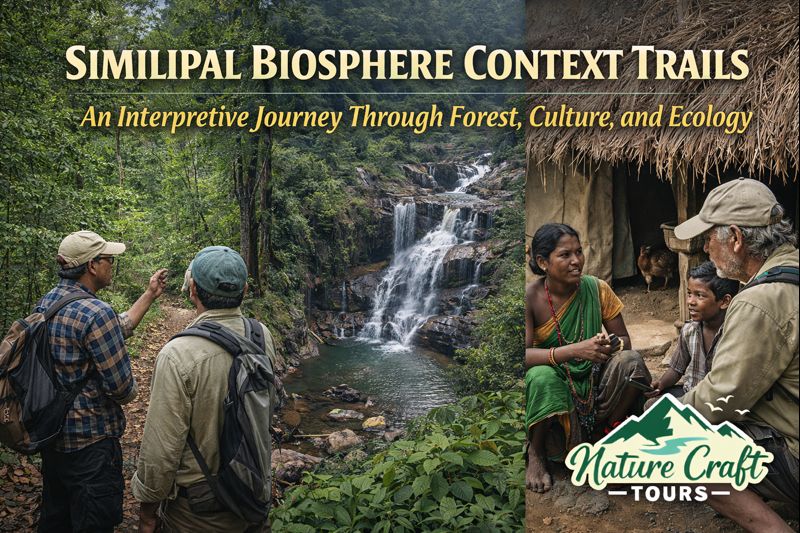
Similipal is often introduced through superlatives—one of India’s largest tiger reserves, a UNESCO-recognised biosphere, a vast sal-dominated forest in northern Odisha. Yet such labels, while accurate, barely prepare a traveller for the layered reality of the landscape. Similipal is not merely a protected area to be seen; it is a living ecological archive that must be read carefully. The idea of “Context Trails” emerges precisely from this need—to move beyond sightseeing and toward interpretation.
The hook “Interpretive Approach” defines a way of travelling through Similipal that prioritises understanding over accumulation. Context trails are not formal trekking routes alone; they are sequences of observation—forest types shifting with altitude, villages negotiating conservation boundaries, streams carving ancient rock, and myths embedded in terrain. To walk or drive these trails is to place each experience within ecological, cultural, and historical frameworks that reveal why Similipal exists as it does today.
Destination Overview: Situating Similipal in the Eastern Indian Landscape
Similipal Biosphere Reserve occupies a central position in northern Odisha, within Mayurbhanj district, forming a major ecological block of the Eastern Ghats. Its terrain rises from gently undulating foothills to a rugged plateau interspersed with deep valleys, perennial streams, and dense forest cover. Elevations range roughly between 300 and 1,200 metres, creating multiple habitat zones within a relatively compact region.
The biosphere includes a core tiger reserve, buffer forests, and transition zones where human habitation and traditional livelihoods continue. This zonation is critical to understanding Similipal, as conservation here has never been about complete exclusion. Instead, it reflects decades of negotiation between wildlife protection, forest-dependent communities, and administrative management.
Similipal’s significance extends beyond Odisha. As a biodiversity refuge linking the Eastern Ghats and the Chota Nagpur plateau systems, it plays a crucial role in genetic flow, watershed protection, and climate regulation across eastern India.
What Are Context Trails? Understanding the Interpretive Framework
Context trails are not defined solely by distance or difficulty. They are interpretive corridors—routes and sequences that allow travellers to understand how geology, vegetation, wildlife, and human history intersect. In Similipal, this approach is particularly valuable because visual impressions alone can be misleading. Dense forest may appear uniform, yet subtle changes in undergrowth, tree composition, or animal signs signal major ecological transitions.
An interpretive trail may include a motorable forest road followed by a short forest walk, a pause near a stream, a visit to a forest-edge village, and a viewpoint overlooking a plateau. The value lies in linking these points conceptually, not merely visiting them.
Landscape Layers: Reading Similipal’s Forest Structure
Similipal’s forests are dominated by sal, but this dominance masks remarkable diversity. Lower elevations support mixed deciduous forests with bamboo, asan, and fruit-bearing species. As altitude increases, sal becomes more prominent, accompanied by dense leaf litter and shaded forest floors that influence wildlife movement.
Context trails allow travellers to observe how forest density affects sound, light, and temperature. Bird calls change with canopy height; insect activity varies with moisture; visibility opens and closes with slope and vegetation. These sensory shifts are as informative as direct wildlife sightings.
Water as a Structural Element
Streams and waterfalls form the skeletal system of Similipal. Most originate on the plateau, cutting through lateritic rock before feeding rivers that sustain agricultural plains far beyond the reserve. Following these watercourses as part of a context trail reveals patterns of erosion, plant succession, and animal usage.
During the monsoon and post-monsoon months, water reshapes accessibility and wildlife behaviour. Dry-season trails, in contrast, highlight mineral licks, exposed riverbeds, and the importance of perennial pools.
Wildlife Interpretation Beyond the Search for Tigers
While Similipal is globally recognised for its tiger population, an interpretive approach discourages single-species obsession. Context trails emphasise signs rather than sightings—pugmarks, scratch marks, scat, feeding evidence, and alarm calls. These indicators tell stories of presence, movement, and ecological balance.
Herbivores such as sambar, chital, and gaur shape vegetation patterns, while smaller mammals influence seed dispersal and soil health. Birds act as ecological indicators, with species composition reflecting forest maturity and water availability.
Understanding these relationships allows travellers to appreciate Similipal even in the absence of charismatic sightings. The forest itself becomes the primary subject.
Cultural Context: Forest, Community, and Continuity
Similipal is not an empty wilderness. Indigenous communities, particularly the Ho and Santhal groups, have lived in and around these forests for generations. Their settlements, now largely located in buffer and transition zones, represent adaptive strategies shaped by terrain, soil, and seasonal cycles.
Context trails often pass near village boundaries, sacred groves, and old forest clearings. These spaces reveal how cultural memory is embedded in the landscape—certain hills associated with origin myths, streams used for ritual purification, or forest patches protected through customary practice.
Traditional Knowledge as Ecological Insight
Local communities possess detailed understanding of plant properties, animal behaviour, and seasonal changes. While this knowledge is not always visible, it informs forest management practices such as controlled harvesting and avoidance of sensitive areas during breeding seasons.
For travellers, respectful engagement with this context deepens understanding of Similipal as a lived landscape rather than a fenced reserve.
Historical Layers: From Royal Hunting Grounds to Protected Biosphere
Historically, Similipal functioned as a royal hunting ground under the Mayurbhanj princely state. Early conservation measures, including restrictions on timber extraction and hunting, were implemented long before modern wildlife laws, shaping the forest’s current structure.
Post-independence, Similipal transitioned through multiple administrative phases—from reserve forest to tiger reserve to biosphere reserve. Each phase introduced new management priorities, leaving traces in road networks, watchtowers, and settlement patterns.
Context trails that follow older routes often reveal these historical layers, providing insight into how conservation philosophy has evolved over time.
Key Context Trails and Experiential Highlights
While specific routes may vary based on access regulations and seasons, several thematic trail types define the interpretive experience in Similipal.
Plateau-to-Valley Transitions
Trails that descend from the central plateau into lower valleys showcase rapid ecological change. Tree height increases, humidity rises, and animal sign density often shifts. These transitions illustrate how elevation shapes biodiversity.
Waterfall and Stream Corridors
Routes aligned with perennial streams allow observation of riparian vegetation, amphibian habitats, and animal movement corridors. These trails are particularly instructive in understanding watershed dynamics.
Forest–Village Edge Zones
Edges between protected forest and human habitation reveal negotiation spaces—fields protected by trenches, forest produce collection zones, and shared water sources. These areas highlight coexistence challenges and adaptations.
Best Time and Season for Interpretive Travel
The most suitable period for context-based exploration of Similipal is between October and February. Post-monsoon conditions bring clear streams, active wildlife movement, and stable access routes. Winter temperatures remain comfortable for extended observation and slow travel.
The monsoon season dramatically alters the landscape, offering ecological richness but limiting accessibility. Summer months provide visibility of animal signs near water sources but require careful timing due to heat.
Ideal Travel Duration
An interpretive journey through Similipal requires time. A minimum of three to four days allows engagement with multiple landscape layers. Five to seven days is ideal for travellers seeking deeper ecological and cultural understanding, allowing repetition and reflection rather than constant movement.
Short visits risk reducing the experience to surface-level observation, whereas extended stays enable patterns to emerge.
Route and Accessibility
Similipal is accessed via Mayurbhanj district, with approach routes from towns such as Baripada. Entry points lead into designated forest zones, where movement is regulated to minimise disturbance.
Road access within the reserve follows established corridors. Context trails often combine vehicle travel with guided walking segments. Flexibility is essential, as routes may change based on forest conditions and management decisions.
Comparative Perspective: Interpreting Forest Landscapes in India
Travellers familiar with other Indian ecosystems may find useful contrasts. Just as a Sundarban Tour demands interpretation of tidal rhythms, mangrove ecology, and human–wildlife interaction, Similipal requires attention to elevation, forest structure, and inland water systems. Both landscapes resist hurried consumption and reward contextual reading.
Practical Insights for Interpretive Travel
Context-based exploration demands preparation. Travellers should prioritise guides with ecological knowledge rather than those focused solely on sightings. Carrying field notebooks, binoculars, and reference materials enhances engagement.
Respect for regulations is non-negotiable. Many areas are seasonally restricted to protect wildlife. Silence, patience, and minimal movement are essential ethical practices on context trails.
Those accustomed to packaged nature experiences such as a Sundarban Tour Package may initially find the interpretive approach demanding. However, the reward lies in depth rather than convenience.
Why Context Trails Matter in Contemporary Conservation
Interpretive travel fosters understanding rather than extraction. By situating each experience within broader ecological and cultural frameworks, context trails encourage respect for complexity and uncertainty—qualities essential for long-term conservation support.
In Similipal, where protection depends on balancing biodiversity, community rights, and administrative realities, such understanding is particularly valuable. Travellers become informed observers rather than passive consumers.
Learning to Read the Forest
Similipal Biosphere Reserve is not a landscape to be conquered or collected. It is a text written in sal leaves, laterite rock, flowing water, and human memory. Context trails offer a way to read this text slowly, attentively, and ethically.
For travellers willing to adopt an interpretive approach, Similipal offers more than wildlife encounters. It offers perspective—on how forests function, how cultures adapt, and how patience can transform travel into understanding. In a world increasingly defined by speed, Similipal’s context trails remind us that some landscapes reveal their meaning only to those who learn to pause and observe.