Srimanta Sankaradeva Kalakshetra (Guwahati): Cultural Complex for Art & Identity
Srimanta Sankaradeva Kalakshetra
— An Explorer’s Passage Through Assam’s Living Cultural Identity
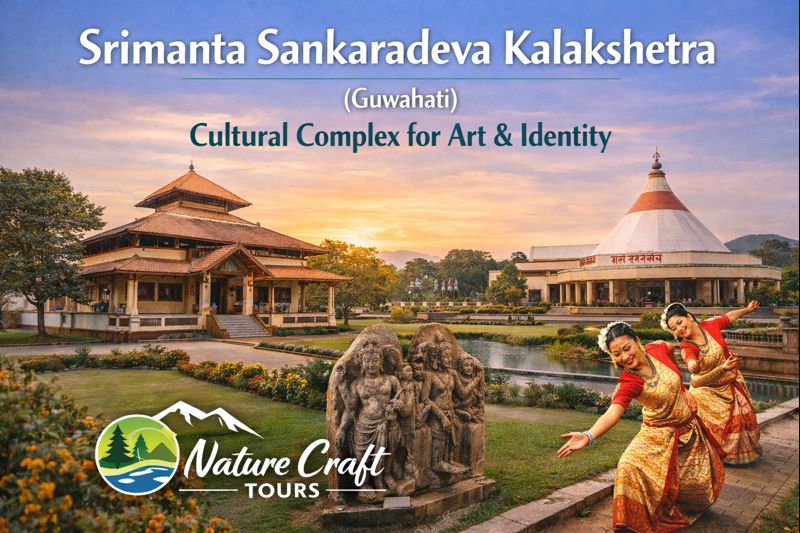
To understand Assam only through its rivers, forests, and temples is to encounter its physical presence; to understand it through Srimanta Sankaradeva Kalakshetra is to encounter its soul. Situated in Guwahati, this expansive cultural complex is not a museum frozen in time, nor a performance arena limited to scheduled events. It is a living, breathing articulation of Assamese identity—where philosophy, art, architecture, folklore, and collective memory converge.
For the explorer who seeks meaning beyond sightseeing, Srimanta Sankaradeva Kalakshetra offers a rare opportunity to walk through the intellectual and emotional foundations of the Northeast. Every pathway, structure, and exhibit here is a statement of continuity—connecting medieval reformist thought with modern cultural expression.
Who Was Srimanta Sankaradeva: The Ideological Core of Kalakshetra
Srimanta Sankaradeva was not merely a saint or poet; he was a civilisational reformer. His ideas reshaped Assam’s spiritual, artistic, and social landscape through the Ekasarana tradition—a movement centred on devotion, equality, and cultural synthesis.
The Kalakshetra does not function as a memorial in the narrow sense. Instead, it translates Sankaradeva’s philosophy into spatial experience. The visitor does not read about reform; one walks through its manifestations—music, dance, drama, craft, and architecture—all woven into a coherent cultural grammar.
Kalakshetra as an Idea, Not Just a Place
The term “Kalakshetra” itself implies a field of art—a dynamic space where creativity is cultivated. This is not accidental. The complex is designed to evolve, reflecting the living nature of Assamese culture rather than preserving it as a relic.
Location and Landscape: Culture Anchored in Geography
Srimanta Sankaradeva Kalakshetra is located in the Panjabari area of Guwahati, set against gently undulating terrain and framed by greenery. The site selection reinforces a fundamental Assamese worldview: culture must exist in dialogue with nature.
The spatial openness of the complex—wide courtyards, water bodies, and landscaped zones—creates an atmosphere of reflection rather than consumption. Visitors are encouraged to slow down, observe, and absorb.
Architectural Language of the Complex
The architecture draws from traditional Assamese forms—namghars, royal Ahom structures, rural homesteads—reinterpreted through contemporary materials. This fusion reflects continuity rather than imitation.
Key Zones and Attractions Within Kalakshetra
Central Museum Complex
The museum section introduces visitors to Assam’s ethnographic and artistic diversity. Exhibits include traditional attire, agricultural tools, ritual objects, manuscripts, and sculptural representations that contextualise everyday life across communities.
Unlike static displays, the curation here focuses on relationships—between object and environment, ritual and season, art and belief.
Cultural Village and Architectural Replicas
This zone recreates traditional Assamese living spaces, allowing visitors to step into historical domestic environments. These structures demonstrate how climate, material availability, and social structure shaped architectural choices.
Open-Air Theatre and Performance Spaces
Kalakshetra functions as a performance ecosystem. Classical and folk dance forms, music traditions, and dramatic expressions—many rooted in Sankaradeva’s legacy—are performed regularly, keeping the site culturally active.
Art Galleries and Temporary Exhibitions
Rotating exhibitions ensure that contemporary artists remain part of the dialogue. This integration prevents cultural stagnation and affirms Kalakshetra’s role as a forward-looking institution.
Cultural Significance Beyond Assam
While deeply Assamese in identity, Kalakshetra addresses universal questions: How does a society remember itself? How does tradition adapt without losing integrity? How can art function as social glue?
These questions resonate with travellers who have explored other culture–nature interfaces, such as those encountered during a Sundarban Tour, where ecology and livelihood shape collective identity.
Best Time to Visit Srimanta Sankaradeva Kalakshetra
October to March: Ideal Cultural Exploration Season
Pleasant weather allows extended exploration of both indoor galleries and outdoor installations. This period often coincides with cultural festivals and performances.
April to May: Artistic Quietude
Though warmer, this season offers fewer crowds, making it suitable for researchers, students, and serious explorers.
Monsoon Months: Contextual Understanding
Visiting during the monsoon reveals how Assamese culture adapts to climatic realities—an insight consistent with broader riverine cultures across eastern India.
Suggested 3-Day Cultural Explorer Tour Plan
Day 1: Orientation and Museum Immersion
Begin with the central museum and permanent galleries. Allocate sufficient time to understand narrative sequencing rather than rushing through exhibits.
Day 2: Architectural and Performance Exploration
Explore the cultural village, open-air spaces, and attend scheduled performances if available.
Day 3: Contextual Guwahati Cultural Circuit
Visit complementary cultural institutions and heritage sites to reinforce insights gained at Kalakshetra.
Educational and Research Importance
Kalakshetra serves as an educational platform for students of anthropology, history, architecture, and performing arts. Its multidisciplinary approach allows cross-referencing of ideas across domains.
For travellers interested in layered journeys—similar in intent to curated experiences such as a Sundarban Tour Package from Kolkata—Kalakshetra provides intellectual depth alongside visual engagement.
Responsible Cultural Engagement
Visitors are encouraged to treat Kalakshetra not as an entertainment park but as a shared cultural resource. Respect for exhibits, performances, and the surrounding environment ensures the site’s longevity.
Cultural heritage survives not through admiration alone, but through disciplined participation.
Why Kalakshetra Is Central to Assamese Identity
Srimanta Sankaradeva Kalakshetra does not attempt to define Assamese identity rigidly. Instead, it presents identity as a conversation—between past and present, rural and urban, sacred and secular.
This openness reflects Sankaradeva’s own philosophy: unity without uniformity.
Walking Through a Living Philosophy
To walk through Srimanta Sankaradeva Kalakshetra is to engage with a civilisation that understands culture as practice, not possession. The complex teaches that identity is sustained through expression—song sung, dance performed, craft made, story told.
For the explorer, Kalakshetra offers something increasingly rare in modern travel: a space that invites understanding rather than consumption. Here, art is not decorative, history is not distant, and identity is not abstract.
In Guwahati’s cultural heart, Srimanta Sankaradeva Kalakshetra stands as a reminder that a society truly lives when it remembers itself—and chooses to share that memory with care.