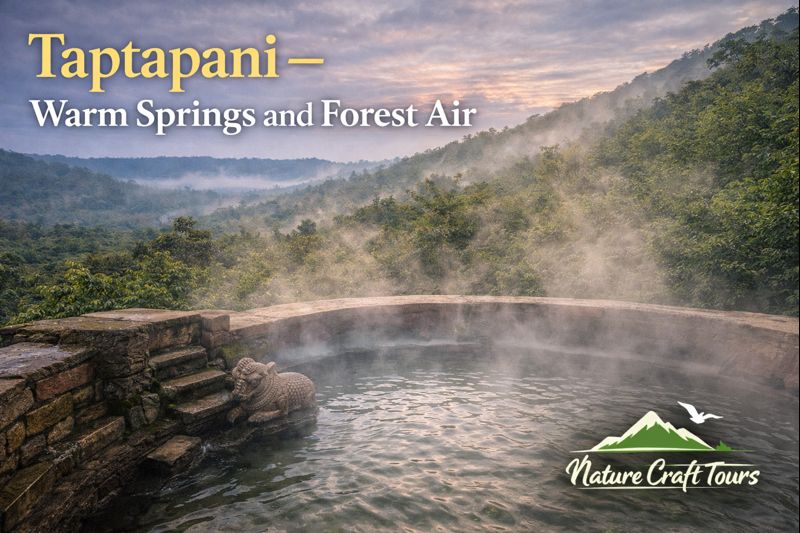
Taptapani is a place defined less by landmarks and more by atmosphere. Nestled in the forested highlands of southern Odisha, it is known for its naturally heated sulphur springs and the quiet, restorative presence of surrounding woodland. Unlike destinations built around spectacle or scale, Taptapani draws attention through elemental contrasts—warm water emerging from the earth, cool air drifting through sal and teak forests, and a sense of seclusion that feels increasingly rare.
For the traveler willing to slow down, Taptapani offers a study in balance: geological forces meeting ecological systems, human tradition coexisting with wilderness, and physical relaxation paired with mental clarity. It is neither a bustling hill station nor a ritual pilgrimage center. Instead, it occupies a reflective middle ground, where nature’s processes unfold gently and without urgency.
Geographical Setting and Regional Context
Taptapani is located in Ganjam district, in the southern part of Odisha, close to the Eastern Ghats range. The region is characterized by undulating hills, dense forests, and seasonal streams that feed into larger river systems further downstream. Elevation here is moderate, but sufficient to create a cooler microclimate compared to the coastal plains.
The landscape surrounding Taptapani is predominantly forested, with sal, bamboo, and mixed deciduous species forming layered canopies. These forests act as both ecological corridors and climatic buffers, regulating temperature and humidity throughout the year. The setting plays a crucial role in shaping the experience of the warm springs, where rising steam often mingles with forest mist during cooler mornings.
The Geological Origin of the Hot Springs
The defining feature of Taptapani is its naturally occurring hot sulphur springs. These springs emerge from deep geological fractures where groundwater is heated by geothermal processes before rising to the surface. The water temperature remains consistently warm, regardless of season, a characteristic that has drawn human attention for generations.
The presence of sulphur gives the water a distinct mineral scent and is widely believed to have therapeutic properties. While modern science explains the heat through geothermal gradients and subsurface rock interactions, local narratives often describe the springs as gifts of the earth—symbols of renewal and balance.
The springs are not violent or eruptive. Water surfaces calmly, reinforcing Taptapani’s overall sense of restraint and continuity rather than dramatic geological display.
Forest Ecology and Environmental Character
The forests surrounding Taptapani are an integral part of its identity. These woodlands support a range of flora adapted to seasonal rainfall patterns and varied soil conditions. During the monsoon, the forest floor becomes dense with undergrowth, while winter reveals clearer sightlines through thinning foliage.
Birdlife is especially prominent, with forest species occupying different vertical layers—from ground-dwelling birds to canopy dwellers. Insects, amphibians, and small mammals form the quieter foundation of the ecosystem, contributing to nutrient cycles and seed dispersal.
Unlike more intensively managed wildlife reserves, Taptapani’s forests retain a lived-in quality. Paths are functional rather than ornamental, and human presence has historically been low-impact rather than extractive.
Cultural Significance and Local Traditions
Taptapani holds cultural importance for nearby tribal and rural communities, many of whom have long associated the hot springs with healing and purification. Traditional beliefs often link the warm waters to natural balance, and seasonal visits for bathing have been part of local routines.
While the area does not host large festivals or pilgrimage gatherings, it reflects a quieter form of cultural continuity. Daily practices—forest collection, small-scale agriculture, and oral storytelling—remain closely tied to environmental rhythms.
This understated cultural presence reinforces Taptapani’s identity as a place of everyday significance rather than ceremonial prominence.
Experiencing Taptapani as a Traveler
A visit to Taptapani is defined by sensory contrast. Stepping into warm spring water while cool forest air moves overhead creates a physical awareness of environment that is both grounding and calming. The experience is unhurried; there is little incentive to rush from one point to another.
Travelers accustomed to dynamic ecosystems shaped by tides and channels—such as those encountered during a Sundarban Tour—may find Taptapani’s appeal lies in stillness rather than movement. Here, change occurs subtly, through shifting light, temperature, and forest sound.
Key Attractions and Natural Highlights
The hot springs themselves remain the central attraction, but the surrounding environment adds depth to the visit. Forest walks reveal gradual elevation changes, occasional viewpoints, and shaded clearings ideal for quiet observation.
Seasonal streams appear after monsoon rains, and winter mornings often bring mist that softens the landscape. These elements are not dramatic in isolation, but together they create a cohesive sense of place.
Best Time and Season to Visit
Seasonal Comfort and Accessibility
The most suitable time to visit Taptapani is between October and February. During these months, daytime temperatures are moderate, nights are cool, and forest conditions are comfortable for walking. The contrast between warm spring water and cool air is especially pronounced during winter.
Monsoon months transform the forest into a vivid green environment, but heavy rainfall can affect accessibility. Summer months are warmer, though the springs remain inviting during early mornings and evenings.
Ideal Travel Duration
Taptapani is best experienced over one to two days. This allows sufficient time to enjoy the springs at different times of day, explore nearby forest areas, and adapt to the slower rhythm of the location. Extended stays may appeal to travelers seeking solitude, though activities remain intentionally limited.
Route and Accessibility
Taptapani is accessible by road from major towns in southern Odisha. The approach journey passes through forested stretches and small settlements, gradually distancing travelers from urban environments.
Road conditions are generally stable, though travel planning should account for seasonal weather variations. Public transport options exist, but private travel offers greater flexibility in timing and exploration.
Practical Insights for Responsible Travel
Visitors should approach Taptapani with respect for both environment and local usage of the springs. Bathing areas should be used mindfully, avoiding excessive noise or disruption.
Forest walks should remain within established paths, and littering must be strictly avoided. The area’s appeal depends largely on its cleanliness and quiet character.
Taptapani in the Broader Landscape of Eastern India
Eastern India’s travel geography includes a wide range of environments—coastal plains, mangrove deltas, forested highlands, and river valleys. Taptapani represents the upland forest segment of this spectrum, where geothermal features intersect with woodland ecology.
Just as travelers explore coastal complexity through experiences like a Sundarban Tour Package from Kolkata, Taptapani offers inland insight into slower, earth-driven processes that shape human and ecological life.
Taptapani as a Place of Quiet Renewal
Taptapani does not rely on scale, spectacle, or constant activity. Its value lies in consistency—the steady warmth of its springs, the dependable presence of forest air, and the enduring relationship between people and place.
For travelers seeking restoration rather than stimulation, Taptapani offers an experience rooted in natural rhythm. It stands as a reminder that some destinations are best understood not by what they offer to do, but by how they invite one to simply be.