Temi Tea Garden, South Sikkim:
A Living Landscape of Himalayan Tea, Culture, and Quiet Grandeur
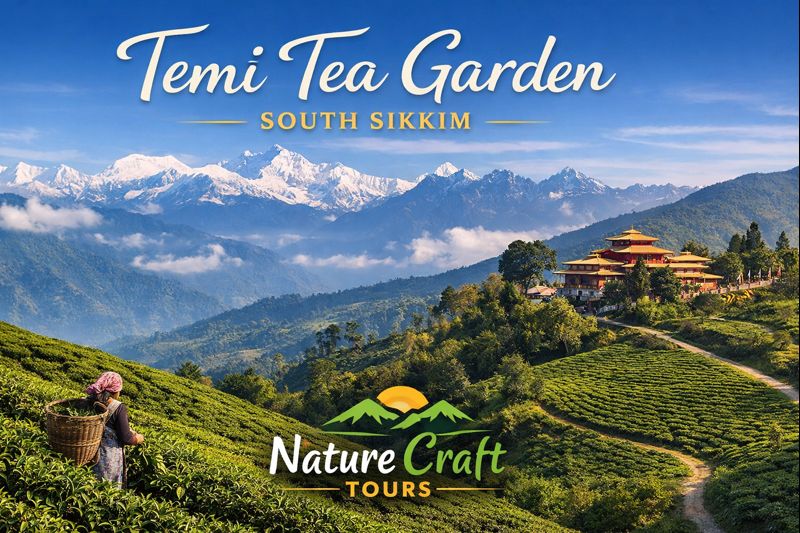
Hidden within the gentle folds of South Sikkim’s mid-Himalayan terrain, Temi Tea Garden stands apart from the region’s better-known alpine destinations. It is not a place defined by dramatic extremes, but by continuity—of landscape, labour, climate, and tradition. Spread across undulating hills between roughly 1,200 and 2,000 metres above sea level, Temi is Sikkim’s only large-scale tea estate and one of the few government-owned tea gardens in India.
For the slow traveller, the cultural researcher, or the explorer interested in Himalayan agro-landscapes, Temi offers a rare opportunity to observe how ecology, economy, and everyday life merge seamlessly. This is not a destination that announces itself through spectacle. Instead, it reveals itself gradually—through the scent of fresh tea leaves, the geometry of plantations etched into hillsides, and the distant silhouette of snow peaks emerging at dawn.
Understanding Temi Tea Garden: Geography, Origins, and Identity
Geographical Setting and Natural Environment
Temi Tea Garden is located in South Sikkim district, approximately 18 kilometres from Namchi, the district headquarters. The estate occupies a series of south- and south-east–facing slopes, benefiting from consistent monsoonal rainfall, deep loamy soil, and a temperate climate throughout most of the year. These factors together create ideal conditions for producing high-quality orthodox tea.
The surrounding landscape is a balanced mosaic of tea-covered hills, patches of secondary forest, cardamom fields, and small rural settlements. Birdlife is abundant, particularly during early mornings when mist rises from the valleys. The estate also functions as a soft ecological transition zone between cultivated land and forested ridges, supporting a quiet biodiversity rarely noticed by hurried visitors.
Historical Background and Establishment
Temi Tea Garden was established in 1969 under the Government of Sikkim, during a period when the region was seeking sustainable economic pathways rooted in agriculture. Unlike many tea estates established during the colonial era, Temi emerged from a post-independence vision that prioritised employment generation, environmental responsibility, and state-supported rural development.
Over time, Temi tea earned international recognition for its clean flavour profile and minimal chemical intervention. Long before organic certification became a global standard, Temi’s production methods naturally aligned with low-input cultivation due to geographic isolation, policy direction, and traditional agricultural knowledge.
The Character of Temi Tea: From Leaf to Landscape
Cultivation Practices and Tea Varieties
The estate primarily produces orthodox black tea, along with limited quantities of green and specialty teas. Plucking is carried out manually by trained workers who understand the precise timing required to preserve leaf quality. Growth cycles are slower due to altitude, resulting in teas with refined aroma, moderate body, and balanced astringency.
For visitors, the most striking aspect is how seamlessly tea cultivation integrates with daily life. Plantation roads double as village pathways, viewpoints overlook working slopes, and the rhythm of agricultural labour defines the pace of the landscape.
Visual and Sensory Landscape
Travel through Temi Tea Garden is marked by repetition and harmony. Rows of tea bushes trace the natural contours of the hills, creating patterns that shift subtly with changing light and seasons. During active plucking months, splashes of colour appear as workers move through the fields, lending scale and vitality to the expansive terrain.
The absence of industrial noise, combined with clean mountain air, gives Temi an atmosphere of deep calm. For photographers, naturalists, and reflective travellers, the estate offers continuous variations of texture, light, and shadow.
Best Time to Visit Temi Tea Garden
Spring (March to May)
Spring marks the renewal of growth across the estate. Tea bushes produce fresh leaves, plucking activity resumes, and surrounding forests display vibrant foliage. Weather conditions remain comfortable, with clear mornings and mild afternoons, making this an ideal period for plantation walks and observation.
Monsoon (June to September)
During the monsoon, Temi transforms into a deeply green and immersive landscape. While rainfall can occasionally disrupt travel, this season offers solitude and unmatched visual richness. Clouds drift low across the hills, and the estate takes on a contemplative, almost ethereal quality.
Autumn (October to November)
Post-monsoon months bring crisp air and excellent visibility. Clear days often reveal distant Himalayan peaks from higher vantage points. This is one of the most balanced seasons for travel, combining pleasant weather with visual clarity.
Winter (December to February)
Winters are cool but generally stable. Tea activity slows, and the landscape adopts muted tones. This season appeals to travellers seeking quietude, long walks, and an unhurried pace, though early mornings can be distinctly cold.
Ideal Travel Duration and Suggested Pace
While Temi Tea Garden can be visited as a short excursion from Namchi, a stay of two to three days allows for meaningful engagement. This duration enables travellers to experience the estate at different times of day, observe agricultural rhythms, and explore surrounding villages without haste.
For those familiar with diverse Indian ecosystems, Temi offers a compelling contrast to lowland environments such as the mangrove-dominated Sundarbans. Travellers who have experienced a Sundarban Tour often find Temi’s hills an instructive counterpoint in understanding how geography shapes livelihoods and culture.
Route and Accessibility
Approach and Road Connectivity
The nearest major access point to South Sikkim is Gangtok, which is connected by road to Siliguri and New Jalpaiguri. From Gangtok, Namchi can be reached via well-maintained hill roads. Temi Tea Garden lies a short drive beyond Namchi, accessible by local roads that pass through rural settlements and plantation land.
Road conditions are generally good outside the peak monsoon months. Travel is most comfortable during daylight hours, allowing visitors to appreciate the changing landscape along the route.
Key Attractions and Highlights Within and Around Temi
Plantation Roads and Viewpoints
The estate’s internal roads offer panoramic views of rolling tea fields and distant valleys. Early morning and late afternoon are particularly rewarding, as light angles accentuate the contours of the hills.
Village Life and Cultural Continuity
Small villages surrounding the estate reflect a way of life closely tied to agriculture. Daily routines follow seasonal cycles, and interactions with residents provide insight into how tea cultivation supports local livelihoods without overwhelming traditional structures.
Sunrise and Distant Himalayan Views
On clear days, higher points within the estate offer glimpses of snow-clad peaks at sunrise. These moments, fleeting yet memorable, add a subtle grandeur to Temi’s otherwise understated landscape.
Cultural, Ecological, and Economic Significance
Temi Tea Garden represents a rare model of state-supported agricultural sustainability in the Himalaya. It balances commercial production with ecological sensitivity and social responsibility, demonstrating that large-scale cultivation need not come at the cost of environmental degradation.
Culturally, the estate has shaped settlement patterns, employment structures, and regional identity in South Sikkim. Ecologically, its low-chemical approach has preserved soil health and surrounding biodiversity, contributing to long-term landscape stability.
Practical Insights for Travellers
Travel in Temi is best approached with flexibility and patience. Weather conditions can change quickly, and the experience rewards those who allow time for observation rather than structured sightseeing. Walking, stopping frequently, and engaging quietly with the surroundings offer deeper understanding than rushed itineraries.
Visitors combining Temi with broader eastern India journeys may find thematic continuity when contrasting mountain agriculture with deltaic ecosystems, such as those explored through a Sundarban Tour Package. Together, these landscapes illustrate the remarkable ecological diversity contained within a relatively compact geographic region.
The Enduring Quiet of Temi Tea Garden
Temi Tea Garden is not a destination of spectacle, but of substance. Its appeal lies in continuity—of land use, labour, and landscape—maintained across decades with quiet determination. For travellers willing to slow down, to observe rather than consume, Temi offers a deeply rewarding encounter with the living geography of the Eastern Himalaya.
In an era when many destinations are reshaped to meet fleeting trends, Temi remains grounded in its original purpose. It stands as a reminder that some of the most meaningful travel experiences are found not in dramatic highlights, but in landscapes that endure, season after season, doing precisely what they were always meant to do.