Triund: The Classic Trek Viewpoint Above McLeod Ganj and the Dhauladhar Wall
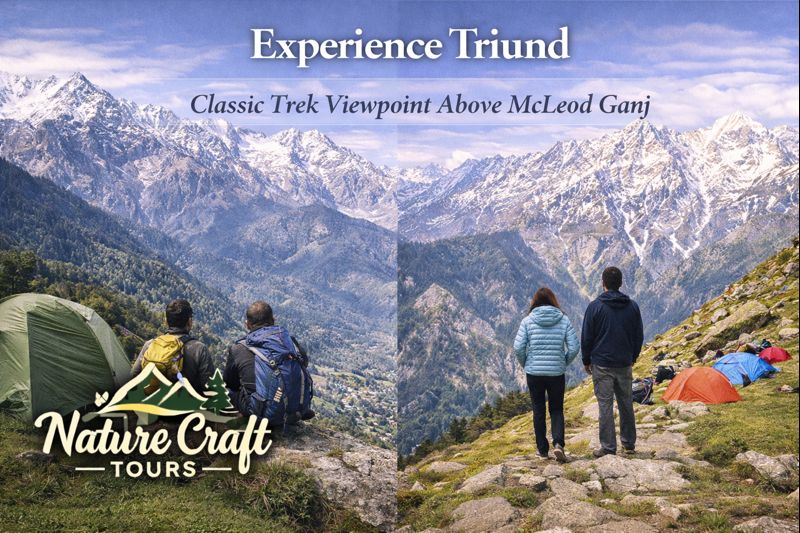
Triund is not merely a trekking destination above McLeod Ganj; it is a threshold experience. Positioned on a grassy ridge at the foot of the Dhauladhar range, Triund offers one of the most immediate and instructive introductions to high-Himalayan landscapes accessible from a settled town. The journey to Triund is as important as the destination itself—each bend in the trail gradually removing the noise of urban life and replacing it with forest silence, wind, and widening sky.
Unlike extreme alpine expeditions that demand technical expertise, Triund occupies a unique middle ground. It is approachable, yet never trivial. The trek introduces altitude, weather variability, and mountain scale in a measured way, making it a formative experience for first-time Himalayan trekkers while remaining rewarding for seasoned walkers. From its ridge, one side opens dramatically toward the Kangra Valley and plains beyond, while the other confronts the sheer rock and ice faces of the Dhauladhar wall at close range.
This article examines Triund as a classic Himalayan trek viewpoint rather than a checklist adventure. It explores the geography, ecology, cultural context, and practical realities of the route, written from a field-observational perspective that values understanding terrain and rhythm over speed or spectacle.
Destination Overview: Situating Triund in the Dhauladhar Landscape
Triund is located at an elevation of approximately 2,850 meters above sea level, directly above McLeod Ganj in Himachal Pradesh. It sits on a broad, gently sloping ridge that forms a natural balcony between forested mid-altitudes and the steep, glaciated upper reaches of the Dhauladhar range.
Geographically, Triund is significant because of its position relative to two contrasting landscapes. To the south and west, the land drops sharply toward the Kangra Valley, offering expansive views across cultivated fields, rivers, and distant plains. To the north and east, the terrain rises abruptly into dark rock faces, snowfields, and seasonal ice, emphasizing the scale and abruptness of the Dhauladhar mountains.
This dual perspective makes Triund an exceptional viewpoint. It allows trekkers to visually comprehend the Himalayan gradient—from plains to peaks—within a single, continuous experience.
A Natural Balcony Between Valley and Range
Unlike summits that isolate the observer, Triund positions the walker within the landscape. One is neither fully above nor below, but suspended between two geological worlds. This spatial placement defines Triund’s enduring appeal.
The Approach to Triund: Forests, Gradient, and Gradual Ascent
The trek to Triund typically begins from the upper reaches of McLeod Ganj or nearby trailheads. From the outset, the path asserts its character: narrow, well-trodden, and consistently ascending. There are no long flat sections. Progress is earned step by step.
Forest Zones Along the Trail
The lower portion of the trek passes through dense mixed forests dominated by oak, rhododendron, and deodar. These forests provide shade and regulate temperature, making the initial ascent manageable even during warmer months.
As altitude increases, tree density gradually thins. The forest canopy opens intermittently, allowing glimpses of the valley below and signaling the approach to higher terrain. This gradual ecological transition prepares the body and mind for exposure above the tree line.
Trail Character and Physical Demand
The Triund trail is steady rather than technical. Its challenge lies in sustained ascent rather than difficult footing. The path is rocky in places, particularly closer to the ridge, where erosion and weather have shaped uneven surfaces.
This steady gradient encourages pacing. Frequent pauses are natural and beneficial, allowing walkers to observe surroundings, regulate breathing, and adapt to altitude.
Triund Top: Ridge, Grassland, and Open Sky
Reaching Triund is marked not by a sharp summit but by a subtle opening of space. Trees fall away, the trail levels slightly, and the ridge reveals itself as a wide, grassy expanse. This transition feels expansive after hours within forest corridors.
The Ridge Landscape
Triund’s ridge is broad enough to walk freely without the vertigo associated with narrow crests. Grasses dominate the terrain, interspersed with scattered rocks and seasonal wildflowers. The openness allows wind to move unobstructed, carrying the sounds of distant birds and shifting weather.
Views Toward the Kangra Valley
On clear days, the southern edge of the ridge offers sweeping views across the Kangra Valley. Villages, rivers, and agricultural patterns appear miniature, reinforcing the sense of elevation gained during the trek.
The Dhauladhar Wall
Perhaps the most defining feature of Triund is the proximity of the Dhauladhar range. From the ridge, the mountains appear sudden and imposing—dark rock faces streaked with snow, rising almost vertically. This immediacy creates a powerful visual and emotional impact.
Ecological Significance: From Forest to Alpine Transition
Triund lies within an important ecological transition zone. The trek crosses multiple vegetation bands within a short horizontal distance, offering insight into how altitude shapes biodiversity.
Forest Ecology
Lower forests support a rich mix of plant species, stabilizing soil and regulating water flow. These forests are essential buffers against erosion and landslides, particularly during monsoon months.
Sub-Alpine Grasslands
The grassy slopes of Triund represent sub-alpine meadow systems that remain green only for part of the year. These meadows are sensitive to trampling and seasonal overuse, highlighting the need for responsible trekking practices.
Cultural and Historical Context of the Triund Route
While Triund is now known primarily as a trekking destination, the route has long been part of local movement patterns. Shepherds historically used these slopes for seasonal grazing, and paths developed organically through repeated use rather than formal construction.
Pastoral Heritage
Seasonal grazing shaped the open character of Triund’s grasslands. The absence of dense shrub growth is not accidental but the result of long-term interaction between people, livestock, and landscape.
Triund and the Rise of Himalayan Walking Culture
In recent decades, Triund has become a formative trek for those new to the Himalaya. Its popularity reflects a broader cultural shift toward experiential travel and walking-based exploration.
Best Time and Season to Trek to Triund
Spring (March to May)
Spring is one of the most favorable periods. Forests are active with new growth, temperatures are moderate, and snow recedes from the ridge, revealing grassland.
Summer (June to September)
Summer allows access, but monsoon conditions may introduce slippery sections and reduced visibility. The landscape is lush, though cloud cover can obscure views.
Autumn (October to November)
Autumn offers clarity, stable weather, and crisp air. This season provides some of the most dramatic views of the Dhauladhar range.
Winter (December to February)
Winter trekking requires caution. Snow may cover the trail and ridge, altering difficulty and accessibility. Conditions vary significantly year to year.
Ideal Travel Duration
Although Triund can be completed as a long day trek, allowing additional time enhances understanding and safety.
Suggested Duration
- One day: Steady ascent and descent with limited time on the ridge
- Two days: Ascent, extended ridge observation, overnight rest, and relaxed descent
Route and Accessibility
Triund is accessed from McLeod Ganj and nearby settlements, which are well connected by road to lower Dharamshala and the Kangra region.
Trail Access Points
The trail begins at clearly identifiable points above McLeod Ganj. From here, walking is the only mode of access, reinforcing Triund’s pedestrian nature.
Navigation and Wayfinding
The main trail is well defined, but weather can reduce visibility. Familiarity with terrain and conservative decision-making are essential.
Key Highlights and Special Features
Forest Silence and Gradual Exposure
The shift from enclosed forest to open ridge is one of Triund’s most memorable experiential features.
Ridge-Level Light and Weather
Light changes rapidly at Triund. Clouds form and disperse quickly, altering perception of distance and scale.
Night Sky and Stillness
When conditions allow, Triund offers clear night skies and deep silence, emphasizing separation from urban environments below.
Triund in a Broader Geographic Perspective
Triund illustrates how altitude creates perspective—both visual and conceptual. From its ridge, one sees how mountains rise abruptly from plains, a contrast mirrored elsewhere in India by very different forces.
Travelers who balance Himalayan treks with lowland explorations—such as journeys into tidal forests and river deltas through Sundarban Tourism—often gain a deeper understanding of how geography shapes movement and settlement.
Practical Insights for Trekkers
Physical Preparation
Steady cardiovascular fitness and proper pacing are more important than speed. Altitude awareness is key.
Clothing and Equipment
Layered clothing is essential due to rapid temperature changes. Footwear with good grip is critical.
Environmental Responsibility
Triund’s popularity makes waste management crucial. All non-biodegradable material must be carried back.
Integrating Triund into Wider Travel Plans
Triund pairs well with journeys that explore contrasting landscapes. Structured itineraries such as a Sundarban Tour Package from Kolkata demonstrate how walking-based experiences differ across mountains and deltas.
A Thoughtful Two-Day Plan for Triund
Day One: Ascent and Acclimatization
Begin early. Walk steadily, allowing time for forest observation. Reach the ridge by afternoon and spend time understanding the landscape.
Day Two: Morning Light and Descent
Observe morning light on the Dhauladhar wall before descending at a controlled pace.
Triund as a Gateway to Himalayan Understanding
Triund endures not because it is easy, but because it is honest. It offers a direct encounter with Himalayan scale without artificial framing or excessive infrastructure. The ridge does not entertain; it reveals.
For those willing to walk attentively and pause often, Triund provides more than views. It offers orientation—showing where valleys end, where mountains begin, and how human movement fits humbly within that vast terrain.