Tsuklakhang / Palace–Monastery Zone, Gangtok:
Sacred Power, Living Monarchy, and the Cultural Heart of Sikkim
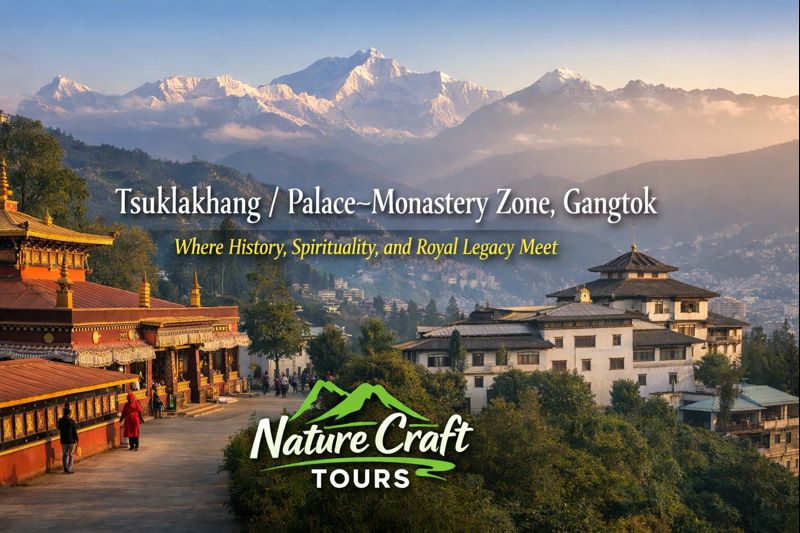
At the very core of Gangtok’s civic life lies a compact yet profoundly layered precinct where spirituality, history, and monarchy intersect with everyday urban rhythms. The Tsuklakhang–Palace–Monastery Zone is not merely a cluster of religious and royal buildings; it is the symbolic nucleus of Sikkim’s identity. Within a short walking radius, one encounters the former royal palace of the Chogyals, Sikkim’s most revered monastery, sacred relics that anchor Tibetan Buddhist belief, and public spaces that continue to host rituals, processions, and state observances.
For the discerning traveller, this zone offers far more than architectural sightseeing. It presents a rare opportunity to understand how faith and governance once functioned as a unified system in the Eastern Himalaya, and how that legacy continues to shape Gangtok’s social and cultural fabric. Unlike remote monasteries that demand arduous journeys, Tsuklakhang reveals its depth gradually—through quiet observation, respectful movement, and an awareness of context rather than spectacle.
Destination Overview: Locating the Sacred Core of Gangtok
Geographical and Urban Context
The Tsuklakhang–Palace–Monastery Zone is located in the heart of Gangtok, positioned slightly above the main commercial axis yet distinctly insulated from its noise. The precinct occupies a gentle ridge that historically allowed clear oversight of the surrounding valley and settlements. This elevated placement was not incidental; in Himalayan polity, physical height often mirrored spiritual and political authority.
The zone includes the Tsuklakhang Monastery complex, the former royal palace (now a residence of the former royal family), administrative buildings, ceremonial courtyards, and restricted areas that remain inaccessible to the general public. Together, they form a spatial narrative of Sikkim’s transition from an independent Buddhist kingdom to a modern Indian state.
Why This Zone Matters
Unlike many historic quarters that have been reduced to static heritage sites, this area remains a living space. Monks conduct daily prayers, lay devotees circumambulate prayer wheels, and members of the former royal household continue to observe ceremonial traditions. The result is an environment where past and present coexist without artificial reconstruction.
Historical Foundations: Monarchy, Buddhism, and Statehood
The Chogyal Dynasty and Sacred Kingship
For over three centuries, Sikkim was ruled by the Chogyals—Buddhist monarchs whose authority was both political and spiritual. The Tsuklakhang Monastery functioned as the state monastery, directly associated with royal rituals, coronations, and diplomatic ceremonies. Decisions of governance were often framed within religious cosmology, reinforcing the king’s role as protector of the Dharma.
The palace complex adjacent to the monastery was intentionally positioned to maintain this close relationship between ruler and religion. Unlike palaces designed primarily for grandeur, the Sikkimese royal residence emphasized proximity to sacred space over architectural dominance.
Transition into the Modern Era
Following Sikkim’s political integration into India in 1975, the functional role of the monarchy ended, but its cultural significance did not. The Tsuklakhang complex retained its religious importance, while the palace area remained symbolically central to state identity. Official ceremonies, high-level religious observances, and significant festivals continue to reference this zone as a focal point.
Architectural and Spiritual Elements of the Tsuklakhang Complex
Tsuklakhang Monastery: Structure and Sacred Objects
The Tsuklakhang Monastery is the most important religious structure in Gangtok. Architecturally, it follows Tibetan Buddhist design principles, with a restrained exterior that gives way to richly ornamented interiors. Inside, one finds statues of major Buddhist figures, thangka paintings depicting tantric iconography, and sacred relics associated with revered teachers.
The monastery houses ritual objects used during state-level prayers and special ceremonies. On certain days, the deep resonance of horns and the rhythmic cadence of chants spill into the surrounding courtyards, offering visitors a sensory experience that is solemn rather than performative.
Prayer Wheels, Courtyards, and Circumambulation
Surrounding the monastery are rows of prayer wheels embedded into walls and corridors. Local residents and visiting devotees walk clockwise, spinning each wheel with deliberate motion. This practice, central to Tibetan Buddhism, transforms movement into meditation and anchors spiritual practice within everyday routine.
The courtyards are intentionally open, allowing gatherings during major festivals and public prayers. Their simplicity reinforces the notion that spiritual authority here derives from continuity and discipline rather than visual excess.
The Royal Palace Zone: Power Without Display
Design Philosophy and Spatial Arrangement
The former royal palace, visible from select vantage points, reflects a Himalayan interpretation of authority. It lacks monumental scale, favouring functional elegance and integration with terrain. Wood, stone, and traditional motifs dominate, reinforcing the palace’s role as an extension of the cultural landscape rather than a statement of separation from it.
Access to the palace remains restricted, underscoring the distinction between respectful observation and intrusion. For travellers, understanding this boundary is essential to appreciating the dignity with which royal legacy is preserved.
Ceremonial Significance Today
Although no longer a seat of governance, the palace retains ceremonial relevance. Certain festivals and commemorations still involve the former royal family, reinforcing the idea that Sikkim’s historical narrative did not end abruptly but evolved through continuity.
Best Time and Season to Visit
Spring (March to May)
Spring offers mild temperatures, flowering trees, and clear mornings, making it ideal for slow exploration of the monastery zone. Religious activity increases during this period, allowing visitors to witness daily rituals without the constraints of peak tourist congestion.
Monsoon (June to September)
While rainfall is frequent, the monsoon brings a contemplative atmosphere. Clouds often envelop the ridge, creating a sense of seclusion. Travel requires caution, but the spiritual ambience is particularly pronounced.
Autumn (October to November)
Post-monsoon months provide the clearest visibility and coincide with major festivals. This is the most culturally active period, though visitors should expect increased local presence during ceremonies.
Winter (December to February)
Winters are cold but dry. The reduced footfall enhances the solemnity of the zone, appealing to travellers interested in quiet observation rather than festival activity.
Ideal Travel Duration and Exploration Strategy
The Tsuklakhang–Palace–Monastery Zone can be physically covered in half a day, but meaningful engagement requires more time. A full day, preferably divided between morning and late afternoon, allows visitors to observe changes in light, activity, and ritual rhythm.
Travellers often integrate this visit into broader journeys across eastern India, pairing mountain cultural sites with contrasting ecosystems. Those familiar with a Sundarban Tour frequently note how the Gangtok palace–monastery zone offers an instructive counterpoint—where spiritual authority replaces ecological dominance as the defining theme.
Route and Accessibility
Reaching the Zone Within Gangtok
The zone is easily accessible on foot from central Gangtok, including MG Marg. Short uphill walks lead to the monastery gates. Vehicular access is limited and regulated, reinforcing the area’s contemplative character.
Visitors are advised to walk whenever possible, as gradual ascent allows better acclimatisation and a more respectful entry into the sacred space.
Cultural and Religious Significance
The Tsuklakhang–Palace–Monastery Zone embodies the philosophical foundation of Sikkimese society, where governance, ethics, and spirituality were historically inseparable. Even today, state ceremonies often reference this space symbolically, acknowledging its role in shaping collective identity.
For culturally attentive travellers, the zone offers insight into a form of Himalayan modernity that values preservation without stagnation.
Practical Insights for Thoughtful Travellers
Respectful attire, quiet movement, and mindful photography are essential. Certain areas may restrict photography during prayers, and visitors should observe without questioning such boundaries. The experience rewards patience far more than documentation.
Those planning extended journeys across diverse Indian landscapes may find thematic continuity by contrasting this sacred urban core with nature-dominated regions explored through a Sundarban Tour Package, together revealing the remarkable cultural and ecological breadth of the subcontinent.
Where Power, Faith, and Memory Converge
The Tsuklakhang / Palace–Monastery Zone is not a destination to be consumed quickly. It is a place to be understood through presence, restraint, and context. Within its courtyards and corridors lies the living memory of a Himalayan kingdom—one that continues to inform Sikkim’s identity long after political structures have changed.
For travellers seeking depth rather than display, this zone offers a rare encounter with continuity itself—quiet, dignified, and profoundly instructive.