Velas (Konkan) — Seasonal Nature Event and Coastal Village Calm
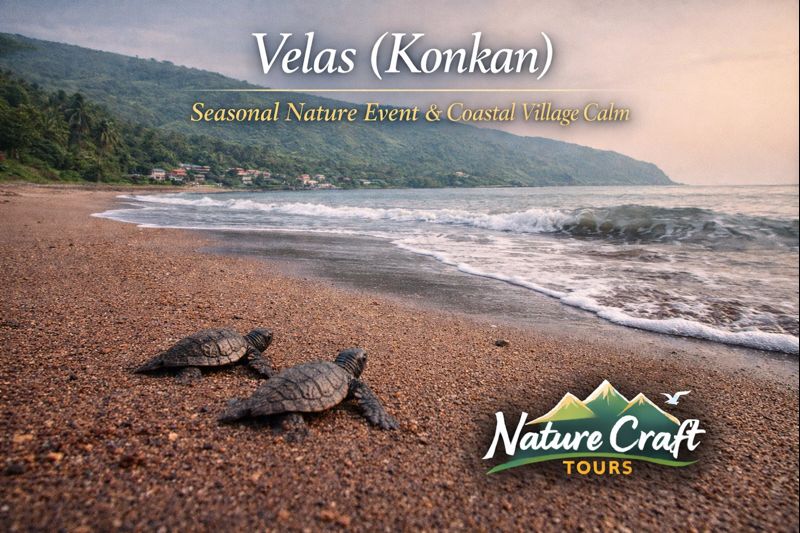
Along the quieter stretches of Maharashtra’s Konkan coast lies Velas, a village that resists the usual definitions of a beach destination. There are no promenades, no rows of resorts, and no attempt to transform the shoreline into spectacle. Instead, Velas is known for something far more delicate and time-bound: a seasonal natural event that unfolds quietly each year, drawing attention not through noise or scale, but through patience, restraint, and collective care. The village has become nationally recognized for its role in olive ridley turtle conservation, yet it remains, at heart, a functioning coastal settlement shaped by fishing, farming, and monsoon rhythms.
Velas represents a rare intersection of ecological responsibility and rural continuity. For a few weeks each year, the village opens itself to visitors who come to witness the hatching of sea turtles along its sandy beach. Outside this period, Velas returns to a slower coastal cadence—waves breaking gently, coconut palms leaning into sea wind, and village lanes carrying everyday life forward. To visit Velas is to engage with both moments: the extraordinary seasonal event and the enduring calm that frames it.
Geographical Setting and Coastal Landscape
Velas is located in the Ratnagiri district of Maharashtra, within the central Konkan belt. The village sits between the Arabian Sea to the west and low lateritic hills to the east, creating a compact ecological zone where marine and terrestrial systems meet. The coastline here is relatively straight and open, with a gently sloping sandy beach that makes it suitable for sea turtle nesting.
Unlike rocky or cliff-bound stretches of the Konkan, Velas Beach offers uninterrupted sand backed by sparse vegetation. Inland, the terrain rises gradually into laterite plateaus dotted with mango orchards, cashew trees, and seasonal agriculture. This spatial arrangement—sea, sand, village, hill—defines Velas as a complete coastal landscape rather than a single-point attraction.
Velas and the Olive Ridley Turtle Phenomenon
Seasonal Nesting and Hatching Cycle
Velas is most widely known for the annual nesting and hatching of olive ridley sea turtles, a species classified as vulnerable due to habitat loss, predation, and human disturbance. Female turtles arrive offshore during the winter months, typically between December and February, to lay their eggs on Velas Beach under the cover of darkness.
After an incubation period of approximately 45 to 60 days, the hatchlings emerge, usually between February and April. Guided by natural light cues, they instinctively move toward the sea. This brief, fragile journey from nest to water is the focal point of Velas’s seasonal identity.
Community-Led Conservation Efforts
What distinguishes Velas from many wildlife-viewing destinations is the central role played by the local community. Conservation here is not imposed externally but managed collectively by villagers in collaboration with environmental groups and forest authorities. Nests are protected, light pollution is controlled, and visitor access is regulated to minimize disturbance.
This model of conservation demonstrates how human presence and wildlife protection can coexist when guided by awareness rather than exploitation. Observing the process requires patience and respect—values that define the Velas experience as much as the turtles themselves.
Beyond the Event: Velas as a Coastal Village
Outside the turtle season, Velas reveals itself as a quiet Konkan village shaped by maritime livelihood and agrarian cycles. Fishing remains a primary occupation, with small boats launched daily depending on sea conditions. Nets dry along open spaces, and the rhythm of tides governs daily routines.
Agriculture complements fishing, with rice cultivation during the monsoon and fruit orchards—particularly mango and cashew—forming an important economic base. These activities ensure that Velas does not become a one-season destination but remains anchored in year-round life.
Best Time and Season to Visit
February to April: The Turtle Hatching Window
The most sought-after period to visit Velas is between February and early April, when turtle hatchlings are expected to emerge. Timing is unpredictable, as hatching depends on incubation conditions rather than fixed dates. Visitors must therefore approach this season with flexibility and realistic expectations.
This period is ideal for those interested in witnessing a natural process rather than guaranteed spectacle. Much like observing tidal wildlife in deltaic regions during a Sundarban Trip, the experience is governed by nature’s schedule, not tourism calendars.
October to January: Coastal Calm and Exploration
For travelers seeking coastal tranquility without the crowds, the post-monsoon and winter months from October to January offer pleasant weather and quiet beaches. The sea is calmer, humidity is moderate, and village life unfolds without seasonal pressure.
This period is suitable for slow walks, photography, and understanding Velas as a living settlement rather than an event-focused destination.
Ideal Travel Duration and Pace
A stay of two to three days is ideal for Velas. This duration allows time to attend turtle conservation briefings (if visiting during the season), explore the beach at different times of day, and observe village routines without haste.
Longer stays deepen the experience, particularly for travelers interested in coastal ecology, rural livelihoods, or simply sustained quiet. Velas does not reward rushed itineraries; its value lies in gradual familiarity.
Route and Accessibility
Velas is accessible by road from major Konkan towns such as Dapoli and Ratnagiri. The final approach passes through narrow village roads and laterite tracks, reinforcing the sense of arrival into a rural setting rather than a resort zone.
Public transport options are limited, especially for last-mile connectivity. Private vehicles offer greater flexibility, particularly during early morning or late evening movements associated with turtle viewing schedules.
Key Attractions and Surroundings
Velas Beach
Velas Beach is wide, clean, and largely undeveloped. Its openness allows uninterrupted views of the Arabian Sea, while its gentle slope supports turtle nesting. Outside the hatching season, the beach remains a place for quiet reflection rather than activity.
Coastal Walks and Village Lanes
Walking through Velas village offers insight into Konkan architecture, household courtyards, and everyday practices. Coconut groves, small temples, and community spaces reflect a landscape shaped by continuity rather than tourism infrastructure.
Nearby Konkan Beaches and Plateaus
Velas can be paired with visits to other lesser-known Konkan beaches and laterite plateaus in the region, each offering distinct ecological and visual character. These extensions add context without overwhelming the core experience.
Ecological Significance Beyond Turtles
Velas’s ecological value extends beyond sea turtle conservation. The beach-dune system, nearshore waters, and adjacent agricultural land form an interconnected habitat supporting birds, insects, and coastal vegetation.
Seasonal changes influence species presence, making Velas a dynamic environment rather than a static one. Observant visitors may notice shorebirds, crabs, and marine life interacting subtly with tidal cycles.
Cultural and Historical Context
The cultural identity of Velas is rooted in Konkan traditions—language, cuisine, and seasonal festivals aligned with agricultural and fishing calendars. Religious practices and community gatherings reinforce social cohesion, particularly during challenging monsoon months.
Historically, the Konkan coast has been shaped by maritime trade and regional movement, though Velas itself remained a small settlement, largely untouched by large-scale commercial development. This relative isolation has preserved both landscape and lifestyle.
Practical Insights for Responsible Travelers
Visitors to Velas, especially during the turtle season, are expected to follow strict guidelines. Photography restrictions, controlled group sizes, and adherence to local instructions are essential to protecting hatchlings.
Accommodation and facilities are modest, emphasizing homestay-style arrangements and simple amenities. This reinforces the need for preparedness rather than expectation of urban comfort.
Travelers familiar with conservation-oriented destinations—such as mangrove ecosystems explored through a Best Sundarban Tour Package—will recognize similar principles at work in Velas: observe, minimize impact, and prioritize ecosystem integrity over personal convenience.
Velas as a Model of Low-Impact Tourism
Velas demonstrates that tourism need not dominate a place to be meaningful. By centering a seasonal natural event and embedding it within village life, Velas offers a template for low-impact, community-led travel.
The village does not attempt to extend the turtle season artificially or create substitute attractions during off months. Instead, it invites visitors to engage honestly with what exists—whether that is a hatchling’s first journey or a quiet afternoon by the sea.
Where Nature and Village Life Align
Velas stands as a rare coastal destination where patience is rewarded and restraint is respected. Its significance lies not only in the olive ridley turtles that briefly emerge each year, but in the village’s commitment to preserving a balance between human life and natural process.
For travelers seeking depth rather than distraction, Velas offers an experience grounded in time, care, and continuity. It is a place where nature is not staged, village life is not paused, and travel becomes an act of quiet participation rather than consumption.